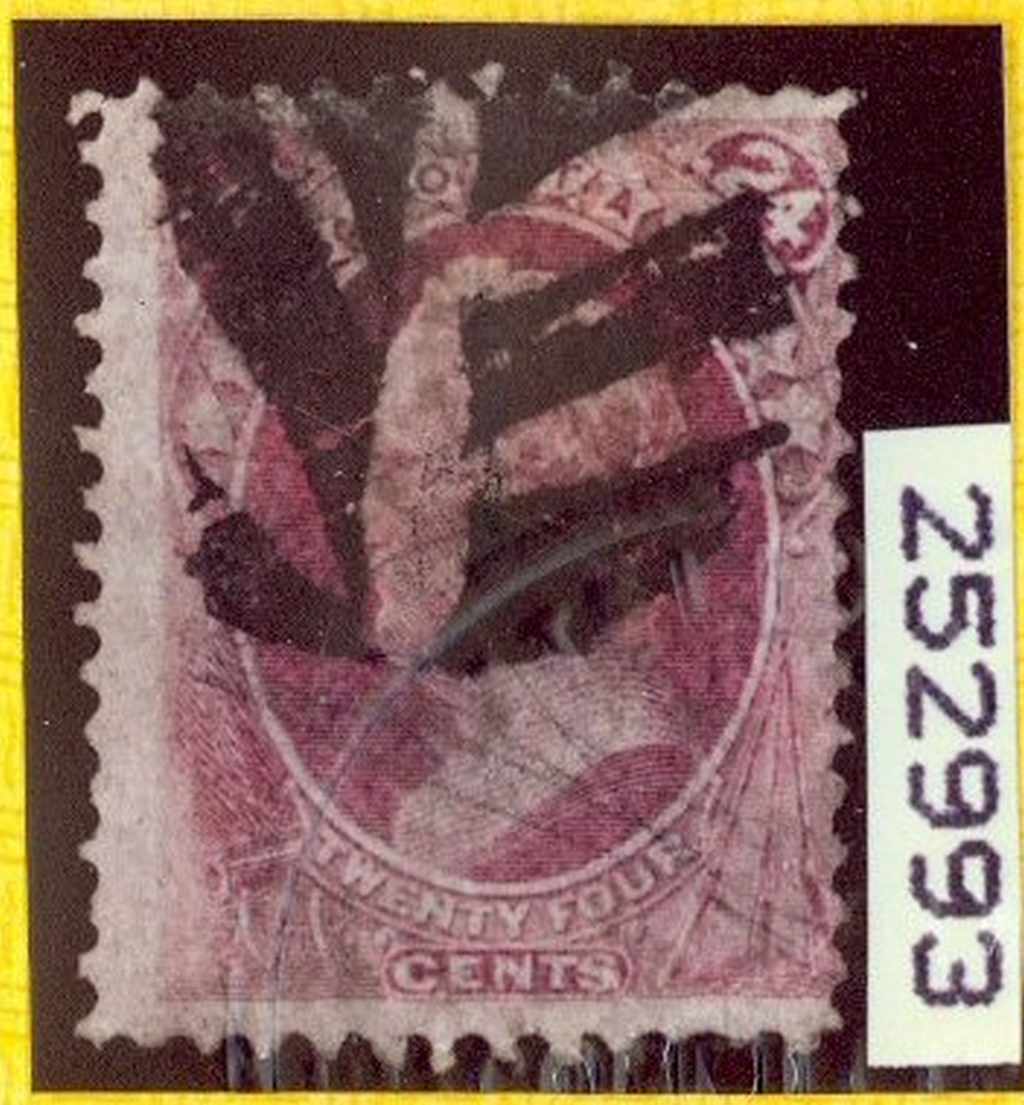
First, let me apologize for this being a lengthy post.
The 24¢ Continental printing is extremely confusing at best. In January 1873 the stamp contract was awarded to the Continental Bank Note Company which took effect May 1, 1873. The contract required Continental to have "on hand in the company's vault, on that date…a sufficient supply of stamps, approved and accepted by the Stamp Agent, as complying with the terms of manufacture, quality of product, etc. to meet all foreseeable withdrawals of stamps…This to apply to ALL denominations…"
In April 1873 all of National's dies and plates were turned over to Continental. Continental modified the 1¢ through 15¢ dies with the "secret marks" but the 24¢, 30¢ and 90¢ values were printed from the National plates. Since the 3 highest values had the lowest production requirements they were probably the first values put to press to meet the contract requirements for stock on hand. They were possibly printed while the dies for the lower values were being modified and the new plates being made.
The number printed is unknown but in September 1873 the Continental inventory showed that they had 120,700 in the vault. John Luff stated that Continental printed and released to the stamp agent 365,000 but this figure is disputed by many as some of this number would have been purchased after the discontinuation of the 24¢ rate in 1875. It is also believed that the PO agent, Boyd, arranged for much of the remaining stock in National's vaults to be sold to the POD probably in late 1873 or early 1874. This stock is thought to have been then transferred to Continental for credit.
Records show that National released 787,050 24¢ stamps to the stamp agent from April 1870 to April 30, 1875. Continental released 557,150 to the stamp agent from July 1873 to June 30, 1875. It is also known that in February 1885 the Post Office Department destroyed 364,950 24¢ stamps which was probably a mixture of 1861 issues and the banknotes. So nobody really knows how many 24¢ Continentals were printed and sold.
The 30¢ and 90¢ Continentals can be distinguished from the Nationals by color but the 24¢ probably used the same ink formulation on both the National and Continental issues due to the problems experienced with the purple ink. Bear in mind that when the contract was awarded to Continental both Charles Steel, supervisor of stamp production, and James Macdonough left National and went to Continental. They would have been keenly aware of the 24¢ color problems.
When National first printed the 24¢ they encountered numerous problems with the color as detailed in the following communications between the Post Office Department and the National Bank Note Co.:
To National Bank Note Company
Post-Office Department,
Office of Third Assistant Postmaster-General
Washington, D. C., April 6, 1870
Sir: The color selected and agreed upon for the twenty-four cent stamp, new series, was a pure purple. The gummed and perforated specimen received to-day from the stamp agent is altogether unlike and inferior in color, as you will observe by comparing the proofs with the gummed and perforated specimens. The color last referred to is the poorest I ever saw; it looks like poke-berry juice after a hard rain. Please investigate at once, and by all means let us have the pure purple equal to the proof-samples. Mr. Boyd has been instructed by telegraph not to issue any of the twenty-four cent stamps of the defective color.
Very respectfully, your obedient servant,
W. H. H. Terrell,
Third Assistant Postmaster-General.
J. Macdonough, Esq.,
Secretary National Bank Note Company, New York.
From National Bank Note Company
National Bank Note Company
New York, April 9, 1870
Dear Sir: Your communication of 6th instant came duly to hand, and would have been immediately acknowledged but that it was thought best to ascertain the reasons for the marked difference in color between the proofs and impressions.
We find that all the carmine tints are injured by the heat of the drying-rooms and the action of the acid of the gum; and the result was shown very unfavorably for us, on the six and twenty-four cent stamps.
Since the receipt of your letter we have worked all of the doubtful colors very carefully and we have got them like the colors on the accepted proofs; we will forward you early next week impressions all gummed and perforated, showing the improved colors.
Very respectfully, your obedient servant,
J. Macdonough, Secretary
Hon. W. H. H. Terrell
Third Assistant Postmaster-General, Washington, D. C
To National Bank Note Company
Post-Office Department,
Office of Third Assistant Postmaster-General
Washington, D. C., April 11, 1870
Sir: The following telegram was this day sent you:
"The Department confidently relies upon the production by your company of the new series postage-stamps, as regards colors and gumming, in a manner that will reflect credit upon the Government and give satisfaction to the public. The engraved proofs submitted are fully approved. Please see that there is no fault in gum or colors. To-morrow, the 12th, was agreed upon, when you and agent Boyd were here, for the new issue to be made. Are you ready? Our arrangements are complete for announcing the change from present to new series by telegraph, and the Postmaster-General expects it to be done to-morrow. Please inform me by telegraph when we can safely make the announcement."
Very respectfully, your obedient servant,
W. H. H. Terrell,
Third Assistant Postmaster-General.
J. Macdonough, Esq.,
Secretary National Bank Note Company,
No. 1 Wall Street, New York.
From National Bank Note Company
National Bank Note Company
New York, April 12, 1870
Dear Sir: Your dispatch of yesterday reached here last evening after business hours. We have to-day telegraphed you in reply: "All the stamps are ready for delivery, excepting the twelve and twenty-four-cent, and they will be in a few days."
We could not give a definite answer to your question as to when you could safely announce the stamps would be issued; for we found some of the denominations have already been sent out, quite to our surprise, and under the following circumstances: Agent Boyd having received an immense order for stamps some days ago, advised the Department that it was impossible to fill it without issuing some of the new stamps, and received in reply, we understand, that when he could not supply old stamps to give the new; and under those instructions the order was filled, some of the new stamps going out on Saturday last, and more since. Agent Boyd is sending out six-cent stamps instead of twelve-cent, and old twenty-four-cents instead of new.
We are experimenting with the twelve and twenty-four-cent stamps, and hope to-day or to-morrow to succeed in the color.
Yours, very respectfully,
A. D. Shepard, Treasurer.
Hon. W. H. H. Terrell
Third Assistant Postmaster-General, Washington, D. C.
From National Bank Note Company
National Bank Note Company
New York, April 16, 1870
Dear Sir: To get a purple tint for the twenty-four-cent stamp, which would remain purple after undergoing the heat of the drying-room and action of the acid of the gum, has caused a very severe trial of your patience.
We have tried all the pure color, and combinations of colors, some even at a cost of $24 per pound, (or sixty cents per 1,000 stamps for color only.) We inclose (sic) two half sheets, marked Nos. 1 and 2, which differ from the sample tint, but are brilliant and seem to promise well; all the others change so much that they would not be satisfactory to you. If either of these is acceptable, please telegraph the number of the sheet, and we will print them at once.
Very respectfully, your obedient servant,
J. Macdonough, Secretary
Hon. W. H. H. Terrell,
Third Assistant Postmaster-General, Washington, D. C.
From D. M. Boyd, stamp-agent
United States Postage-Stamp and Envelope Agency
New York, April 18, 1870
Sir: Inclosed (sic) please find a sheet of twenty-four cent stamps submitted, as near like the specimen as the contractors think they can be produced. If acceptable, the full series can be issued by Monday, the 25th instant, not before, as this color takes much longer to dry than any of the others.
I send to-day to all the offices requiring twelve-cent stamps that have been detained, and I am ready to issue that denomination on future orders.
Respectfully yours,
D. M. Boyd, Agent
Hon. W. H. H. Terrell,
Third Assistant Postmaster-General, Washington, D. C.
To National Bank Note Company
Post-Office Department,
Office of Third Assistant Postmaster-General
Washington, D. C., Mau 2, 1870
Sir: The following telegram was sent you this morning: "General Terrell accepts sample No. 2 as color for the twenty-four-cent stamps."
To prevent mistakes, I herewith inclose (sic) some stamps taken from the sheet submitted by you.
Very respectfully,
W. M. Ireland,
Acting Third Assistant Postmaster-General
J. Macdonough, Esq.,
Secretary National Bank Note Company, New York
From National Bank Note Company
National Bank Note Company
New York, April 19, 1870
Dear Sir: We are in receipt of your favor of 18th instant, and telegram of this date, informing us that "General Terrell accepts sample No. 2 as color for twenty-four-cent stamps."
We shall immediately proceed with the printing, and will furnish proof-sheets of this stamp, in the No. 2 color, to your Department soon as they can be prepared, to be used instead of the proofs you now have.
Very respectfully, your obedient servant,
J. Macdonough, Secretary
W. M. Ireland, Esq.,
Acting Third Assistant Postmaster-General, Washington, D. C.
With the above mentioned color issues with the 24¢ stamp I doubt that Continental would have made changes to the ink.
So, since the 24¢ Continental and National printings were from the same plate and probably with the same ink formulation the only method of distinguishing the printings would be either the Continental ribbed paper or the Continental silk fiber paper which is not recognized as a Continental printing distinction on the 24¢ by Scott.
|





 Posted 02/18/2013 12:11 pm