Edgar "Daddy" Allen and how it all began
Tragedy to triumph is the story of Easter Seals; a story that began over 100 years ago.
On Memorial Day, May 30, 1907, Edgar Fiske Allen's 18 year old son, Homer, was a victim of a street car accident which injured 80 and claimed nine lives. The serious lack of adequate medical services was detrimental during the treatment of his child who eventually died. This tragedy prompted Mr. Allen to sell his business and begin a city-wide fund raising campaign to build a hospital in his hometown of Elyria, Ohio. Allen became aware of the magnitude of the need for a facility for crippled children. Allen raised $105, 000 for the new Elyria Memorial Hospital which opened on October 30, 1908 with just 36 beds.
In the fall of 1909 while volunteering as treasurer of Elyria hospital, Allen met 8 year old Jimmy Bodak, brought to the hospital in an effort to help straighten his legs. Jimmy developed much affection for Allen and began to call him by the name for which Allen would come to be known, "Daddy". His relationship with Jimmy and the doctors treating him moved him to survey neighboring communities.
In 1910, a survey conducted that showed in Lorain County, Ohio alone there were over 200 crippled children whose only care was what could be given in their own homes. While the hospital was serving the public well, it was evident that children with disabilities were often hidden from the public view and not receiving the support needed. Well aware of the problems of the crippled child, Mr. Allen was once again spirited to raise even more money for the crippled children. Fortunately a very generous subscription was made by Mrs. Ada Gates as a memorial to her late husband. The funds raised were enough to establish the Gates Memorial Hospital for Crippled Children which opened on April 5, 1915. Although equipped to accommodate 45, nobody came and the new hospital sat empty for three months.
Knowing that the new hospital could help so many children, Mr. Allen was determined to solve this dilemma. He soon came to realize that a number of things needed to take place; the parents needed to be persuaded to accept treatment for their child, an organization of some sort was needed to achieve this, and a there was a need to minimize the trauma of separating parent and child.
In 1918, Mr. Allen was inspired to bring together an organization of several Rotary clubs concerned with the welfare of crippled children and established Ohio's first association for crippled children named the Ohio Society for Crippled Children.
The great work that was being done in Ohio soon attracted the attention of other charitable groups who were interested in what was being accomplished in Ohio and wondered whether similar things could be initiated elsewhere.
On October 13, 1921, a meeting with representatives from Illinois, Michigan , New York and the Province of Ontario as well as a number of prominent citizens from Ohio was held to discuss what was taking place in Ohio and to consider expanding to other states and Canada. By 1922 the International National Society for Crippled Children was formed with associated chapters in Canada; it was the first organization of its kind. By the end of the decade 23 affiliated state societies had been founded.
The United States chapters remained incorporated into the International Society for Crippled Children until 1939 when they returned to being only a national organization.
With the depression in full force, the need for the expansion of children services was greater than ever; but with both government funding and private support plummeting, it was decided a national campaign was needed to raise the funds for these services. With inspiration from the success of the National Tuberculosis Society, it was thought that the National Society for Crippled Children could sell seals to encourage donations to the society.
Late in the summer of 1933, Paul H. King, Allen's eventual successor, championed the idea of selling seals as a way of raising funds. He presented a report to the finance committee, in which he said in part, "We suggest Easter as the time for the sale of the seals. Thoughts of Easter and the crippled child harmonize wonderfully. Easter means, of course, Resurrection and New Life; and certainly the rehabilitation of crippled children means… new life and activity, complete or partial, physically, mentally and spiritually." At this time the seals to be printed were referred to as "White Cross" seals with a large white Greek cross on an orange background and a drawing of the crippled child in the center of the cross.
The announcement of this seal sale caused controversy with the National Tuberculosis Association. Dr. Emerson, on behalf of the NTA, wrote to the National Society for Crippled Children urging that the society discontinue the sale of its seals; but it was to late as sale of seals had already been approved.
In the spring of 1934, National Society for Crippled Children began its first "White Cross" seals campaign to raise money for its services. The public donors were to show their support by placing these seals on envelopes and letters.
Despite that only eight states chose to participate in the sale of these seals, the first campaign was launched March 1, 1934. This first attempt was tentative and experimental, but even with the limited size of the campaign, it was clearly demonstrated that the idea had caught on. That first sale was the beginning of an unprecedented expansion, not only for the National Society for Crippled Children, but for the entire movement on the behalf of children with disabilities. Overwhelming public support for the 1934 seals campaign raised $47,000; an amazing accomplishment considering the economy at the time. The amount was more than twice the annual budget.
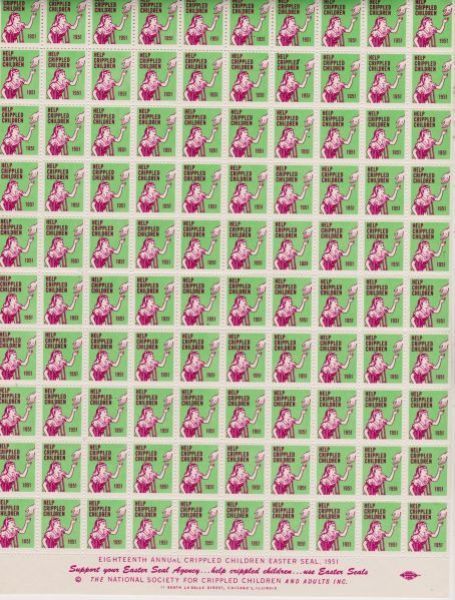
The seals were issued in sheets of 100 selling at $1.00 per sheet and distributed through state and local units. The National Society received 20 cents of each dollar raised; the state unit would receive 30 cents and the local unit would retain 50 cents.
The designs of the first three years of seals were created by Cleveland, Ohio cartoonist, James H. Donahey (1875-1949). Mr. Donahey is quoted as saying "Simplicity of design seems most appropriate, since the crippled child ask simply for the right to live a normal life. Enduring physical handicaps, the cause of which science may someday conquer and control. This child commands the center of a white cross, expressing civilization's devotion to a program of rebuilding human frames and dedicating its efforts to prevention."
The printing of the 1934 seal is unique in the fact that it was done by letter press; subsequent issues were produced by the offset process. The process today is done by photography and huge multicolor presses.
By 1935 the term "White Cross" seals was dropped because of other societies had issued seals with a similar name; such as the White Cross Anti-narcotic Society which issued seals the two previous years (1932-1933).
With the society seals being placed on sale during the Easter season, it wasn't long before the seals became known as "Easter Seals."
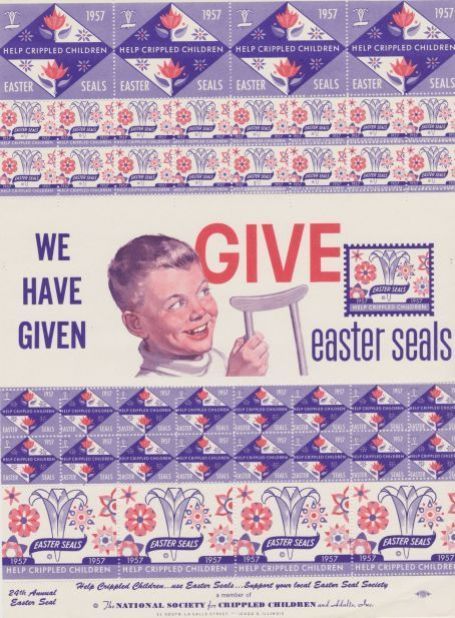
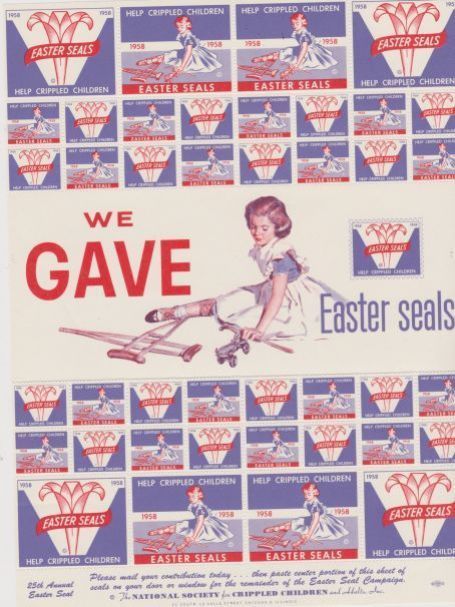
Beginning in 1935, the society began placing a stylized lily on their seals, thus beginning a tradition that, with a few exceptions, has continued to date.
During the early years of Easter Seals, the organization's advertising featured children, with such slogans as, "Hey Mister! Lend Me a Dollar to Help Me Walk!" Over time, adults with disabilities came to be seen as equally deserving of support and Easter Seals advertising reflected their need. In 1944 the society broadened its mission to include disabled adults; changing its name to the National Society for Crippled Children and Adults.
In 1952, the lily, a symbol of spring, was officially incorporated as the Easter Seals logo, appearing on the 1953 seal. With overwhelming public support for the "Easter Seals" campaigns and with nationwide expansion of the organization, the society formally adopted the name "Easter Seals", becoming the "National Easter Seal Society for Crippled Children and Adults" in 1967.
In 1981, National Society for Crippled Children and Adults officially changed its name to the National Easter Seal Society. This name change added political correctness to the society name and took advantage of the popularity of the term "Easter Seals."
For over 90 years, the society has been helping individuals with disabilities and special needs, and their family, live better lives by offering a variety of service to assist people with life's challenges and achievement of personal goals. Despite the use of Christian symbolism, the organization is not affiliated with any particular religious organization.
Today the Easter Seals Society offers a wide variety of services designed to meet individual needs. Easter Seals offers medical rehabilitations, including physical therapy, occupational therapy, speech and hearing therapy and early intervention. The provide residential services, serving children, adolescents and adults as well as child care for children ages 6 months to 5 years. Their services provide job training and employment, and day programs for adults with disabilities and older adults.
As of July 12, 2007, Easter Seals has partnered with the Autism Society of America in efforts to address the significant needs of individuals with autism and their families. The Autism Society of America (ASA) is the oldest and largest autism organization in the United States. ASA is dedicated to increasing public awareness about autism and the day-to-day issues faced by individuals with autism, their families.
Edgar Fiske Allen, a descendant of Patriot Ethan Allen, was born on May 8, 1862 and died on September 20, 1937. He is buried in the Ridgelawn Cemetery in Elyria, Ohio. His grave marker bears the inscription "Father, Known as "Daddy" to all Friends of the Crippled."
Easter Seals came in sheets as few as 9 and as many as 100. The most desirable used seals are those placed next to the postage stamp so it receives part of the cancel.
|





 Posted 02/11/2015 12:08 pm