Hi itma, Agreed. Try to find some known thicknesses and perfect you technique and 'feel' for the caliper/tool. Do this before you try any stamps. I have trained a number of QA people over the years on measurement processes; striving for a consistent process and feel for the tool and process will definitely pay off in the long run.
What I see a lot of today are stamp hobbyists who simply go buy cheap digital caliper, as soon as it comes in they grab a stamp and start measuring. This is a sure way to fool oneself, especially if they already have a thickness number in mind. Don
For what it's worth, I looked into micrometers, etc. to measure paper thickness awhile back, and I came away pretty convinced that as with many other things the accuracy of the Chinese-made equipment -- which is often the cheapest -- was not very reliable. I heard many stories of them not only mis-measuring (which can happen with any equipment) but actually breaking. Cheap technical equipment seems like a contradiction in terms. Read the reviews if you can. And, as noted already, measuring paper thickness is not a very exact science since paper is flexible. With metal, thickness gauges will be pretty reliable. With paper, as tight as you get the gauge, the thinner the paper is going to seem.
This is a sure way to fool oneself, especially if they already have a thickness number in mind.
I object to this wild comment. I am sure you have never handled Por. India Corôa or Ceres keytype issues. Anyone serious about these stamps will know how important is paper thickness to differentiate array of differenet papers (sometimes thicknesses differ in same type of paper) and there is specialist literatures on the paper thickness of Por. Colonies Corôa/Ceres stamps including Índia.
It is absolutely OK (nothing foolish about it) if one has a number (recorded range) in mind when measuring paper thickness of postage stamps. What matters is the mastering the use of micrometer (SAFE 9680 Digital Micrometer I mentioned, specifically prepared for stamps but outrightly rejected by the OP) which requires some practice.
There is a children's comedy classic literature in Bangla language (my mother tongue) titled "Heshoram Hushiyarer Diary" by Sukumar Ray (1887-1923) where a character named Chandrakhai, the nephew of the protagonist Professor Heshoram during his expedition to an unidentified location near Bandikush Mountain (fictional place based on Hindukush), measured the height of a hill by trigonometrical survey calculation at "42000 feet". Realizing that world's highest mountain Mt. Everest is only 29000 feet, after several recalculations yielding different results every time, the height was finally calculated at only 2700 feet.
Hi Joy, It was not a 'wild comment', it was a responsible comment. My context was a collector far less experienced then you. Please keep in mind that the majority of people who read these posts are casual collectors. They read a post about paper thickness, go online to buy a cheap caliper, have a thickness number in mind, then conformation bias kicks in as they measure for the first few times.
No, I have not handled Por. India Corôa or Ceres keytype issues. But in a manufacturing QA capacity I have made tens of thousands paper thickness measurements. I have trained dozens of people on how to use calipers. As Moderator here, I feel it is part of my job to help the silent 'lurkers' and other less experienced members. Please do not assume that that my posts are directed to the handful of experience people like yourself. Don
Have been watching this thread a while, and appreciate your comments Studebaker about being aware of confirmation bias, etc. I settled on a Clockwise Tool DCLR 0605. I usually take three or four measurements of a given stamp on different axes and along the middle and the edge to get a better idea. Paper thickness being what it is, there is sometimes a range, but not usually enough to matter. Michel uses ranges of paper thickness to differentiate between types and the ranges are usually enough to encompass what I find 'in the wild'. Users should just be patient and most importantly practice, practice, practice, with the tool. Read the catalog carefully and use the tool to improve your skills and advance your knowledge!
Further questions about equipment. I refer to simple stamps, up to 5-10 CV, so for stamp thickness, I don't need the ability to measure ultra-thin stamps like Port' India or the Ceres series, but if one wants to give information for the majority of readers, it is welcomed. Here I go.
Stamp thickness 1) What level of accuracy is needed? 0.1 mm? 0.01 mm? In this topic thread, it was mentioned that stamps can be as thin as 20 microns, so 0.1 mm accuracy does not seem adequate. 2) For the thickness of thin stamps, how effective are gum and cancellation thickness? In catalogs, do they refer to mint thickness, or used stamp thickness? 3) Isn't a plastic caliper safer than a metal caliper, being made of a softer material? How erroneous were plastic calipers found to be? 4) Is a micrometer a better fit to measure a stamp's width than a caliper?
Magnification 5) Some stamps have small differences and details. What magnification is needed? Should one buy a microscope? of x500? of x1000? For me, using a computer and scanning is not an option.
6) Are Ali Express and temu items worth considering to order from? I'm not worried about ebay because they don't ship to my country "for my own protection", their rep explained.
Thank you for reading.
Off topic: For those who asked about me - thank you. I got a bit preoccupied with local and health issues. My village and I are not a strategic target, so I only flinch whenever a car accelerates nearby (sounds like an air raid alarm).
Let me preface this by saying I have no interest whatsoever in measuring the thickness of stamps - I don't have the attention span to 'flyspeck'.
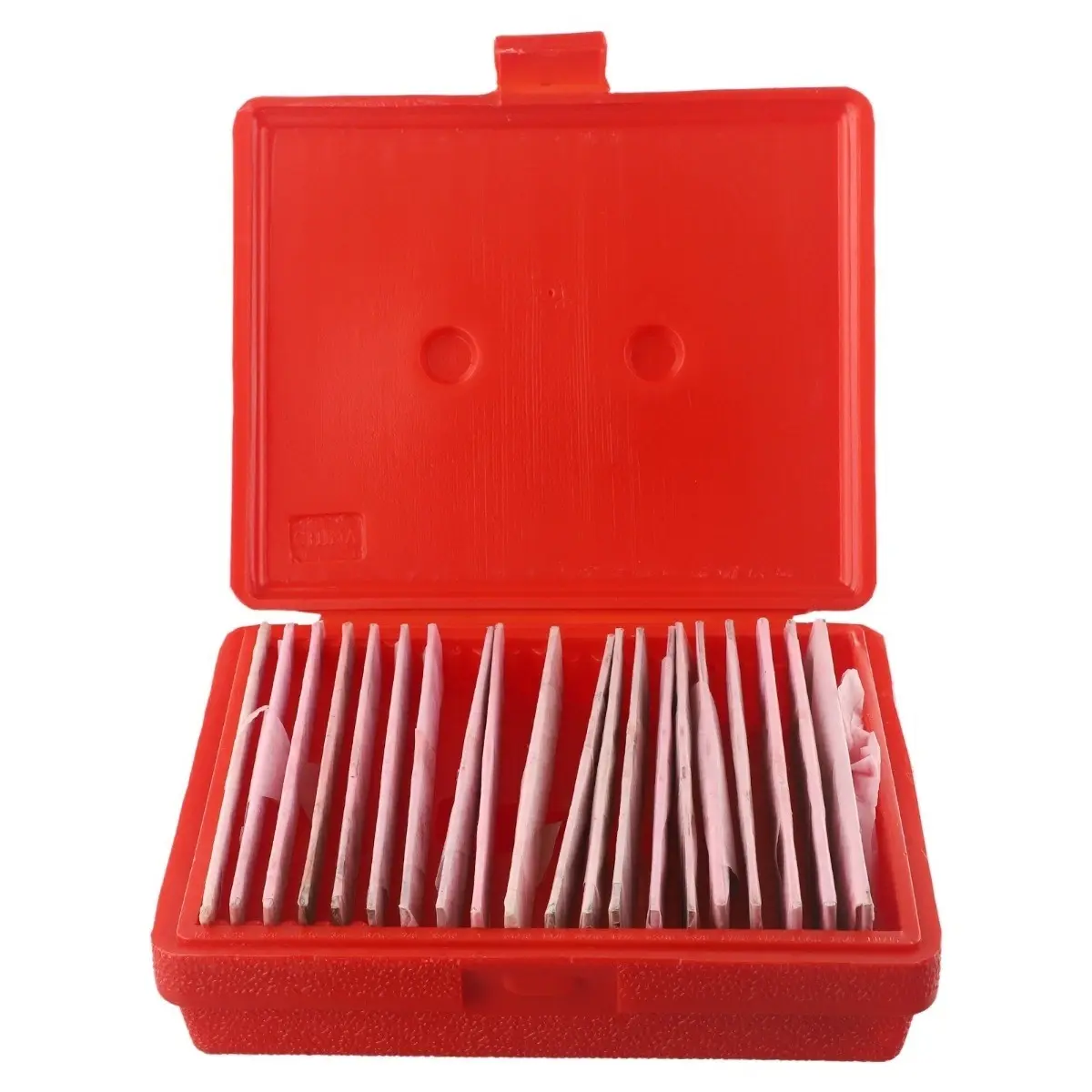
However, a thought I had was to sandwich a stamp between two thin style steel parallels (see photo of set) and measure the parallels with and without a stamp using a micrometer or dial indicator thickness gauge. There are ways to streamline this process using a dial indicator mounted to a static base if one had a lot of stamps to measure.
You wouldn't want to do this with thicker blocks/parallels because they weigh to much, but thin sets would work great imo.
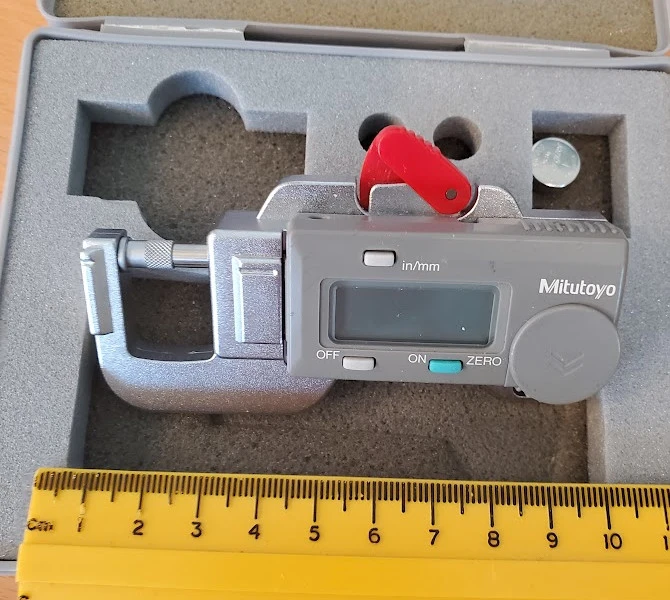
Some years ago, I was fortunate to find a Mitutoyo quick-mini digital micrometer at a very reasonable price.
I find this ideal for measuring stamp thickness. It is spring-loaded, so it exerts a constant pressure on the item being measured. To use it while keeping the stamp clean, I measure the stamp inside a mount. I then subtract the thickness of the empty mount. It is very accurate, with a resolution of 0.01mm.
Unfortunately, a quick web search has shown that these devices are now horrendously expensive. However, many Chinese clones are available from sites such as AliExpress or possibly Amazon, however, I can't vouch for their accuracy or reliability.
Clive
Rob Roy, Great to hear that you are still around :)
AlbumEasy - Free software for creating custom stamp album pages ChromaMate - Compare, match, analyse, free colour matching software ImageSleuth - Images, hidden inside images, revealed. A retroReveal alternative PSGSA - The Philatelic Society for Greater Southern Africa
Thanks for the welcome, Clive. I saw something similar in Ali Express, but naturally not Mitutoyo and not metal, but it shows results up to 0.01 mm. I guess it will be good enough for stamps.
Disclaimer: While a tremendous amount of effort goes into ensuring the accuracy of the information contained in this site, Stamp Community assumes no liability for errors. Copyright 2005 - 2026 Stamp Community Family - All rights reserved worldwide. Use of any images or content on this website without prior written permission of Stamp Community or the original lender is strictly prohibited. Privacy Policy / Terms of UseAdvertise Here





 Posted 01/10/2019 11:59 am




 BACK!!!!!