| Author |
 Replies: 28 / Views: 4,398 Replies: 28 / Views: 4,398 |
|
Pillar Of The Community
Canada
879 Posts |
|
|
|
|
Pillar Of The Community
United States
1125 Posts |
|
|
Pillar Of The Community
India
557 Posts |
|
|
SAFE 9680 Digital Micrometer.
It is indispensible for any collection of Índia Portuguêsa Corôa keytype and Ceres issues with several varieties of paper. |
Send note to Staff 
|
|
|
Pillar Of The Community
United States
3224 Posts |
|
|
Per Joy and docfd, it is best to use a paper thickness micrometer rather than a standard one to avoid false readings and damage. That said, a quick check of non-philatelic paper micrometers show ones with large anvils unsuited to measure stamps.
Remember also that you are measuring paper only and not ink and paper. You'll also have to compensate for gum on mint stamps.
|
|
Send note to Staff
|
|
|
Bedrock Of The Community
Australia
38679 Posts |
|
|
Micrometer This what I use $20 from ebayThe little knurled knob at the end, has to be used with an ultra light feel, like massaging the wings of a butterfly. 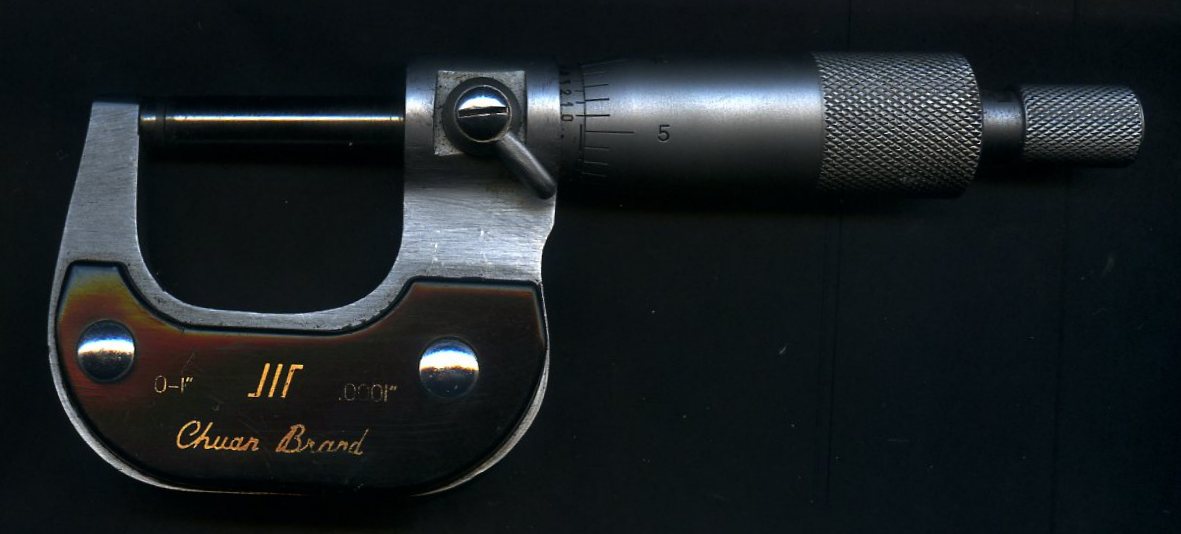 This was recommended to me 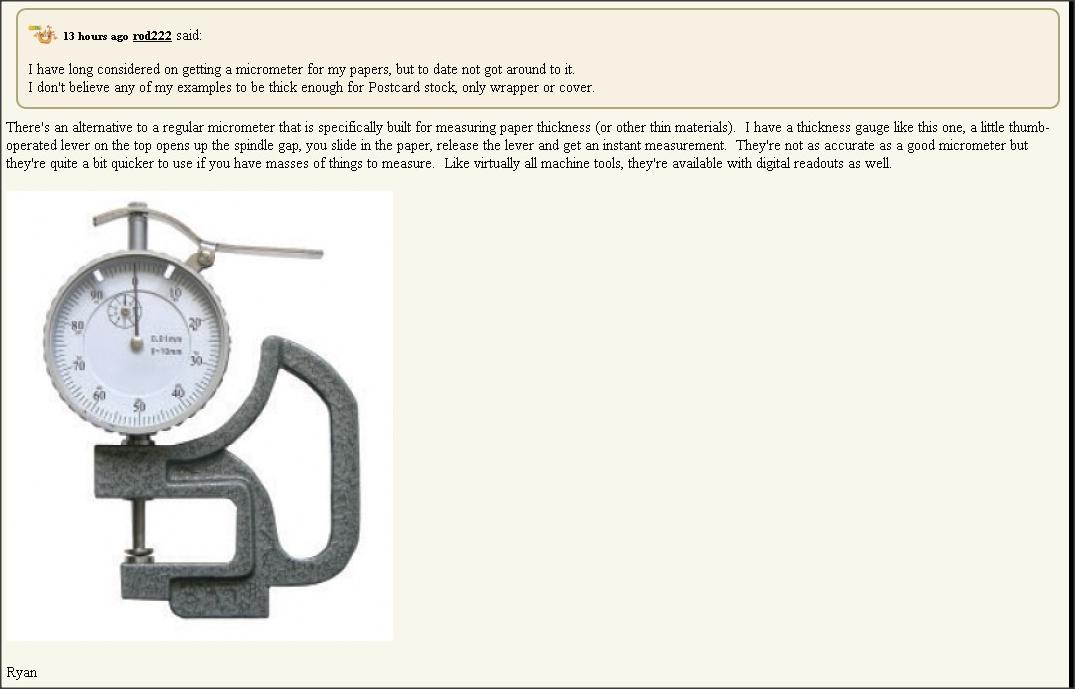 |
|
Send note to Staff
|
|
|
Pillar Of The Community
United States
3305 Posts |
|
|
Pillar Of The Community
United States
2555 Posts |
|
|
Pillar Of The Community
United States
2555 Posts |
|
|
I also don't get concerned about measuring ink thickness on top of paper thickness. I find the stamps that I measure have a very predictable range of thicknesses using my technique. |
|
Send note to Staff
|
|
|
Pillar Of The Community
India
557 Posts |
|
|
@rod222 Quote:
...like massaging the wings of a butterfly.
I am struggling to visualize how Rod massages the alæ of papiliones, considering the fact that the alæ are full of lepis (thus imparting its taxonomic Order the name Lepidoptera) which invariably will result unpleasant desquamation.  |
|
Send note to Staff
|
|
|
Pillar Of The Community
India
557 Posts |
|
|
Here is the paper thickness guide in Mundifil (ex-Afinsa) for Por. Colonies stamps including Índia Portuguêsa. 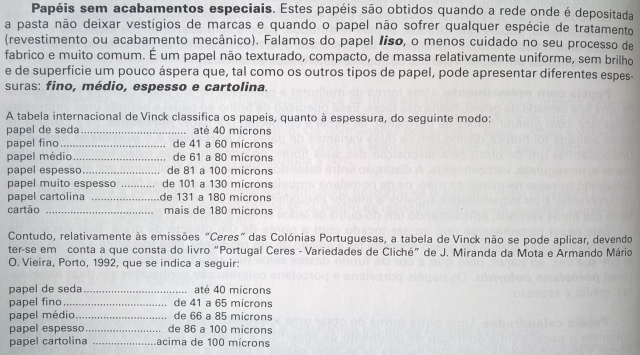 |
|
Send note to Staff
|
|
|
Pillar Of The Community
United States
532 Posts |
|
|
Here's picture of both-I use them often-on steel not paper-but I like the picture- 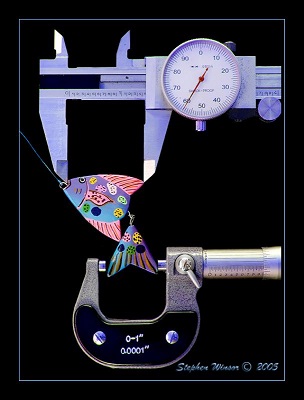 |
|
Send note to Staff
|
|
|
Pillar Of The Community
United States
532 Posts |
|
|
Pillar Of The Community
United States
1179 Posts |
|
|
Pillar Of The Community
Canada
879 Posts |
|
|
Sorry for the delay in getting back to you as I've been away for a few days.
Thanks for all your comments. I think I'll go for he type of micrometer as suggested by Rod et al. |
|
Send note to Staff
|
|
|
Moderator

United States
12330 Posts |
|
|
Measuring the thickness of something like paper also has a large dependency upon the user and the process. If you give the same tool and the same paper to 10 people, it is not unusual to see a range of measurements.
Between the other issues noted (i.e. ink thickness) and the user variances; I do not recommend that hobbyists try to measure paper thickness. It is VERY easy to for confirmation bias to influence the process. With the process being so dependent upon the tactical feel, it is important to maintain a consistent, unbiased process.
Don |
|
Send note to Staff
|
|
|
Pillar Of The Community
Canada
879 Posts |
|
|
Thanks for that caveat, Don. I would, however, like to give it a try. Based on your comments, my best strategy would be a comparative approach. Let's say that a particular stamp has thicknesses of 0.0075 and 0.01 and I test a batch. If one comes in at, say, 0.83 and the others range from 0.0097 to 0.0115. Also, there may be visual clues (my interest is Australia). These factors combined should give a fair degree of confidence in the discovery of a "thin paper" variety.
Well that's my theory ;) And the cost of trying this out is not horrendous. |
|
Send note to Staff
|
|
|
Replies: 28 / Views: 4,398 |
|




 Posted 01/01/2019 11:06 am


