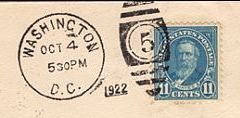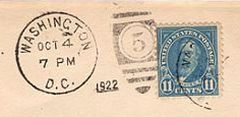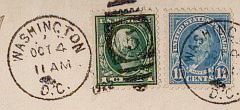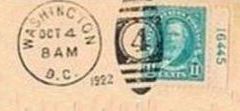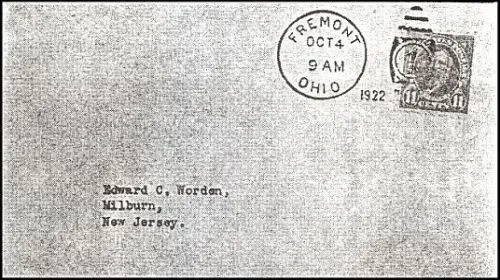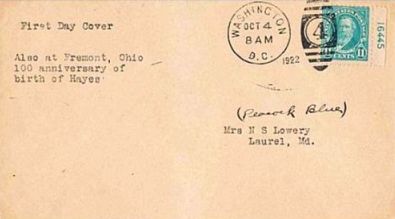
Some time ago while searching the internet with the phase "Scott 563" in Google, I came across a hit that said "1922 First Day Cover 11-Cent President Hayes Scott 563." Following upon that, I came across the cover depicted above. It had been sold as such in an auction five months earlier. The unnecessary add-on text on the cover is factual; however most everything else about the cover makes it as phony as a three dollar bill.
The plate number stamp is from plate 16445, a plate that did not exist until 1926, almost four years after the October 4, 1922 First Day of Issue for the Hayes stamp. Only plate 14058 was used to produce Hayes stamps for the First Day. Let's remove the plate number selvage from the stamp and continue our evaluation.
The counterfeiter would still be in trouble. Peacock blue, as mentioned on the cover, was indeed the designated color of the new stamp and the first Hayes stamps produced reflected that color. But as the years went by, more and more green creep into the makeup of the stamp, until by 1928, the stamp was being printed in a yellowish green with no trace of blue in the stamp. It is claimed that Scott 563 has a greater range of color than other postage stamp produced by the Bureau of Engraving and Printing during the twentieth century. The greenish color displayed on the stamp on the cover is appropriate for stamps printed from plate 16645, but not for the First Day.
Let's help the counterfeiter again by giving him a peacock blue Hayes stamp. There is still a problem, but now with the cancellation. The stamp was made available on the First Day not only at the designated First Day city of Fremont, Ohio where the first public First Day ceremony was held, but also at the Philatelic Stamp Agency in Washington, DC. The cancellation city is okay. However, the Agency's hours started at ten o'clock in the morning. The choice of an eight o'clock morning cancellation is another clue to the nature of the cover.
Another problem with the cancellation is a concern, but not to the same degree as that of the first three problems. The stamp on the cover is cancelled with a hand operated canceler, not a machine operated canceler. The hand device was often used when there were two or more stamps on a cover. Covers with single stamps were normally machine cancelled.
Let's also assume that the counterfeiter had franked the cover with two stamps, an appropriate 11-cent Hayes stamp and an ordinary 1-cent stamp, thereby meeting the special delivery letter rate and possibly requiring a hand cancellation. He could still be in trouble if he used the one cent Franklin ordinary stamp that was available in 1926. That stamp was not released until 1923 in either its flat press or rotary press versions. He should have used the one-cent Washington stamp of the earlier Washington-Franklin series. Life can certainly be difficult for an amateur counterfeiter.
The name on the cover is Mrs. N. S. Lowery of Laurel, Maryland, a town located near our nation's capital. I looked for and found that name in the 1920 and 1930 Federal censuses. What I discovered probably explains the source of the cover. Mrs. Lowery was the wife of Norman S. Lowery, a clerk working for the United States Post Office in Washington. Whether in fun or for real, he violated federal law. The hand cancellation can now be explained since he had ready access to manipulate a hand canceler, but possibly not a machine canceler. It appears that his crime was not discovered since the 1930 census shows that he was still a post office clerk.
As far as I can tell, this Hayes cover never appeared in auction again. Even though I have not tried to discover other Lowery covers, I suspect he tried his hand on counterfeiting other FDCs.
If Lowery had been more skillful in his backdating effort, his cover would have not been challenged.





 Posted 12/16/2025 11:44 pm