Stamp Community Family of Web Sites
Thousands of stamps, consistently graded, competitively priced and hundreds of in-depth blog posts to read


Stamp Community Forum
 
Username:
Password:
Save Password
Forgot your Password?

This page may contain links that result in small commissions to keep this free site up and running.

Welcome Guest! Registering and/or logging in will remove the anchor (bottom) ads. It's Free!

A Counterfeit Scott 563 First Day Cover

 
To participate in the forum you must log in or register.
Author Previous TopicReplies: 11 / Views: 981Next Topic  
Valued Member
United States
75 Posts
Posted 12/16/2025   11:44 pm  Show Profile Bookmark this topic Add Hayes to your friends list Get a Link to this Message

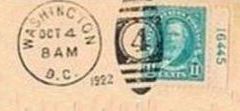
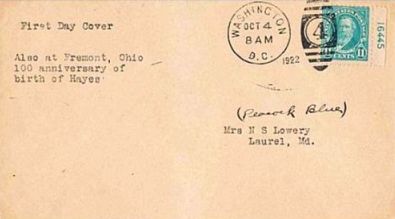
Some time ago while searching the internet with the phase "Scott 563" in Google, I came across a hit that said "1922 First Day Cover 11-Cent President Hayes Scott 563." Following upon that, I came across the cover depicted above. It had been sold as such in an auction five months earlier. The unnecessary add-on text on the cover is factual; however most everything else about the cover makes it as phony as a three dollar bill.

The plate number stamp is from plate 16445, a plate that did not exist until 1926, almost four years after the October 4, 1922 First Day of Issue for the Hayes stamp. Only plate 14058 was used to produce Hayes stamps for the First Day. Let's remove the plate number selvage from the stamp and continue our evaluation.

The counterfeiter would still be in trouble. Peacock blue, as mentioned on the cover, was indeed the designated color of the new stamp and the first Hayes stamps produced reflected that color. But as the years went by, more and more green creep into the makeup of the stamp, until by 1928, the stamp was being printed in a yellowish green with no trace of blue in the stamp. It is claimed that Scott 563 has a greater range of color than other postage stamp produced by the Bureau of Engraving and Printing during the twentieth century. The greenish color displayed on the stamp on the cover is appropriate for stamps printed from plate 16645, but not for the First Day.

Let's help the counterfeiter again by giving him a peacock blue Hayes stamp. There is still a problem, but now with the cancellation. The stamp was made available on the First Day not only at the designated First Day city of Fremont, Ohio where the first public First Day ceremony was held, but also at the Philatelic Stamp Agency in Washington, DC. The cancellation city is okay. However, the Agency's hours started at ten o'clock in the morning. The choice of an eight o'clock morning cancellation is another clue to the nature of the cover.

Another problem with the cancellation is a concern, but not to the same degree as that of the first three problems. The stamp on the cover is cancelled with a hand operated canceler, not a machine operated canceler. The hand device was often used when there were two or more stamps on a cover. Covers with single stamps were normally machine cancelled.

Let's also assume that the counterfeiter had franked the cover with two stamps, an appropriate 11-cent Hayes stamp and an ordinary 1-cent stamp, thereby meeting the special delivery letter rate and possibly requiring a hand cancellation. He could still be in trouble if he used the one cent Franklin ordinary stamp that was available in 1926. That stamp was not released until 1923 in either its flat press or rotary press versions. He should have used the one-cent Washington stamp of the earlier Washington-Franklin series. Life can certainly be difficult for an amateur counterfeiter.

The name on the cover is Mrs. N. S. Lowery of Laurel, Maryland, a town located near our nation's capital. I looked for and found that name in the 1920 and 1930 Federal censuses. What I discovered probably explains the source of the cover. Mrs. Lowery was the wife of Norman S. Lowery, a clerk working for the United States Post Office in Washington. Whether in fun or for real, he violated federal law. The hand cancellation can now be explained since he had ready access to manipulate a hand canceler, but possibly not a machine canceler. It appears that his crime was not discovered since the 1930 census shows that he was still a post office clerk.

As far as I can tell, this Hayes cover never appeared in auction again. Even though I have not tried to discover other Lowery covers, I suspect he tried his hand on counterfeiting other FDCs.

If Lowery had been more skillful in his backdating effort, his cover would have not been challenged.

Send note to Staff

Pillar Of The Community
United Kingdom
8600 Posts
Posted 12/17/2025   01:01 am  Show Profile Check GeoffHa's eBay Listings Bookmark this reply Add GeoffHa to your friends list  Get a Link to this Reply
Fascinating - thank you!
Send note to Staff  Go to Top of Page
Valued Member
United States
34 Posts
Posted 12/17/2025   07:18 am  Show Profile Bookmark this reply Add Philatelius to your friends list  Get a Link to this Reply
I'm curious, was the typical use of a machine cancel (as opposed to a hand cancel) when there was only a single stamp on cover exclusive to Washington?

Or was that standard practice in all first day cities where Fourth Bureau Issue stamps were issued?
Send note to Staff  Go to Top of Page
Pillar Of The Community
6341 Posts
Posted 12/17/2025   10:45 am  Show Profile Bookmark this reply Add John Becker to your friends list  Get a Link to this Reply

Quote:
The hand device was often used when there were two or more stamps on a cover. Covers with single stamps were normally machine cancelled.

This just is a coincidence.
There is zero reason to sort covers by the number of stamps. The only logical reason to cull a cover from a bundle would be by the unusual position of the application, such as a block where the two lower stamps might be missed by the machine. A horizontal pair would not typically be pulled for hand cancelling, although examples probably exist.
Also consider instead the mobility of the handstamp to be brought to the window (or anywhere else) versus the heavy cancelling machine permanently located in the back work room. Or consider whether a stack or a single item is being processed. Or whether they were going to pass through the mail or be handed back (did they permit that in the 1920s?). In other words "think" like a clerk.
Send note to Staff  Go to Top of Page
Bedrock Of The Community
United States
10667 Posts
Posted 12/17/2025   11:26 am  Show Profile Bookmark this reply Add revcollector to your friends list  Get a Link to this Reply
A careful examination of that cancel would probably send red flags up as well; the shape of the letters, and the size and shape of the killer are very unlikely to match an original duplex cancel.
Send note to Staff  Go to Top of Page
Valued Member
United States
75 Posts
Posted 12/17/2025   1:53 pm  Show Profile Bookmark this reply Add Hayes to your friends list  Get a Link to this Reply
I thank and stand corrected by John Becker for his words on cancellations. I should have looked at some Scott 563 FDCs before I said that two or more stamps incurred a hand cancellation. Other than Edward C. Worden's many FDCs which all were single stamped, the majority of the other Scott 563 FDCs were or should have been sent special delivery which meant that they had an additional one cent stamp on the cover. Most of those covers were machine cancelled because the two stamps were side by side. In the case where the second stamp was elsewhere on the cover, the cover received hand cancellations. I note that there were two covers that received both types of cancellations. Superintendent of Stamps Michael Eidsness presided over the First Day ceremony at Fremont, Ohio for the Hayes stamp release. He serviced five of his own FDCs. Even though only one of his five covers required a hand cancellation, all five received it because it was convenient. The reference for my words is my hayesfdc.wordpress.com site.
Send note to Staff  Go to Top of Page
Pillar Of The Community
United States
4336 Posts
Posted 12/17/2025   3:54 pm  Show Profile Bookmark this reply Add Parcelpostguy to your friends list  Get a Link to this Reply

Quote:
A careful examination of that cancel would probably send red flags up as well; the shape of the letters, and the size and shape of the killer are very unlikely to match an original duplex cancel.


Unlikely as noted by the OP:


Quote:
...Norman S. Lowery, a clerk working for the United States Post Office in Washington. Whether in fun or for real, he violated federal law. The hand cancellation can now be explained since he had ready access to manipulate a hand canceler....
Send note to Staff  Go to Top of Page
Bedrock Of The Community
United States
10667 Posts
Posted 12/17/2025   8:45 pm  Show Profile Bookmark this reply Add revcollector to your friends list  Get a Link to this Reply
Assuming that he was a clerk at a window. But would he if his job was to load trucks?
Send note to Staff  Go to Top of Page
Valued Member
United States
75 Posts
Posted 12/17/2025   9:57 pm  Show Profile Bookmark this reply Add Hayes to your friends list  Get a Link to this Reply
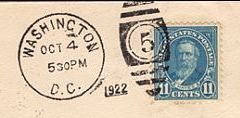
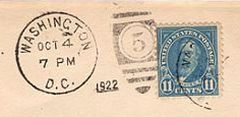
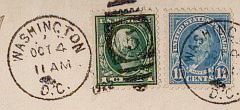
For comparison purposes, here are three copies of the only hand cancellation found on the Hayes Oct. 4, 1922 Washington, DC FDCs. It is found on ten different covers with a variety of times of day. All ten covers have the enclosed 5.


Send note to Staff  Go to Top of Page
Valued Member
United States
75 Posts
Posted 12/17/2025   10:05 pm  Show Profile Bookmark this reply Add Hayes to your friends list  Get a Link to this Reply
The census records gave Lowery's occupation as clerk at the post office
Send note to Staff  Go to Top of Page
Bedrock Of The Community
United States
10667 Posts
Posted 12/17/2025   10:20 pm  Show Profile Bookmark this reply Add revcollector to your friends list  Get a Link to this Reply
Just offhand, notice the difference in the "o" of Washington. It's much larger than the other three. Also the numeral 2 in the year date appears different in that cancel compared to the others. A close study might well find other differences.
Send note to Staff  Go to Top of Page
Valued Member
United States
75 Posts
Posted 04/25/2026   8:13 pm  Show Profile Bookmark this reply Add Hayes to your friends list  Get a Link to this Reply
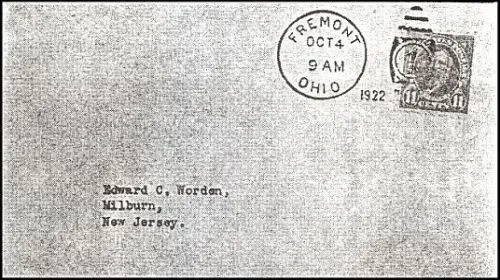
This cover was featured in the Jan. 10, 1976 R & R Auction. It is a counterfeit Worden FDC since there are cancellation discrepancies between its cancellation and appropriate Fremont FDC postmarks. Also, it is a lone cover. Worden always made multiples FDCs of a new issue for his business. I have never seen the actual cover.


A click on https://hayesfdc.wordpress.com will take you to a Hayes FDC internet site for more information.

Send note to Staff  Go to Top of Page
  Previous TopicReplies: 11 / Views: 981Next Topic  
 
To participate in the forum you must log in or register.

Go to Top of Page

Disclaimer: While a tremendous amount of effort goes into ensuring the accuracy of the information contained in this site, Stamp Community assumes no liability for errors. Copyright 2005 - 2026 Stamp Community Family - All rights reserved worldwide. Use of any images or content on this website without prior written permission of Stamp Community or the original lender is strictly prohibited.
Privacy Policy / Terms of Use    Advertise Here
Stamp Community Forum © 2007 - 2026 Stamp Community Forums
It took 0.19 seconds to lick this stamp. Powered By: Snitz Forums 2000 Version 3.4.05