Local tax stamp -Translation from the link below:
Juan Pablo Aguilar Andrade
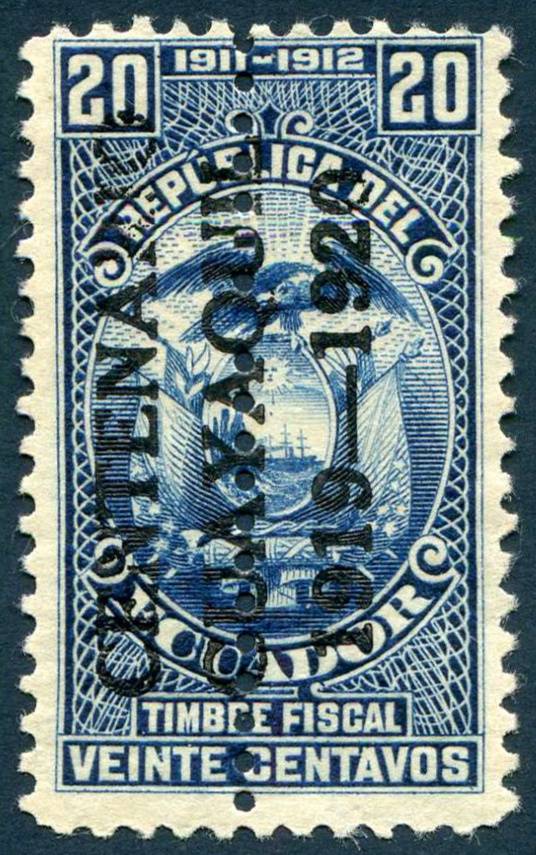
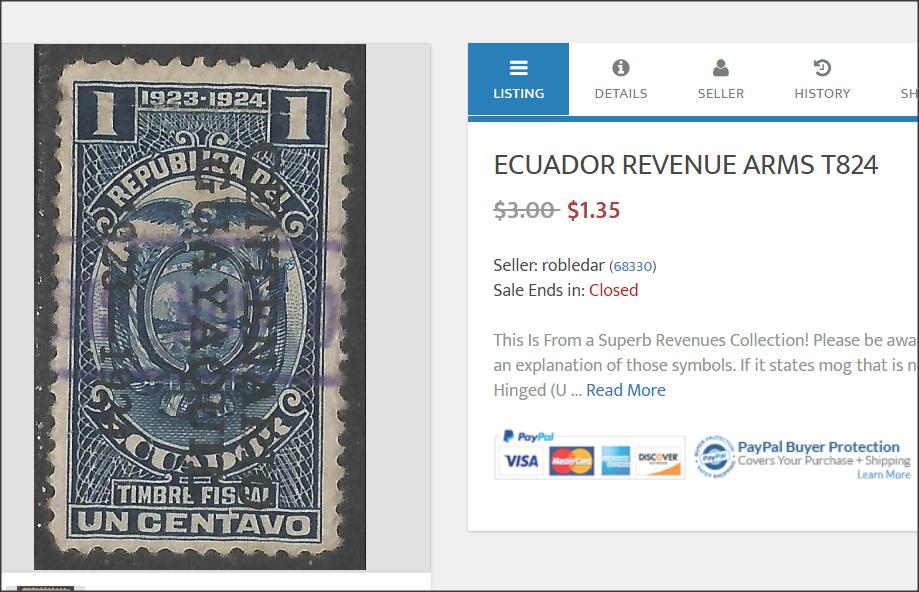
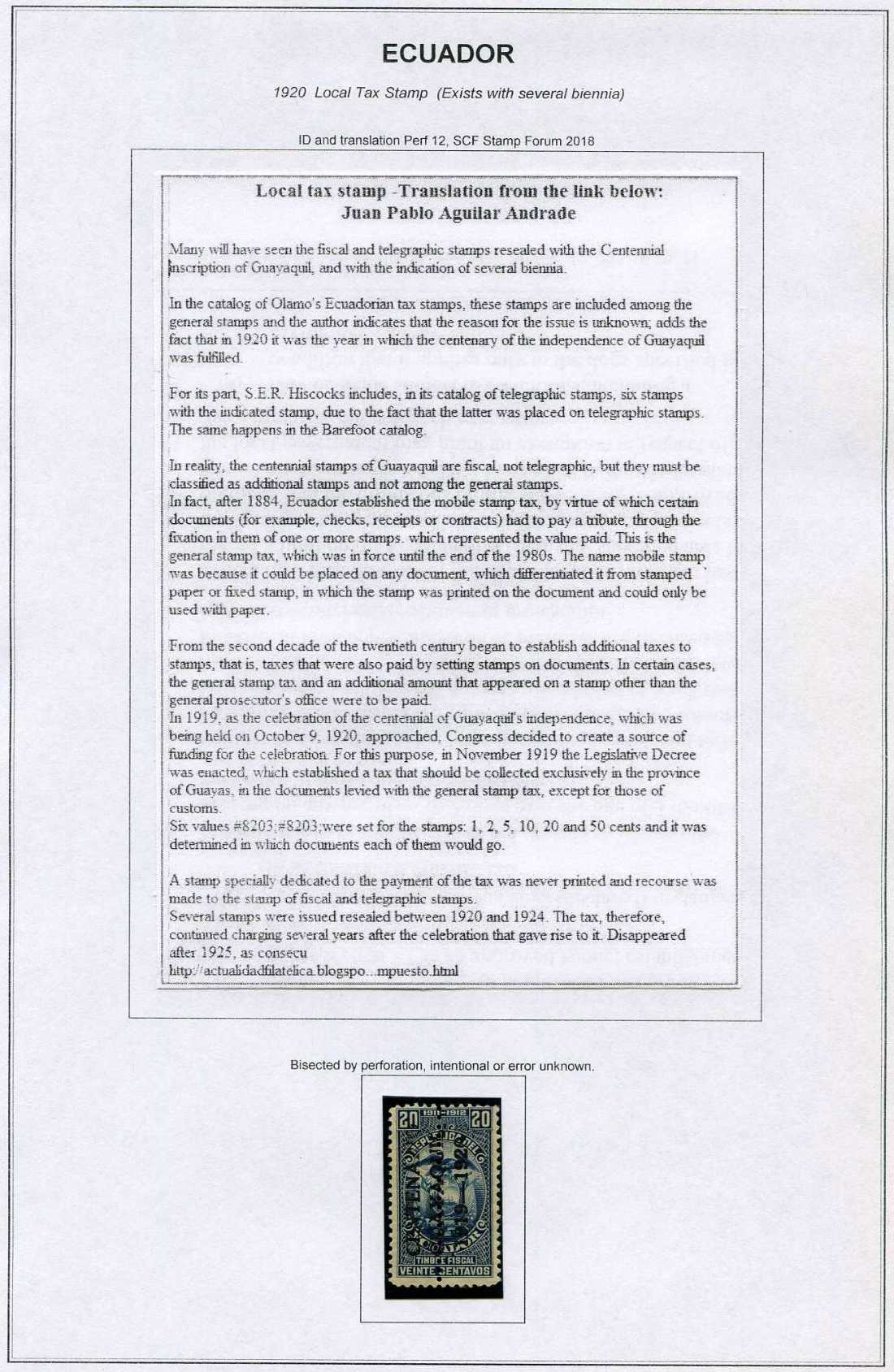
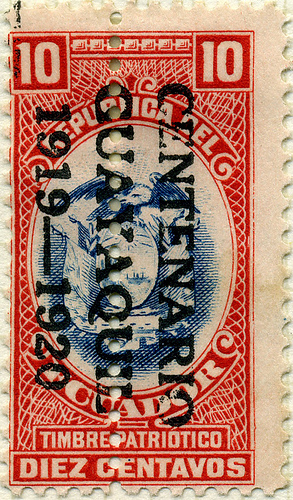
Many will have seen the fiscal and telegraphic stamps resealed with the Centennial inscription of Guayaquil, and with the indication of several biennia.
In the catalog of Olamo's Ecuadorian tax stamps, these stamps are included among the general stamps and the author indicates that the reason for the issue is unknown; adds the fact that in 1920 it was the year in which the centenary of the independence of Guayaquil was fulfilled.
For its part, S.E.R. Hiscocks includes, in its catalog of telegraphic stamps, six stamps with the indicated stamp, due to the fact that the latter was placed on telegraphic stamps. The same happens in the Barefoot catalog.
In reality, the centennial stamps of Guayaquil are fiscal, not telegraphic, but they must be classified as additional stamps and not among the general stamps.
In fact, after 1884, Ecuador established the mobile stamp tax, by virtue of which certain documents (for example, checks, receipts or contracts) had to pay a tribute, through the fixation in them of one or more stamps. which represented the value paid. This is the general stamp tax, which was in force until the end of the 1980s. The name mobile stamp was because it could be placed on any document, which differentiated it from stamped paper or fixed stamp, in which the stamp was printed on the document and could only be used with paper.
From the second decade of the twentieth century began to establish additional taxes to stamps, that is, taxes that were also paid by setting stamps on documents. In certain cases, the general stamp tax and an additional amount that appeared on a stamp other than the general prosecutor's office were to be paid.
In 1919, as the celebration of the centennial of Guayaquil's independence, which was being held on October 9, 1920, approached, Congress decided to create a source of funding for the celebration. For this purpose, in November 1919 the Legislative Decree was enacted, which established a tax that should be collected exclusively in the province of Guayas, in the documents levied with the general stamp tax, except for those of customs.
Six values #8203;#8203;were set for the stamps: 1, 2, 5, 10, 20 and 50 cents and it was determined in which documents each of them would go.
A stamp specially dedicated to the payment of the tax was never printed and recourse was made to the stamp of fiscal and telegraphic stamps.
Several stamps were issued resealed between 1920 and 1924. The tax, therefore, continued charging several years after the celebration that gave rise to it. Disappeared after 1925, as consecu
http://actualidadfilatelica.blogspo...mpuesto.html





 Posted 12/01/2010 07:20 am