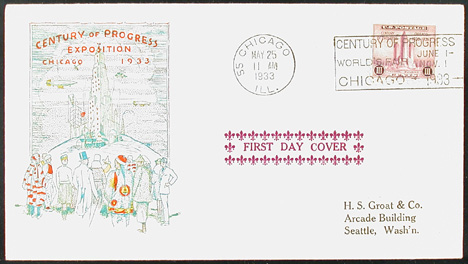
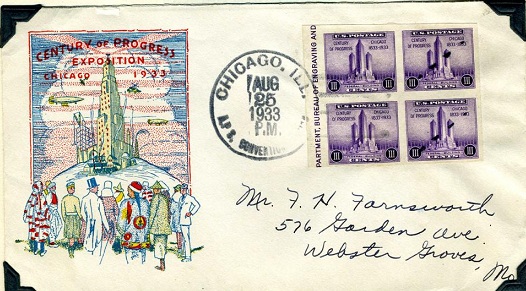
bfranton: I found it! Finally! After some web searching I finally found reference to that Century of Progress cacheted cover you posted on 08/24/2011. It is a Harry Ioor Cachet ... and very unusual for that cachetmaker as it is far apart from his normal cachets for that day. Although the cachet is used on a different Century of Progress issue, it is described as a "scarce" cachet, according to this write-up (be patient, it takes a minute to download ... and advance to Page #10, Column #2 (Figure #4)):
http://www.rieschapterafdcs.com/Spr...wsletter.pdfIn fact, I downloaded another example from James McCusker's FDC website but in this example, the colors are not near as bold as the ones scanned in your example:
By the way, here's an interesting history of Ioor cachets:
Quote:
Ioor Cachets were produced by the early FDC Cachet Pioneer, Harry C. Ioor, many with the artistic assistance of his sister, Travilla Ioor. Harry Ioor was located at 802 State Life Bldg, Indianapolis IN, where he also operated a chiropractic practice. The First Cachets by Harry C. and Travilla Ioor were five different varieties of #651-9 2c George Rogers Clark, issued 2/25/29. (Mellone, Planty Vol. II, 1994, pp. 24-25; Monty et al., First Cachets Revealed, 2006, p. 15). Early Ioor Cachets of the period 1929-1933 are based on fine line drawings. Ioor Cachets from 1934-1940 tend to be black-and-white photos surrounded by a block of a single bright color. The photos were printed on the envelope, in contrast to Crosby's method of pasting a photo on the envelope, or Beazell's method of transferring an image to an envelope made of photographic paper (Mellone and Newton 1979, pp. 33-34).
Harry Ioor never married. He died Feb 16, 1940, before the completion of the Famous American Series of 1940, #859/893. His sister Travilla completed this Series and continued the Ioor brand of Cachets. Travilla Ioor's cachets from 1940-1951 are usually identified by the signature "Ioor" someplace in the design. (Mellone and Newton 1979, pp. 33-34).
Travilla Ioor met her FDC competitor, E. Milnor Peck (the founder and owner of the Fleetwood Cover Service), when Peck came to Indianapolis August 29, 1949 for the First Day of Issue Ceremonies of the #985 3c G.A.R. Stamp. It was love at first sight, and they were married in June of 1950 and combined their FDC businesses. Travilla's Last Cachet for the Ioor line was #998-20 3c United Confederate Vets, issued 5/30/51, but she continued as an enthusiastic participant in the business of Fleetwood Cover Service. Travilla and Milnor Peck logged hundreds of thousands of miles together traveling to first day cities across the country until Travilla died March 16, 1967. (Monty et al., First Cachets Revealed, 2006, p. 15; Mellone, FDCs of 1950s, 1999, p. 38; Unicover 2004 pp. 38-39).
After the death of Travilla, Milnor Peck lost his enthusiasm for continuing the FDC business, and in December of 1968 he sold Fleetwood Cover Service to to Unicover Corporation of Cheyenne WY. Unicover was launched by FDC Servicer James A. Helzer with venture capital. Unicover operated Fleetwood as a separate division of Unicover, with the first Fleetwood Cachet under the Unicover umbrella being the #1369 6c American Legion stamp issued 3/15/69. In 1971 Unicover purchased Cachet Craft Cover Service from Athol and Virginia Cliff (who had purchased it from Frederick B. Fitts Co. in 1953), and folded the Cachet Craft brand into the Fleetwood brand of Cachets.
Unicover sold its Fleetwood Division to Mystic Stamp Company (www.mysticstamp.com) in 2007, which still produces some Fleetwood brand Cachets.





 Posted 08/22/2011 10:48 pm





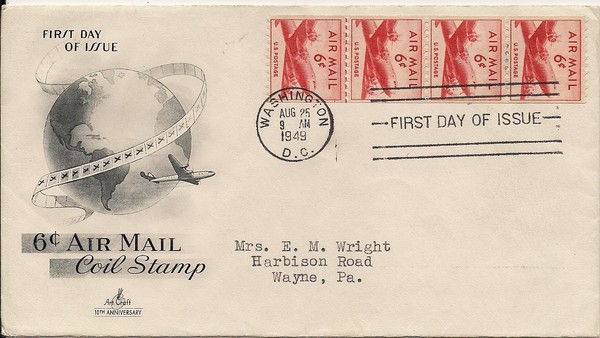

 Thanks for digging. Work has a way of taking precedence.