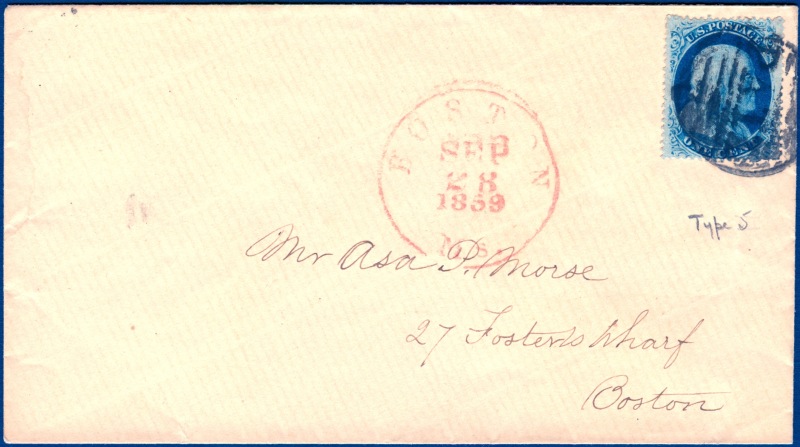
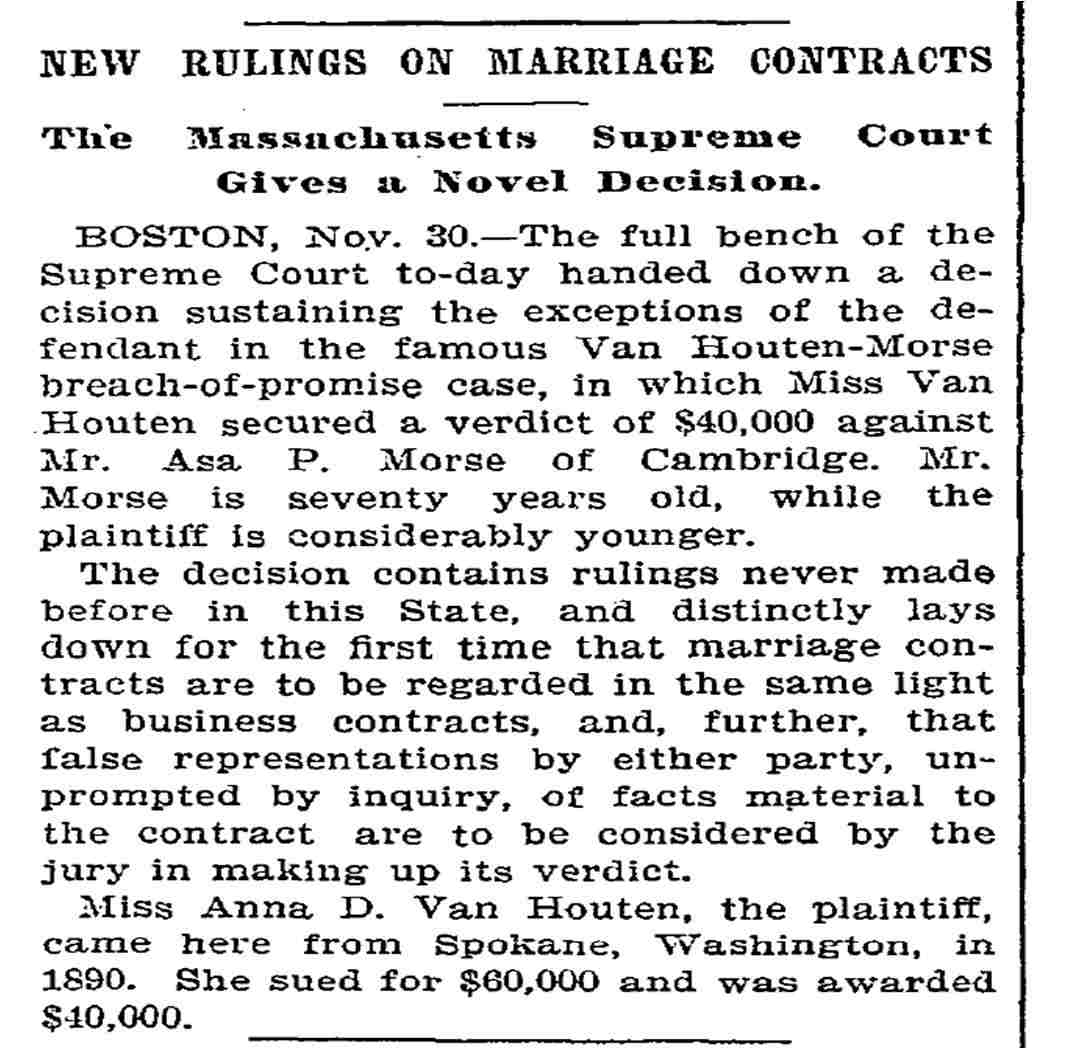
The earlier post with a newspaper article on Asa P. Morse only shows one dimension of his life. According to this biography, he was quite an accomplished businessman in banking, trade, real estate and building construction businesses, as well as a minor politician in his day, even with some questionable faults:
Quote:
Biography of Asa Porter Morse
Asa P. Morse was the son of Daniel Morse and Sarah Morse (first cousins) and was born on September 1, 1818 in Haverhill, New Hampshire. He married Dorcas Louis Short (1822-1864) in 1845 in Cambridgeport, Massachusetts. They had three children: Mary Louisa (b. 1847); Velma Maria (b. 1851); and Arthur Porter (1858-1863).
According to the Memorial of the Family of Morse:
"Hon. Asa Porter Morse came to Boston, in 1840, and began as book-keeper in the house of Hayward & Morse, who were engaged in the Provincial and W.I. Trade. In 1846 he moved to Cambridgeport, Mass., where he has ever since resided, and where he became interested in real estate operations, and for a long time [he was] an extensive builder. He has been connected with the Cambridge Fire Insurance Company, as Director, the Cambridge Hospital, as Trustee, and other charitable Institutions, and for about thirty-five years Director of the Cambridgeport National Bank, and for the past twelve years its President; was one of the Committee of Investment, and also Vice-President of the Cambridgeport Savings Bank, and for sixteen years member of the School Board.
Although often called to positions of public trust, it has always been at the solicitation of his fellow citizens. He was Alderman in 1866, and member of the Legislature in 1869, and in 1872 he was again elected, serving the House of 1873, holding important places on several Committees, and declining reelection.
The Republicans of Cambridge of the Third Middlesex Senatorial District in the Campaign of 1878, sought to find their strongest man, and selected Mr. Morse as Candidate for Senator, and he was elected by a handsome majority.
He was appointed by President Cogswell as Chariman of the Joint Committee on Prisons, and also on the Committee on Claims. The Committee on Prisons [was] called upon to revise the entire system of prison supervision, a very important and difficult duty. Under the lead of Mr. Morse a new system was perfected which proved completely satisfactory, and the law of 1879 is acknowledged by all familiar with it to be a superior piece of legislation. So successful was he in bringing about this change, and so heartily and intelligent an interest in prison matters did he manifest, that he was, against his protest, made Chairman of the Joint Special Committee on Contract Convict Labor, which, in the summer and fall of 1879, investigated that subject. The report of that Committee was probably the most exhaustive and valuable ever made in this Country upon that topic, and permanently settled many questions which had before been in controversy.
He was reelected to the Senate of 1880 by an unusual majority. He was again placed at the head of the Committee on Prisons, and also on the Committee on Education, and Expenditures."
Asa P. Morse was the owner of a flourishing business which both manufactured and invested in cooperage materials. He had his own cooperage, in South Boston, which made shooks and constructed casks, drums, hogsheads, pipes, and barrels. He also contracted from various milling companies and individuals for shooks, staves, heads, and hoops in all sizes from sugar and molasses hogsheads to wine pipes and beer barrels. His agents, such as L.E. Persons in West Virginia, conducted many of these transactions for him in various regions of the country. By supplying machinery and money to pay labor costs, Morse also helped to finance individual entrepreneurs who cut, hauled, and fashioned staves and shooks in such areas as Michigan, Georgia, North Carolina, New Hampshire, Maine, and northeastern Connecticut. Materials were delivered, by canal barge, rail, steamer, and sailing vessel, to his warehouse and shop on India Wharf in Boston, and later to Morse's Wharf on First Street in South Boston. Parts or finished products were shipped by boat to Cuba for sugar and molasses, to Spain for wine, to St. Pierre and Miquelon for dried fish, and to Liverpool.
Morse must have been a shrewd businessman during the difficult Civil War years and the business depression of the 1870s, because he appears to have prospered in spite of complaints from his correspondents of slow payment of bills and his own grumbling about the inability to get seasoned wood and good workmanship. Nor was he adverse to cutting corners and trying to include poor "culls" in bundles of good staves!
Morse owned his own home in Cambridgeport and rented out various houses in Cambridge, MA, and the 1893 Directory of Cambridge lists him as President of the Cambridgeport National Bank. He must have been respected by his business associates because he maintained many of the same working relationships for twenty-five years and more, and he financed some smaller milling concerns when bankruptcy threatened.
Asa Porter Morse died March 18, 1906, and is buried in the Mt. Auburn cemetery in Cambridge, Massachusetts.





 Posted 09/25/2011 12:23 pm














 what kind of a father am I?

