| Author |
 Replies: 15 / Views: 2,913 Replies: 15 / Views: 2,913 |
|
|
Pillar Of The Community
Australia
2156 Posts |
|
|
In the lot of old Indian stamps I bought recently there were 8 of these 9 pie issues (1932/36). The one on the right in the image below seems to have been printed on a different kind of paper than the rest, which just appear to be on ordinary white paper. Paper varieties are not listed in my Gibbons. Does anyone know if this is from a special printing on toned paper or whether it's just been 'tropicalised'? 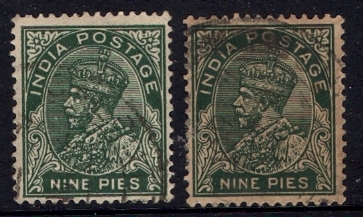 Front:  Back: 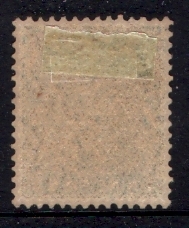 |
|
Send note to Staff
|
|
|
|
|
Pillar Of The Community
Australia
3547 Posts |
|
|
Just tropicalised, I'm, afraid. A very, very common problem with older Indian stamps which have been kept on the Subcontinent.
That value, and a couple of others from the late George V/early George VI era do occur printed typo and offset-litho. (Yours appears to be the typo version.) Usually there isn't much difference in price between the two, though, because the stamps were printed in such huge numbers. |
Send note to Staff 
|
|
|
Pillar Of The Community
Australia
2156 Posts |
|
|
Pillar Of The Community
Australia
3547 Posts |
|
|
Valued Member
India
125 Posts |
|
|
nice stamps from india, I have the stamp you have given in the post.
warm wishes. |
|
Send note to Staff
|
|
|
Pillar Of The Community
Australia
2156 Posts |
|
|
Bedrock Of The Community
Australia
38679 Posts |
|
|
A basic idea of "tropicalisation"
Temperature relates to the degree of vibration
which is present within the molecules which make up a material.
it follows that the rate of detioration occurs in an object
the higher the temperature rises.
The lower the temperature the lower the degradation.
the recomended archival storage is 10 degrees cent +/- 2 degrees
if the temp is too low one gets condensation and irrgularities
in expansion (eg bi metallic strip) damages paper.
humidity
amount of moisture in the air
a stable humidity is preferred around 30% but more practical at 50%
humidity too high
deteriration of arganic material (browning of paper)
biological damage
increase tack of gums (you gotta hate those gums)
increased tack of printing inks
some water soluble inks bleeding.
too low
brittleness of paper
cracking gums
curl problems of gums
increased static electricity.
flaking of pigments and writing inks
|
|
Send note to Staff
|
|
|
Pillar Of The Community
Australia
2156 Posts |
|
|
Thanks, rod222. Would any one of those factors be chiefly responsible for inducing a change in the colour of the paper? |
|
Send note to Staff
|
|
|
Pillar Of The Community
Australia
3547 Posts |
|
|
I think Rod has answered that for you: Quote:
humidity too high
deterioration of organic material (browning of paper) |
|
Send note to Staff
|
|
|
Bedrock Of The Community
Australia
38679 Posts |
|
|
I once bought a wooden box at a car boot sale
(like an old petroleum/oil box)
It had been sent from Straits settlements, malaysia
and it was chock full of letters /stamps from
Nestle Straits settlements.
Some of the stamps inside had browned as yours had
(tropical toning), but they had gone a step further
in their deterioration, they had gone absolutely brittle,
and the least touch had them falling to the ground in tiny shards.
The best I could do was scan, and throw them away.
Our Philatelic Library in Perth, has some Stanley
Gibbons catalogues that are so old, they have gone the same way.
It is a terrible conundrum, to leave well alone, or
look at them before they disappear, but as you turn a page
another bit falls off.
|
|
Send note to Staff
|
|
|
Pillar Of The Community
Australia
2156 Posts |
|
|
tonymacg, thanks for pointing that out.
I sometimes don't read things on computer screens too well. |
|
Send note to Staff
|
|
|
Pillar Of The Community
Australia
3547 Posts |
|
|
Tropicalisation can be a frustratingly variable phenomenon, too. Much seems to depend on the paper involved. Old Indian postal stationery postcard stock seems to be particularly subject to it. (Or is it simply deterioration with age?) In this example  the Indian card has gone a distasteful brown colour, but the paper of the ¼ Anna brown Jammu & Kashmir stamp (SG 141) has remained quite white. I also remember from, I think, the Murray Payne Ltd periodical on George VI stamps, that some pre-WWII Colonial stamps were issued with quite brownish gum, which could be mistaken for tropicalisation. In fact, it isn't - and it can help identify a particular printing. So all that's brown isn't, well ... you know. And, jimjamtwo, you may not have understood Rod's post. I had to tidy up a couple of spelling errors. Of course, Rod can't help it; he lives out in the mulga in WA. 'Nuff said. |
|
Send note to Staff
|
|
|
Bedrock Of The Community
Australia
38679 Posts |
|
|
Note to secretary : Hold Tony's gift of mint Poonch, until improvement in manners is noted. I am a speed typist, and on the rare occaision an incorrect spelling flies through. There's no quality control in my business. I don't like doing this Tony, but Mr. Yamamoto sent me some of your recent work...  |
|
Send note to Staff
|
|
|
Pillar Of The Community
Australia
3547 Posts |
|
|
Bedrock Of The Community
Australia
38679 Posts |
|
|
Pillar Of The Community
Australia
3547 Posts |
|
| |
Replies: 15 / Views: 2,913 |
|




 Posted 01/15/2011 9:02 pm


