| Author |
 Replies: 15 / Views: 6,775 Replies: 15 / Views: 6,775 |
|
|
Valued Member
United Kingdom
81 Posts |
|
|
With my interest in cinderellas of the George VI period, I would be interested in finding out more about this charity issue. The printer is Posterstamps Ltd (the same company that issued the very similar format commemorative cinderellas for the 1937 George VI Coronation) and I assume that they were issued sometime around the late 1940s to 1950s (maybe just post-war). There are two sizes and types. The first, in a sheet of four, printed in red and priced at 6d each, is an upright format (36 x 50 mm printed area) showing a bust of the RNLI founder:  The second element is a sheet of eight, printed in turquoise and priced at 3d each is a horizontal format (37 x 23 mm printed area) showing various lifeboats and including two upright portraits:  This comes with a once folded card 'album', priced at 3d, to receive the eight turquoise stamps plus one of the larger red ones:     So far so good. The only anomaly is that the large format red stamps come in a sheet of four but there is only space for a single in the folder. Then there is another sheet of eight, printed in purple, also priced at 3d each and in the same format as the turquoise sheet but this time, the sheet is titled 'Series No 2' and depicting 'Famous Rescues':  I wonder whether there might be two further sheets (that I have not seen anywhere so far), 'Series No 3' and 'Series No 4' which would result in four sheets plus the sheet of four of the large format red issue; perhaps coming with another three of the card folders to suit. The total cost to fill one card folder would be 2 shillings and 9d (with the folder cost plus one sheet of eight plus a single of the large stamp). If the two additional sheets I am speculating about were issued, the potential cost to purchase a 'full' set would be for four card folders (3d each), one sheet of large stamps (6d each so 2 shillings per sheet) and four sheets of eight (at 2 shillings per sheet) - a not inconsiderable sum for those days of 11 shillings! As stated on the back of the folder, the proceeds from selling the stamps and folders were to help fund the RNLI and it was presumably the RNLI who commissioned them. Has anyone seen any other versions? Chris Wren |
|
Send note to Staff
|
|
|
|
|
Bedrock Of The Community
Australia
38679 Posts |
|
|
If I can stick my butt in here Chris with a subsidiary query,
I have for some time been trying to connect Posterstamps Ltd,
to "The International Poster Stamp Association".
I wonder if anyone knows the background to either of these
businesses?
I have a cardboard photo frame style stamp shop counter
advertisement for free memberships to any
children buying a set of poster stamps
British Coronations 2/-
Canadian National Exhibition 1937 1/-
Australia's 150th Anniv 1/-
These differ somewhat to Chris's since they
are lithographed in 4 colours.
|
Send note to Staff 
|
|
|
Valued Member
United Kingdom
81 Posts |
|
|
I can make the link between the British Poster Stamp Association and the printing company - I can add the poster stamps for the Wembley Monarchs Ice Hockey Club (sadly only 8 of the 12 stated to have been printed), printed by Poster Stamp Publicity Ltd (which seems to be the same company, Posterstamps Ltd, as for the Coronation and RNLI issues) and firmly dated to 1938:   I have once seen the 'companion' set for the Wembley Lions Ice Hockey Club but have yet to acquire them. I do not know if any more were published in this general series as the Monarchs set is labelled 'Series S.904' and 'Wembley Sports Series No 1'. From vague memory, I think the Lions set was No 2. Perhaps the RNLI issue is pre-war and maybe the company, as with many others with wartime restrictions and rationing of paper, etc went out of business during the war. I think that I have other things by this company and will try and find them - if I do, I will post them but a seperate thread on the specific question of the printing company and the British Poster Stamp Association might be worth starting. Chris Wren |
|
Send note to Staff
|
|
|
Valued Member
United Kingdom
81 Posts |
|
|
Postscript: From reading the puff on the inside of the Wembley Monarchs folder, where it refers to '....over the last two years', the BPSA might have been established in 1936. Chris Wren |
|
Send note to Staff
|
|
|
Valued Member
United Kingdom
81 Posts |
|
|
Postcript to the Wembley Monarchs poster stamps: It's a funny old world! I have had the folder with the eight Monarchs stamps for some years and have not seen another on offer. Within the last ten minutes, I have seen and bought three of the missing stamps from the set of 12 - the joys of the internet - only one more to go!  Not as good as having an intact sheet perhaps, but I am still pleased! Chris Wren |
|
Send note to Staff
|
|
|
Bedrock Of The Community
Australia
38679 Posts |
|
|
Thanks very much Chris, yes, I think a dedicated thread would be useful. Half the counter placard : full item will not fit on the bed of my scanner. 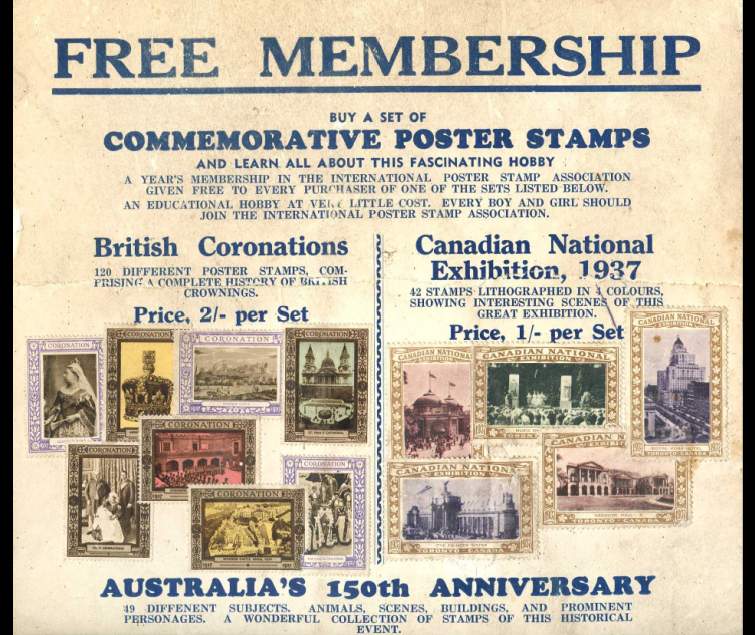 |
|
Send note to Staff
|
|
|
Valued Member
United Kingdom
81 Posts |
|
|
Rod, that is very interesting. The printer for those Coronation stamps and the Australia set was Parkshaw Publishing Co, London - not Posterstamps Ltd, London. The 1937 Coronation stamps illustrated on the item are part of the set of 60 that were issued (folded) in a small brown envelope - this is the version of the envelope overprinted 25c for sale in North America:  I had thought that The International Poster Stamp Association and The British Poster Stamp Association were the same organisation or were connected, now I am not sure so perhaps they were competitors. I will have to research further and maybe start another thread where these things can be repeated. Chris Wren |
|
Send note to Staff
|
|
|
Bedrock Of The Community
Australia
38679 Posts |
|
|
Indeed,
I am getting the feeling around 1936
some people were trying to promote the then
popular collecting habit, by introducing new
and collectible labels.
Cigarette cards had taken off and people were also collecting
monograms and seals, and I think this venture was a
further attemp to make money.
BTW my placard has the original stamps gummed
there, that is not a printed image.
I am faced with whether to soak them off or not,
the placard is just bog standard cardboard.
|
|
Send note to Staff
|
|
|
Valued Member
United Kingdom
81 Posts |
|
|
I agree with what you say about collecting in general and that these Associations and the printing companies who probably set them up were trying to expand the market by making their products accessible and to actively promote collection. The mid to late 1930s does seem to have been the time when these two (presumably rival) printing companies were most active. The war intervened (even normal British stamps were affected; this was the time when paler stamp colours were introduced, to save on ink) so non essential things like poster stamps would likely have been an early casualty. I would definitely not soak the stamps off the placard. I have never seen this item before and I think it likely to be very rare - I would love to find one! The Coronation stamps are readily available from about $25 or so a set on ebay (although you do see some people offering them in singles or part sheets at high prices). I have several sets, with a selection of envelope variations. The others are not so easy to get but they do turn up. There is also the matter that the sets on the placard are not complete anyway so you would end up with just some odd singles, lacking their gum. Could you possibly scan and post the other half of the placard as I would love to see it? Chris Wren |
|
Send note to Staff
|
|
|
Pillar Of The Community
United States
1947 Posts |
|
|
Bedrock Of The Community
Australia
38679 Posts |
|
|
Chris: subject to your advice I'll leave alone and store in arch plastic. I am not an expert on ebay rohumpy, but try perhaps things like "coronation poster stamps" "Australia poster stamps" etc. Good Luck. 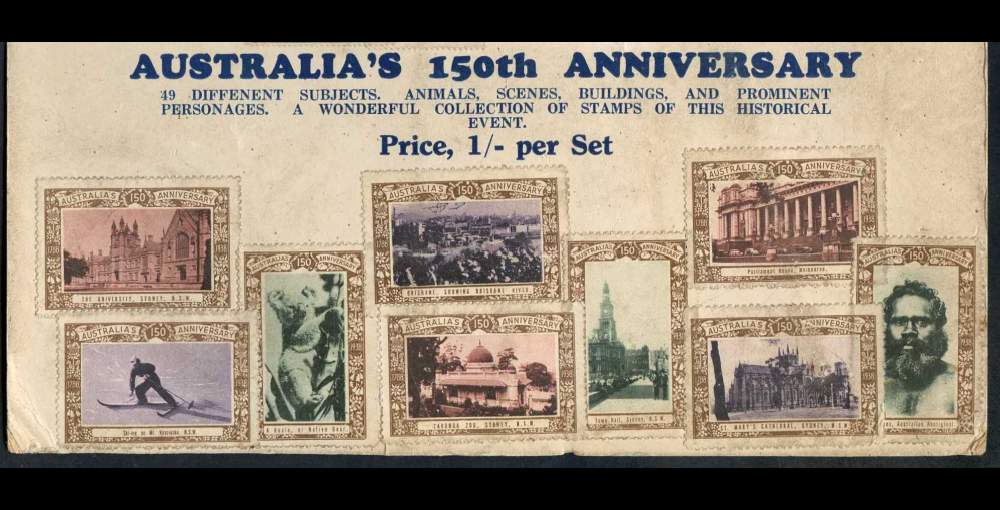 Reverse:  |
|
Send note to Staff
|
| Edited by rod222 - 03/04/2011 05:57 am |
|
|
Valued Member
United Kingdom
81 Posts |
|
|
Searching on ebay is often more an art than a science! So much depends on the wording that a seller uses and the section he lists the item within and normal logic often flies out of the window. For example, there is a section within stamps specifically for cinderellas but a seller may not list his offering within this heading so you need to be a lot more devious in your searches and try to use terms that a seller could possibly have used so similes are necessary. Professional sellers usually are pretty comprehensive and will list in several different sections to try to reach the maximum number of potential bidders. Private sellers on the other hand often have no idea how to describe or list what they are offering so these can be hidden away in obscure corners. Many cinderellas are listed in headings completly outside the stamps section - maybe under the event name or the printer name or something else. I have about 50 different search patterns that I regularly use and I use them on google and other search engines too to find other sales outlets, from dealers to auctions to stamp clubs or whatever - it is how I found this forum! Chris Wren |
|
Send note to Staff
|
|
|
Valued Member
United Kingdom
81 Posts |
|
|
Many thanks Rod for the rest of the placard - it is a lovely thing and I do envy it! |
|
Send note to Staff
|
|
|
New Member
United Kingdom
1 Posts |
|
|
Hi, following on from the original post I have recently been given my great uncle's stamp album, which in the main contains general issue British Commonwealth stamps up to early 1960's. One page however may be of interest to this thread. It has a set of the first series RNLI stamps as singles but in various colours. comparing them to the miniature sheet in your post the colours (from top left to bottom right of the miniature sheet are; Turquoise, Green, Purple, Red, Black, Brown, Maroon, Dark Blue.
This may suggest that the miniature sheets exist in other colours apart from Turquoise and Purple. If anyone would like me to post an image of these stamps please let me know. Regards |
|
Send note to Staff
|
|
|
Pillar Of The Community
United States
1510 Posts |
|
|
British Royal National Lifeboat Institute
The Royal National Lifeboat Institution (RNLI) is a charity that saves lives at sea around the coasts of Great Britain, Ireland, the Channel Islands and the Isle of Man, as well as on selected inland waterways.
The RNLI was founded on 4 March 1824 as the National Institution for the Preservation of Life from Shipwreck, with Royal Patronage from King George IV of Great Britain and Ireland. It was given the prefix 'Royal' and its current name in 1854 by Queen Victoria of Great Britain and Ireland. It has official charity status in both the United Kingdom and the Republic of Ireland.
The RNLI operates 444 lifeboats (332 are on station, 112 are in the relief fleet), from 235 lifeboat stations around the coasts of Great Britain, Ireland, the Isle of Man and the Channel Islands. The RNLI's lifeboats rescued an average of 22 people a day in 2009. RNLI lifeboats launched 9,223 times in 2009, rescuing 8,235 people. The RNLI's lifeboat crews and lifeguards have saved more than 139,000 lives since 1824. RNLI lifeguards placed on selected beaches around England and Wales, aided 15,957 people in 2009. The RNLI Operations department defines 'rescues' and 'lives saved' differently.
In 2009, the RNLI Lifeguards service was expanded to cover more than 140 beaches. RNLI lifeguards are paid by the appropriate town or city council, while the RNLI provides their equipment and training. In contrast, most lifeboat crew members are unpaid volunteers. The RNLI is funded by voluntary donations and legacies (together with tax reclaims), and has an annual budget of £147.7 million (€168 million).
There are other Lifeboat Services that are independent of the RNLI, available to the coastguards that provide lifesaving lifeboats and lifeboat crews 24 hours a day all year round.
Sir William Hillary came to live on the Isle of Man in 1808. Being aware of the treacherous nature of the Irish Sea, with many ships being wrecked around the Manx coast, he drew up plans for a national lifeboat service manned by trained crews. Initially he received little response from the Admiralty. However, on appealing to the more philanthropic members of London society, the plans were adopted and, with the help of two Members of Parliament (Thomas Wilson and George Hibbert), the National Institution for the Preservation of Life from Shipwreck was founded in 1824.
Thirty years later the title changed to the Royal National Lifeboat Institution and the first of the new lifeboats to be built was stationed at Douglas in recognition of the work of Sir William.
At the age of 60, Sir William took part in the rescue, in 1830, of the packet St George, which had foundered on Conister Rock at the entrance to Douglas Harbors. He commanded the lifeboat and was washed overboard with others of the lifeboat crew, yet finally everyone aboard the St George was rescued with no loss of life. It was this incident which prompted Sir William to set up a scheme to build The Tower of Refuge on Conister Rock - a project completed in 1832 which stands to this day at the entrance to Douglas Harbor.
In its first year, the RNLI added 13 boats to the existing 39 independent lifeboats. By 1908 there were 280 RNLI lifeboats and 17 independents.
|
|
Send note to Staff
|
|
|
Pillar Of The Community
United Kingdom
1187 Posts |
|
|
In 2013 The Royal National Lifeboat Institute Volunteer Lifeboat Crews
launched 8,304 times, often in perilous seas
rescued 8,384 people
saved 325 lives that would otherwise have been lost
And the RNLI Volunteer Lifeguards
attended 19,594 incidents
rescued 1,567 people
saved 100 lives that would otherwise have been lost
All at no cost to the taxpayer.
Wonderful men and women all.
Terry |
|
Send note to Staff
|
| Edited by Terence Collins - 02/01/2014 6:17 pm |
|
| |
Replies: 15 / Views: 6,775 |
|



 Posted 03/03/2011 11:55 am


