In the late 1880s, the German East Africa Company was facing a persistent threat from Arab tribes who opposed the presence of Europeans in their territories. In an effort to quell the insurrections, the Company reached out to the German government for assistance. In response, Germany sent forces under Imperial Commissioner Hauptmann Hermann von Wissmann to not only quell the uprising, but to establish a full-fledged German colony in East Africa. By 1891, he had done just that.
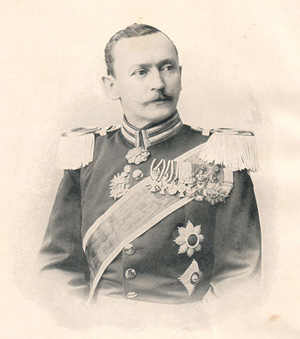
Hermann von Wissmann
Upon establishment of the colony, the Imperial Government faced the question of how to institute mail service. The colony was vast, sparsely populated, and still hostile.
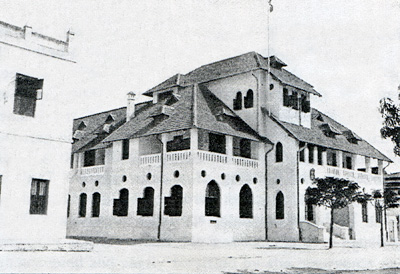
German post office in Dar-es-Salaam
So, the government resorted to private measures and contracted with Schülke & Mayr, a German firm with commercial interests in the colony, to provide mail service. Under the terms of the contract, Schülke & Mayr would provide, for a period of one year, monthly service from Dar-es-Salaam to the military stations of Muansa and Bukoba on Lake Victoria, via Kilossa-Mpapua-Tabora.
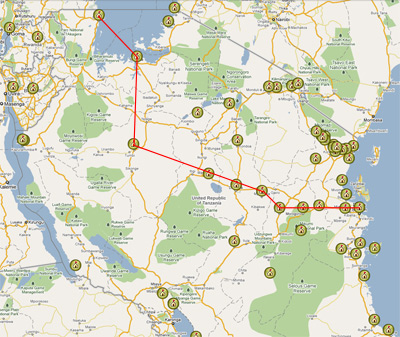
Link to Google Map of German Post Offices in Deutsch-Ostafrika
(Daressalaam-Kilossa-Mpapua-Tabora-Muansa-Bukoba shown in red)
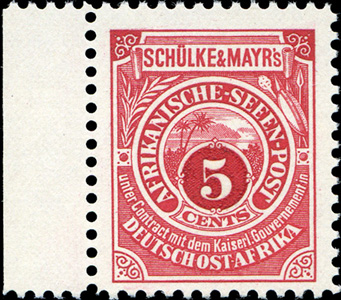
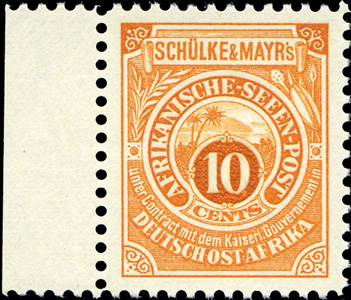
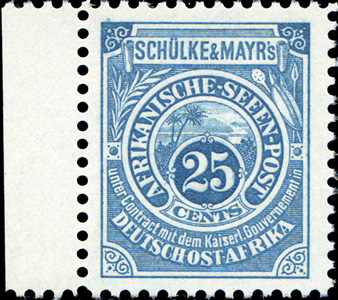
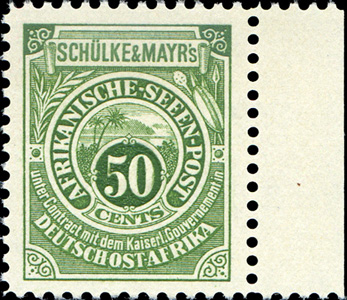
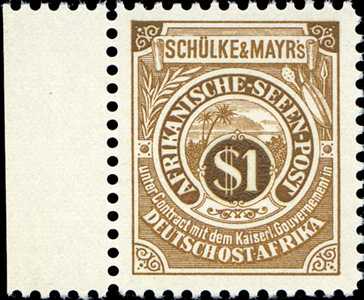
Five stamps were printed in 1892 for use with the Schülke & Mayr service. They are inscribed "Schülke & Mayr's Afrikanische-Seeenpost unter Contract mit dem Kaiserl. Gouvernement in Deutsch-Ost-Afrika" (Schülke & Mayr's African Lake Post under contract with the Imperial Government in German East Africa). They were printed by Giesecke & Devrient in Leipzig in sheets of 25. Each features a colored burelage and line 11 1/2 perf.
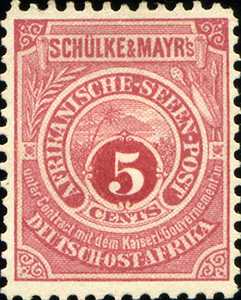
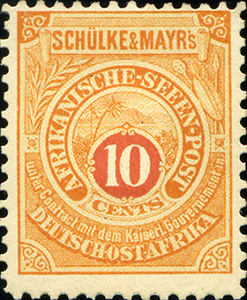
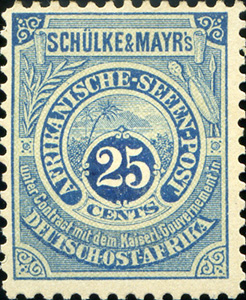
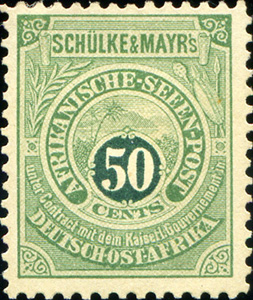
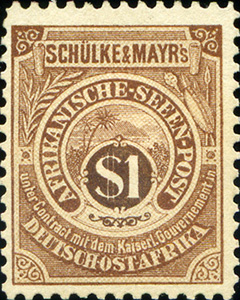
Before the stamps could be introduced into service, however, the one-year contract ran its term. The Imperial Government declined to renew the contract, citing unreliable service and frequent losses of mail caused by the difficulties of the route. Reliable mail service to the interior would have to wait a few years...
In 1939, to commemorate the 50th anniversary of the Schülke & Mayr company, private reprints of the Schülke & Mayr Issues were produced. The 3,000 sets of reprints were printed
by the same firm, Giesecke & Devrient, with the original plates [
see correction below], in the original colors. They can be differentiated from the originals by the lack of burelage, line 10 3/4 perf, and copper-plate printing as opposed to lithography.
And BTW, Schülke & Mayr is still in business today. They're a chemical company specializing in preservation and industrial hygiene.
*** Moved by Staff to a more appropriate forum. ***





 Posted 05/15/2011 09:26 am


