Another surprise in my mailbox today. The second set of #321;ód#378; Ghetto stamps.
After capturing Poland in 1939, Germany began relocating Polish Jews to centralized collection points. One of the first was in the town of #321;ód#378; (Litzmannstadt in German). The Ghetto was soon transformed into a major industrial center, causing the German authorities to change plans and keep the Ghetto open.
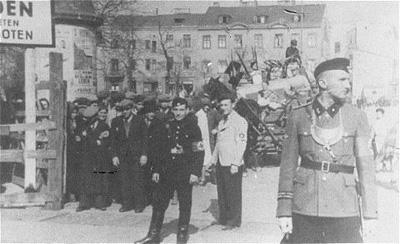 Entrance to the #321;ód#378; Ghetto
In February 1940, the local post office stopped delivering mail to the Ghetto. The Jewish mail (Judenpost) was then delivered to a single building, where it was sorted and then picked up personally by the addressee.
In early/mid-1940, the German postal authorities and the appointed Jewish administrator of the Ghetto, Chaim Rumkowski, reached an agreement allowing for mail service within the Ghetto. By December 1940 the mail department in the ghetto employed 62 clerks, 50 letter carriers, and 27 messengers.
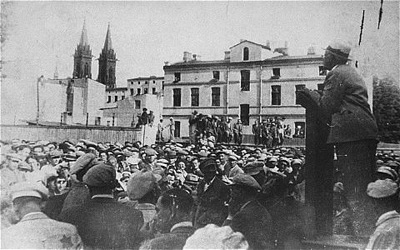 Rumkowski speaking to the Ghetto inhabitants
In March 1944, the Ghetto administration issued two sets of stamps for use on Ghetto mail. The first set is the rarer of the two. The second set features Rumkowski and the symbols of the labor guilds active in the Ghetto.
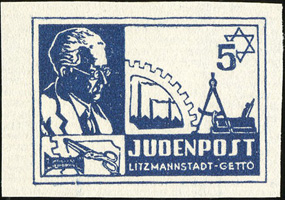
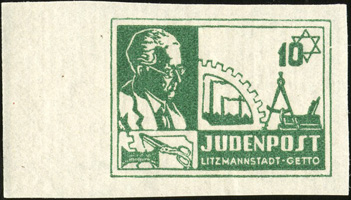
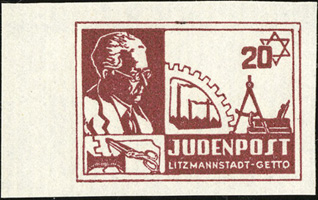
The stamps were not in circulation for long. In the summer of 1944, the Ghetto was liquidated, with only 10,000 of its 200,000 inhabitants surviving the war. Most copies in existence today are believed to have bought by Germans who saw their value as post-war collectibles.





 Posted 06/25/2011 5:54 pm


