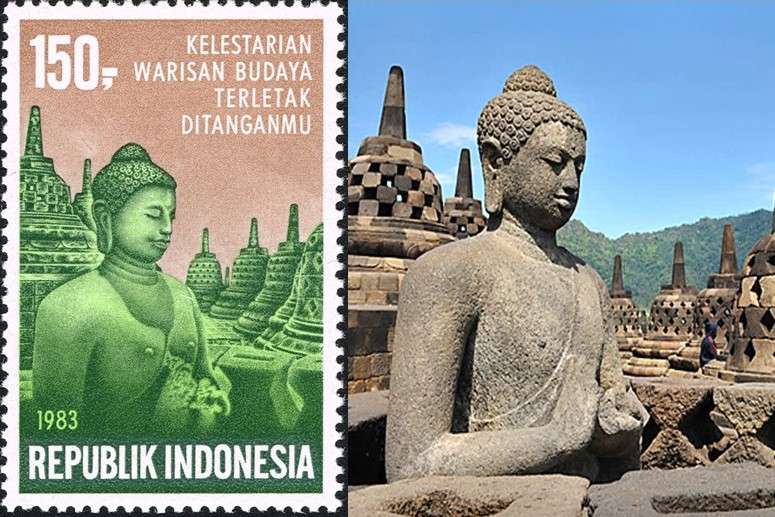
Indonesia Borobudur Temple February 23, 1983 Borobudur is a 9th Century Mahayana Buddhist temple in Magelang, Central Java, Indonesia. It is the largest Buddhist temple, as well as one of the greatest Buddhist monuments, in the world. The monument consists of nine stacked platforms topped by a central dome. The temple is decorated with 2,672 relief panels and 504 Buddha statues. The central dome is surrounded by 72 Buddha statues, each seated inside a perforated stupa. The cross-legged Buddha statues seated in a lotus position, shown in the stamp, are distributed on the five square platforms and on the top platform.
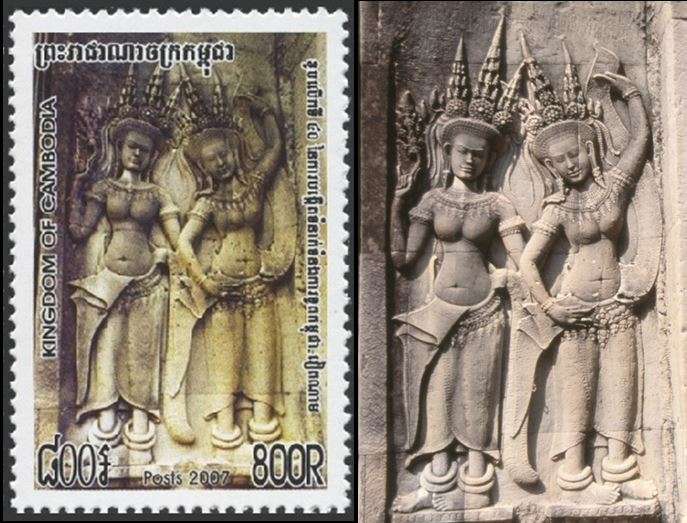
Cambodia The 40th Anniversary of Diplomatic Relations with Vietnam June 24, 2007 The design features stone relief statues of Apsara dancers from Angkor Wat, a Buddhist temple complex built in the 12th Century.
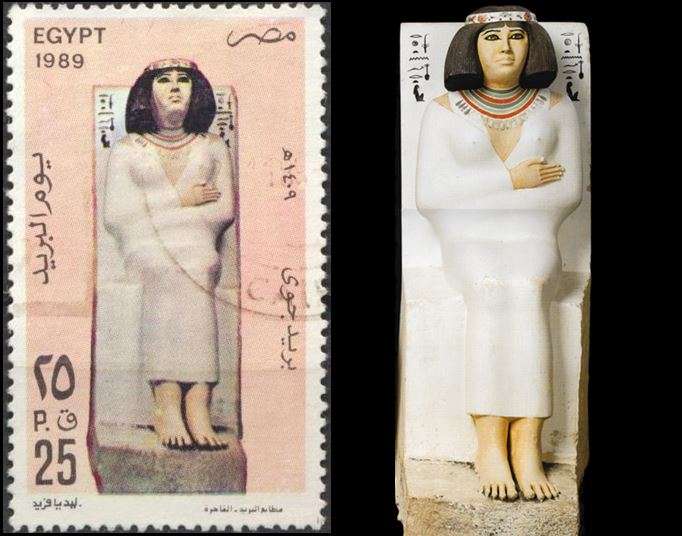
Egypt Nofret Statue January 2, 1989 Nofret statue is a painted limestone statue now on display in the Cairo Museum. The 120 cm-high statue from ca. 2600 B.C. was discovered in the mastaba of Rahotep, Maydum.
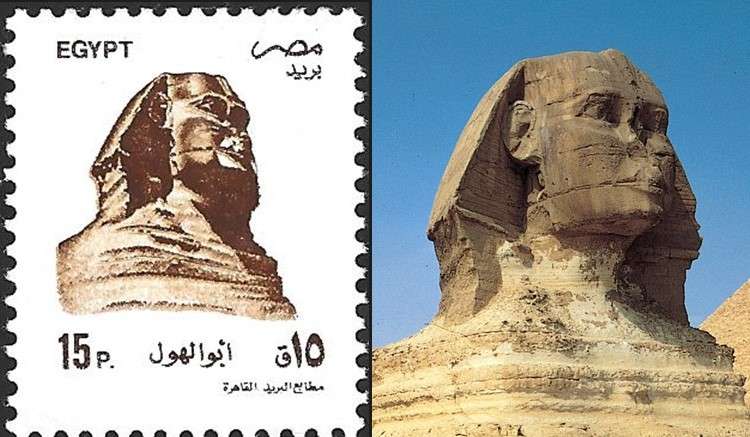
Egypt Definitive Issue February 1, 1993 The Great Sphinx of Giza (ca. 2550 B.C.) is a limestone statue of a reclining sphinx that stands on the Giza Plateau. The face of the Sphinx is generally believed to represent the face of the Pharaoh Khafra. It measures 73 m long, 20.2 m high from the base to top of the head, and 9 m wide at its rear haunches.
The Trung sisters (Trung Trac and Trung Nhi, c. 12- c.43 AD) were Vietnamese military leaders who ruled for three years after leading a rebellion in 40 AD against the first Chinese domination of Vietnam; they are regarded as national heroines of Vietnam. Here is an image of an engraved stamp depicting three women and the 1962 Trung sisters monument in Saigon, topped with a statue sculpted by Nguyen Van The, and issued by (South) Vietnam on March 1, 1963 as one of a set of four similar stamps for Women's Day, Scott No. 203, plus images of the monument and statue.
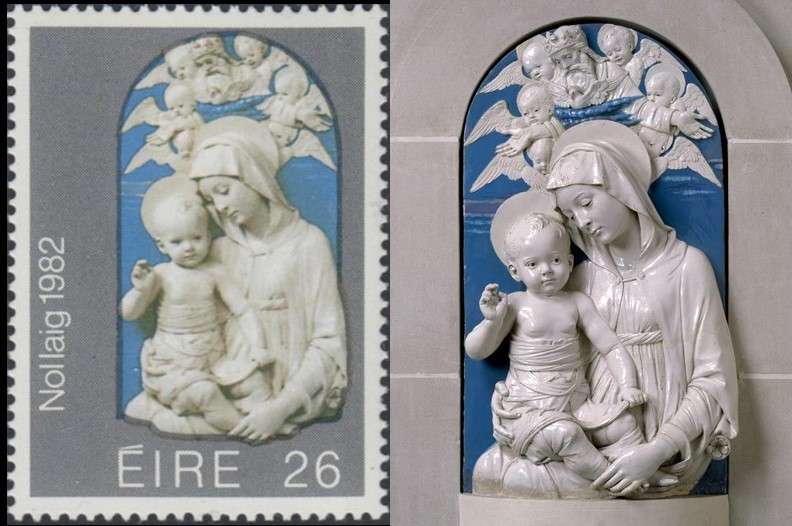
Ireland Christmas November 11, 1982 The design features a glazed terracotta statue Virgin and Child (94.9 x 54.9 cm) by Andrea della Robbia (Italian, 1435–1525).
The Vredesmonument (Peace Monument) in Vereeniging was designed by South African artist Coert Steynberg (1905-1982), and dedicated in 1961 to honor all who fought and all who died during the Anglo-Boer War (1899-1902). It is in the form of a fatally wounded farmer soldier, sculpted in granite; from the dagger in the soldier's heart rises the spirit of hope, faith and power, in stainless steel. Here is an image of a stamp featuring cameo profiles of Boer political leaders Martinus Steyn (1857-1916) and Paul Kruger (1825-1904), and depicting the monument, printed by photogravure, and issued by South Africa on May 31, 1971 as one of a set of two stamps commemorating the 10th anniversary of the Republic of South Africa, Scott No. 367, plus a photo of the Peace Monument.
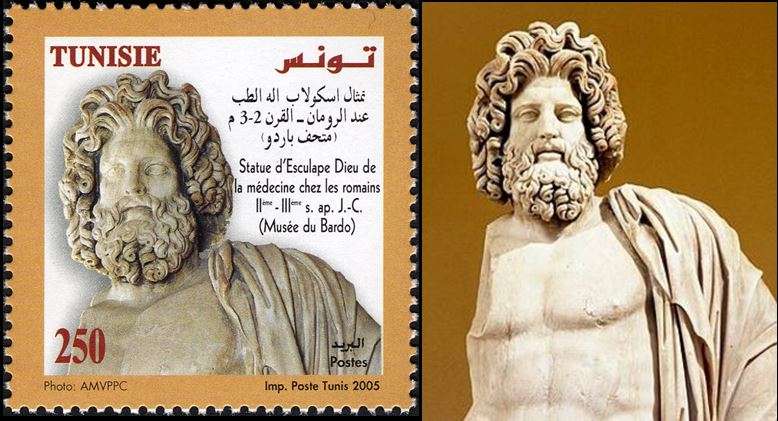
Tunisia Sculptures from the Punic and Roman eras May 18, 2005 The stamp features a 2nd Century Roman marble statue of Asclepius, the Greek god of medicine. The statue was uncovered in Bulla Regia and is a collection of Musée National Du Bardo, Tunis.
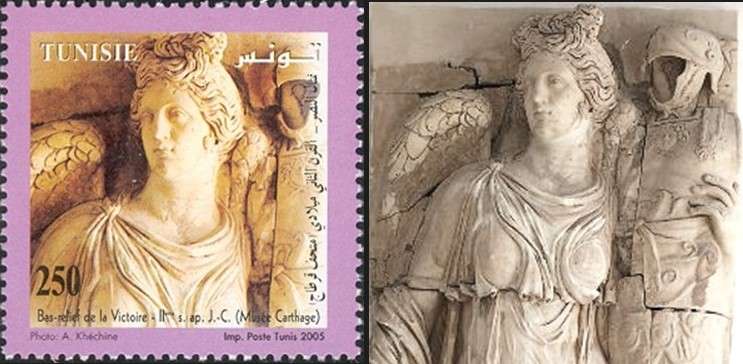
Tunisia Sculptures from the Punic and Roman eras May 18, 2005 The stamp features the Grand Relief of the Victory, one of the 2nd Century Roman statues probably to honor Emperor Marcus Aurelius. The life-size statue is a collection of the Carthage National Museum in Tunis.
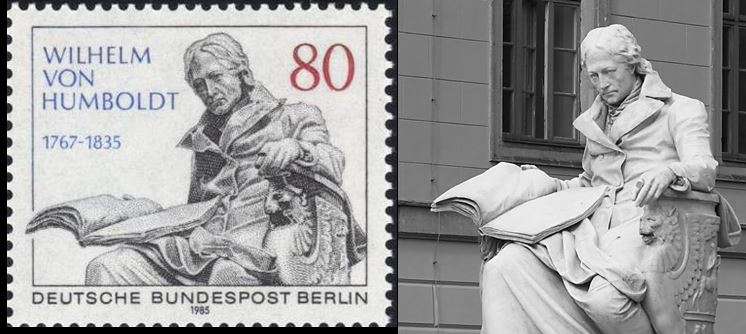
Berlin (Germany) The 150th Anniversary of the Death of Baron Wilhelm von Humboldt February 21, 1985 Friedrich Wilhelm Christian Karl Ferdinand von Humboldt (1767 – 1835) was a Prussian philosopher, diplomat, and founder of the Humboldt University of Berlin. He made important contributions to the philosophy of language and to the theory and practice of education. The stamp design features the statue of Wilhelm von Humboldt by Martin Paul Otto is located at Humboldt University of Berlin in Berlin-Mitte.
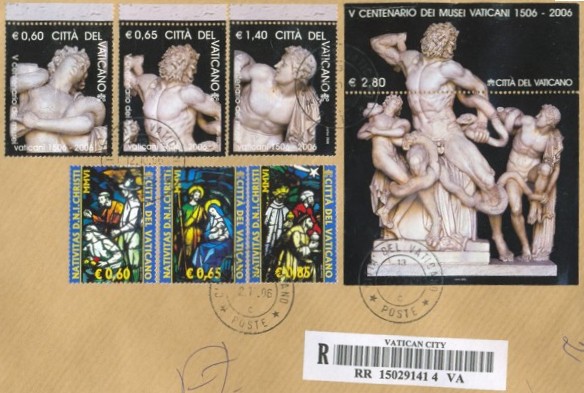
On October 12, 2006, the Vatican issued a set to commemorate the V Centenary of the Vatican Museums, composed of three stamps 0.60; 0.65 and 1.40 euros and a souvenir shet (2.80 euros)
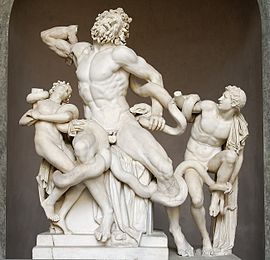
The reason chosen to represent in the set is the sculptural group of the , considered the work that led to the Vatican Museums. On 14 January 1506 the Laocoon was discovered in a settlement near the Baths of Titus in Rome vineyard.
The sculpture represents the Trojan priest Laocoon and his two sons. Narrates the scene, which also account Virgil in the Aeneid, which develops the trip that the Trojan Aeneas launched after the destruction of the city of Troy, which together with the legend of Romulus and Remus are the two legends of the founding of the city Rome. The Trojan War was told by Homer in the Iliad. Laocoon scene related to the famous scene of the Trojan Horse. Laocoon was a Trojan priest who try to avoid the wooden horse entered the besieged city, the gods as punishment sent two sea serpents to murder the priest and his two sons. Time is chosen to represent in the sculpture, which highlights the priest's face, where the pain is physical and psychological plasma produced by contemplating death of his two sons unavoidably.
Disclaimer: While a tremendous amount of effort goes into ensuring the accuracy of the information contained in this site, Stamp Community assumes no liability for errors. Copyright 2005 - 2026 Stamp Community Family - All rights reserved worldwide. Use of any images or content on this website without prior written permission of Stamp Community or the original lender is strictly prohibited. Privacy Policy / Terms of UseAdvertise Here





 Posted 08/25/2016 7:49 pm