| Author |
 Replies: 39 / Views: 12,783 Replies: 39 / Views: 12,783 |
|
|
|
Pillar Of The Community
United States
3300 Posts |
|
|
Pillar Of The Community
United States
2555 Posts |
|
|
Posting a decent image for a half million dollar stamp should be a given, so don't let me discourage you from doing that. However, my opinion is that you have an E grill stamp or perhaps it is an F grill. There is also some chance that extra grill points have been fradulently added to an F grill to fake a Z grill. The problem is the grill does not have the right characteristics, even if it appears to have the proper number of columns and rows. |
Send note to Staff 
|
| Edited by sinclair2010 - 12/26/2018 1:02 pm |
|
|
Valued Member
Spain
93 Posts |
|
|
Sorry for the quality of my picture, but really I dont know how to do better. I have good camera but I dont know how to use. When you have the stamp down the magnifying glass, the direction of the points are right and the number of them is right, that I cant tell you if the points are genuine or fraudulent. But ill try to make a better picture. |
|
Send note to Staff
|
|
|
Pillar Of The Community
673 Posts |
|
|
Astrakov,
One thing I recommend when working with a stamp ID is, rather than trying to prove what it is, try to prove instead, what it is not. Then the ONLY thing left will be what it is.
First thing in this case, you need to get serious with your magnification (not just the photo), but the actual item. A 15x loop is great, but when it comes to detecting alterations, particularly grills, I utilize a 50x to 200x USB microscope which allows me to take great images for clarity of analyzing what it's appearance is.
First step you should make on this ID is the graphite test.
Take a graphite pencil, run it in circles on a piece of clean paper until a powder forms (2 - 3 minutes). Dip the tip of your little finger into the power, then rub it lightly across the surface of the grill points. This will help enhance the points visibility without altering your stamp, or causing any permanent issue (can be taken off later with a light eraser).
The clear shape of the points will then be visible, as well as where any "alterations" my be visible.
Also place them under a reasonable power microscope to look very closely at the formation of each point. Are they all uniform? Is there any anomaly, particularly in direction of points or how the points are formed (especially on outside rows, versus inside rows).
To me both the bottom row and the right row look extremely suspect. But the image isn't sharp enough to determine. Add the graphite, put it under a microscope and see if it still withstands the test of a Z grill.
|
|
Send note to Staff
|
|
|
Pillar Of The Community
1375 Posts |
|
|
Just take a normal photo (maybe macro) of the stamp on the desk, best with a little oblique light coming from the side. Then you can cut the photo so that we only see the stamp. Important is just that the photo is sharp.
Graphite is not recommended by all collectors or experts. I don't use it.
|
|
Send note to Staff
|
|
|
Pillar Of The Community
United States
2555 Posts |
|
|
With all due respect to ClassicPhilatelist. Advising an obvious novice to use is graphite is a mistake. I have many and have seen many stamps ruined by clumsy attempts to do what he is suggesting. In fact, I wish the practice would come to an end altogether, regardless of experience level. We should teach and practice to first, do no harm.
The stamp has almost zero chance of being a #85D, not because they are rare but because the grill doesn't look like a Z grill. Defiling it with graphite would be foolish and unnecessary. Better Mr. Asrakov to learn some basics first... |
|
Send note to Staff
|
|
|
Pillar Of The Community
United States
2555 Posts |
|
|
Oblique lighting works well but I don't like the light coming in from the side or from the top exclusively. My preference (at least for counting purposes) is to have the light intersect the grill rows and columns at a 45 degree angle. |
|
Send note to Staff
|
|
|
Pillar Of The Community
1375 Posts |
|
|
Yes, that is true. I just meant "side" as "not from the top". I rotate the stamp normally while having a very small light source being on the desk. |
|
Send note to Staff
|
| Edited by stamperix - 12/27/2018 11:51 am |
|
|
Valued Member
Spain
93 Posts |
|
|
The answer of ClassicPhilatelist is really interesting for me, I think is a good way to identifu a stamp. About the picture, ill bring to the pictures shop of a member of my collector club to take a macro picture, and ill try to upload it next days. Thanks everybody for your answers. About Graphite, I listened to talk about it, and I saw how to use, im not a new collector I started more than 30 years ago to collect, and I had others grills from other countries like Peru, I had USA essays Z.grill and others. We will talk next days. Thanks again to everybody
|
|
Send note to Staff
|
|
|
Moderator

United States
12330 Posts |
|
|
The post immediately before your's had a link to Stamp Smarter which described the same technique. Have you explored the this link or done other discovery on grills? Don 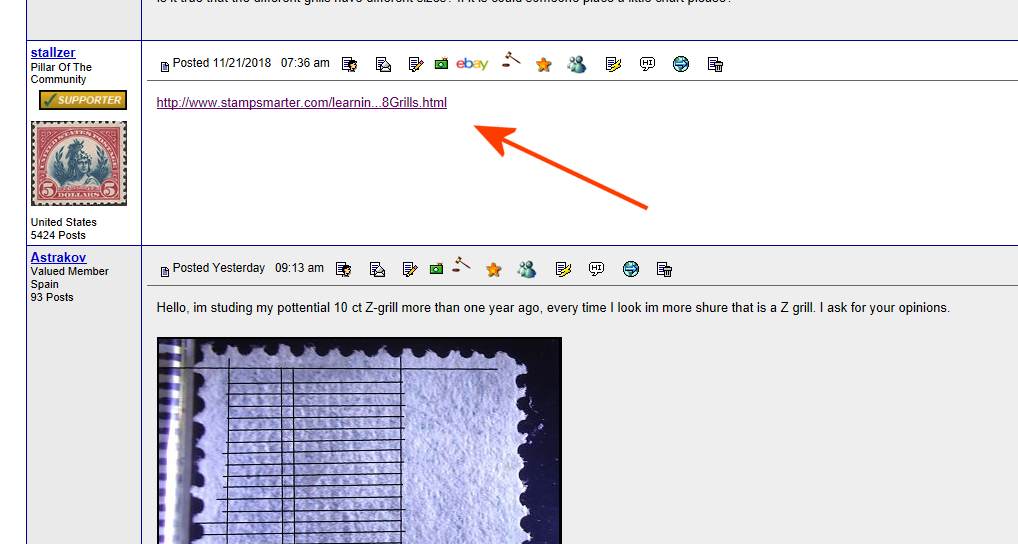 The very first image in this thread illustrates how NOT to apply graphite (as pointed out by sinclair2010's post). Graphite is difficult (at best) to remove, many stamps have been ruined by someone trying to erase the graphite. |
|
Send note to Staff
|
|
|
Rest in Peace
7742 Posts |
|
|
Pillar Of The Community
673 Posts |
|
|
Astrakov,
Sinclair2010's comment is really important as well. It is true, the graphite test is an advanced technique, and the idea here is to apply as little as possible to enhance the visibility of the grill. Don't make it black. Use a VERY light touch if you decide to attempt this approach. No need to press hard or rub it into the fibers. Just glide over it with very thin amount of dust on your finger. It's up to you if you decide, but don't go overboard. If it doesn't seem to improve with just a little bit, then stop. Don't keep adding in the hope it will become clearer the more graphite present.
The strong magnification will tell us more. Focus on the bottom 2 - 3 rows and left 2-3 rows, as those look most suspicious to me.
|
|
Send note to Staff
|
|
|
Pillar Of The Community
673 Posts |
|
|
Astrakov,
One more thought on the graphite test, if you decide to try it... don't try it first on this stamp. If you have another low-value F-Grill like a 94 or a 93, try it there first. Get comfortable and understand it before trying on a potentially high value stamp. You can also practice it on textured non-stamp paper to get the feel for how much to press down, how much graphite on your finger is enough, etc.
Only once you get the right feel down, then you might try it with this one.
|
|
Send note to Staff
|
|
|
Pillar Of The Community
6363 Posts |
|
|
Quote:
the graphite test is an advanced technique, Or better yet, the graphite test is absolutely the LAST resort to be tried only after visual examination, scanning with skewed exposure, side-lighting, etc. I avoid it. |
|
Send note to Staff
|
|
|
Pillar Of The Community
673 Posts |
|
|
John,
Do agree with you there. It's only to enhance the visibility, not a starting point.
|
|
Send note to Staff
|
|
|
Replies: 39 / Views: 12,783 |
|




 Posted 12/26/2018 09:58 am


