| Author |
 Replies: 1,052 / Views: 231,773 Replies: 1,052 / Views: 231,773 |
|
|
|
Valued Member
283 Posts |
|
|
Pillar Of The Community
Israel
6191 Posts |
|
|
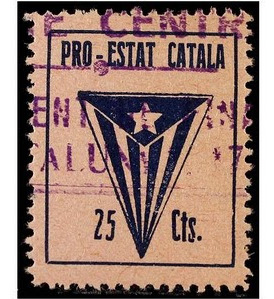
Devine !  That last one is just made for my 'Flags on Cinderellas' collection ! More items to search for !  |
Send note to Staff 
|
|
|
Pillar Of The Community
2343 Posts |
|
|
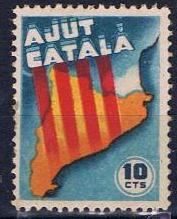
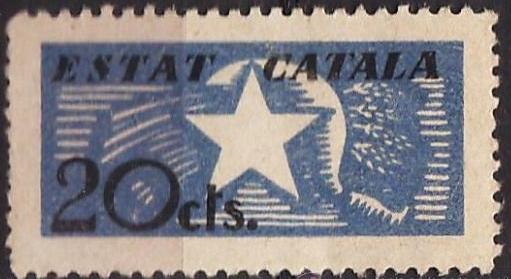
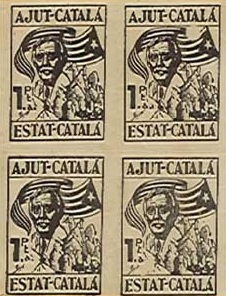
Thank you vey much Rod and Mike (LB1) for your comments. I think that SCF is just the place for a thread like this, that should be inthinkable elsewhere. As for the cindis shown by Malamute, jut to say that Estat Català or Catalonia's Free State was and independentist party, founded by Francesc Macià (Vilanova I la Geltrú, 1859 - Barcelona, 1933). Macià is an interesting person, as he from being colonel of the Spanish army in 1908 became Catalan miltary insurgent against Spanish militar dictatorship, fighting for a Free Catalonia (1923-1929), President of the short-lived 2nd Catalan Republic (April, 14 to 17, 1931) and died as President of the Catalan Autonomous Government inside the (more or less federal) 2nd Spanish Republic. Under the flag, you can also see Montserrat Hills, a very peculiar mountain in Central Catalonia; which is considered Catalans' Holy Mountain. By the way, the Caribean island of Montserrat, takes its name from this mountain, as C. Columbus, who knew Catalonia very well (perhaps, he even was a Catalan) remembered Montserrat Hills when he first saw the island. 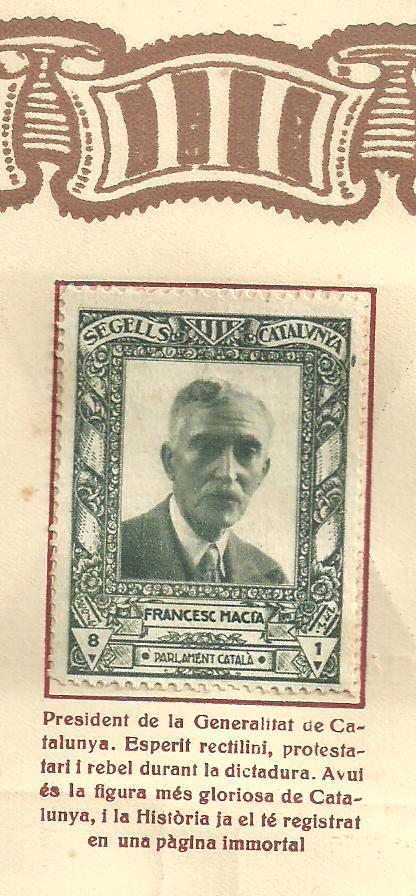 |
|
Send note to Staff
|
| Edited by Cursus - 09/05/2012 2:58 pm |
|
|
Pillar Of The Community
2343 Posts |
|
|
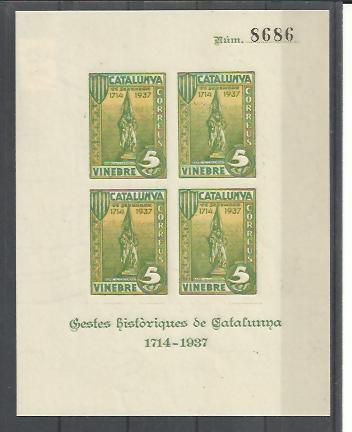
Cinderella, issued in Pi de Llobregat (today, Sant Joan Despí) in 1937 for Catalonia's National Day. It shows Barcelona's monument to Rafael Casanova (Moià, 1660 - Sant Boi de Llobregat, 1743). Major of Barcelona, he fell injured on our city walls while commanding the city militia who was fighting the Franco-Spanish invaders. That happened on September 11th 1714. We, still remember and honour him. 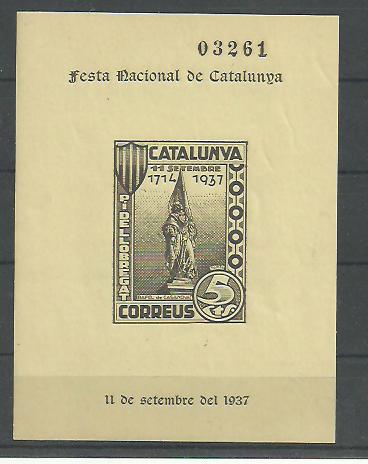 |
|
Send note to Staff
|
|
|
Pillar Of The Community
2343 Posts |
|
|
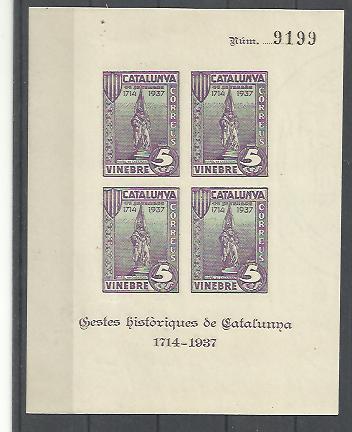
Vinebre (Sothern Catalonia) September 1937. Two cinderellas issued for Catalonia's National Day, showing Major Rafael Casanova monument in Barcelona. 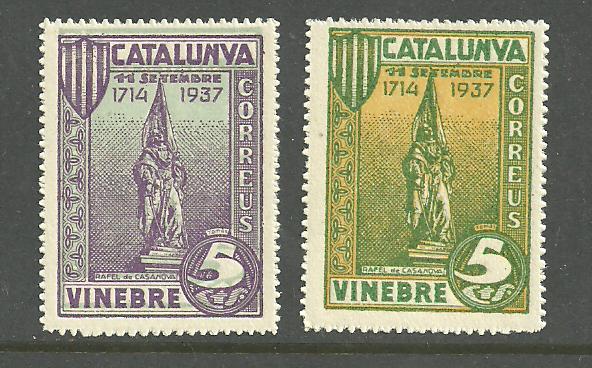 This monument, like many others in Barcelona, has a adventurous history. A very classical bronze work of 1888 by Rossend Novas, between this date and 1939 was placed in two Barcelona's locations. The last one, where Casanova is said to have fell injured on September 11th, 1714, while commanding Barcelona Guild's Militia. When, on January 1939, Franco's army occupied our city, orders were given to destroy the monument as it symbolizes Catalan struggle for freedom. Nevertheless civil servants following the orders of Barcelona's new major (fascist and a Franco's friend, but a son of the city, anyway)hided it behind a false wall on a city store, and were told "to forget about it". At Franco's dead, in 1975, everybody though that the monument was destroyed in 1939. But someone remembered the sad days of 1939 and the concealing of the monument. It was found and returned to its former place in 1977 to be honoured by Catalans every September 11th. |
|
Send note to Staff
|
|
|
Bedrock Of The Community
Australia
38679 Posts |
|
|
Nice story.
The Jade Buddha of Thailand shares a similar story I believe,
When besieged by the Burmese, it was hidden under a clay coating
for many centuries before being re discovered.
|
|
Send note to Staff
|
|
|
Pillar Of The Community
2343 Posts |
|
|
Pillar Of The Community
2343 Posts |
|
|
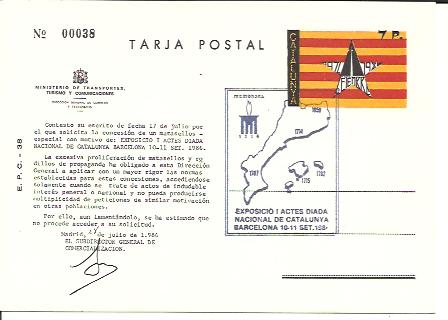
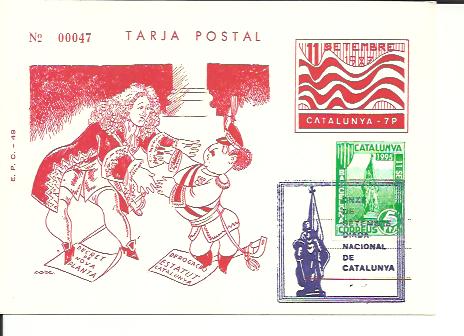
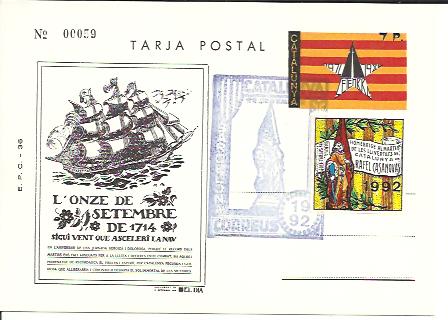
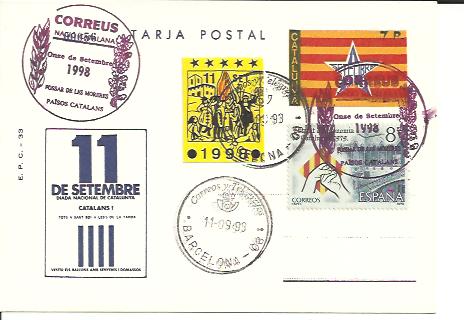
I don't know if this is something new here; but, so far I haven't seen "cinderella postcards", that is: postcards issued with a cinderella printed as stamp. This was the method chosen by a Catalan Nationalist organisation to divulge its activity on 1980's and 1990's Catalan National Days. I'll start by showing the ones issued in 1983 and 1986. On the last one, there's a well known (for us!) poem: "We don't beg for the right to live right, which is neither sold nor bought; a nation who deserves her freedom If she's not given it, she takes it" 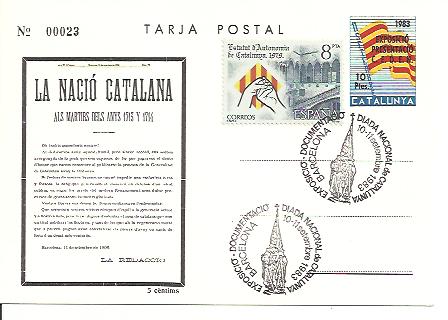 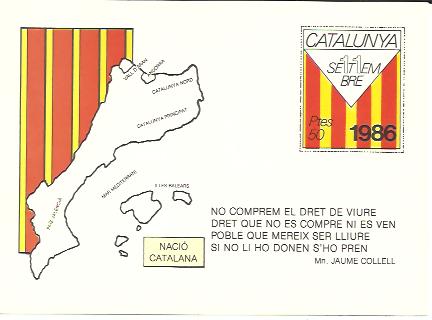 |
|
Send note to Staff
|
| Edited by Cursus - 09/09/2012 4:27 pm |
|
|
Pillar Of The Community
2343 Posts |
|
|
Pillar Of The Community
2343 Posts |
|
|
As today is Catalonia's National Day, I'll show tow cinderellas that show the spirit of this day for us. The first one, issued on September 1982, is a XIX century picture, showing Major Rafael Casanova, falling injured on Barcelona's walls while fighting Spanish invaders. 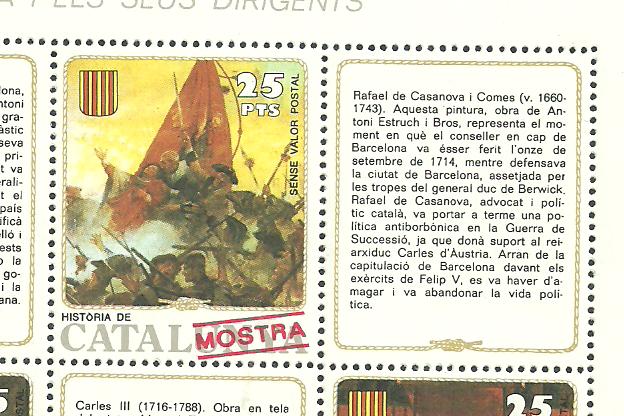 He was in command of the "Coronel·la", the Barcelona Guild's Militia, that was defending the city. Very much, like colonial militias that were to fight British on America's Independence War, sixty years later. A member of Barcelona's city militia can be seen on this cinderella issued in January 1983 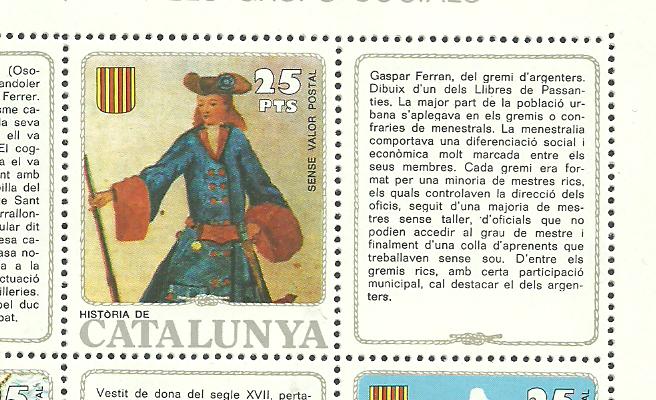 |
|
Send note to Staff
|
|
|
Pillar Of The Community
2343 Posts |
|
|
In 1956 the Petritxol street, in downtown Barcelona,issued these nice wood engraving cinderellas: It's a small (130 metres long and 3 metres wide) but very lively. Opened on the 14th century, all its remaining buildings date from the 18th and 19th ones (not so old for Barcelona's standards!) and it's one of the most typical streets of our city. On the cinderellas, issued in green, red and blue inks, there can be seen known (for us!) people that lived on the street along the centuries, as well as curiosities related to it. 1.- Alegory of the Plaça del Pi (Pine tree square) close to the street 2.- Virgin of La Mercè: One Barcelona's main devotions 3.- Santiago Rusiñol: Painter, journalist and writer 4.- Àngel Guimerà: writer 5.- Peius: writer 6.- Ramón Parés: Owner of the "Sala Parés" the first Barcelona's art gallery. 7.- Enric Clarasó: sculptor. 8.- Ramon Casas: painter 9.- Moratín: writer 10, 11 & 14.- Views of the street 12 & 13.- Songs related to the street All depicted people were Catalan, except for # 9 (Moratín), who was Spanish. The wood engraving was done by Ricard Vives I Sabaté (Reus, 1907 - Vilanova I la Geltrú, 1995). 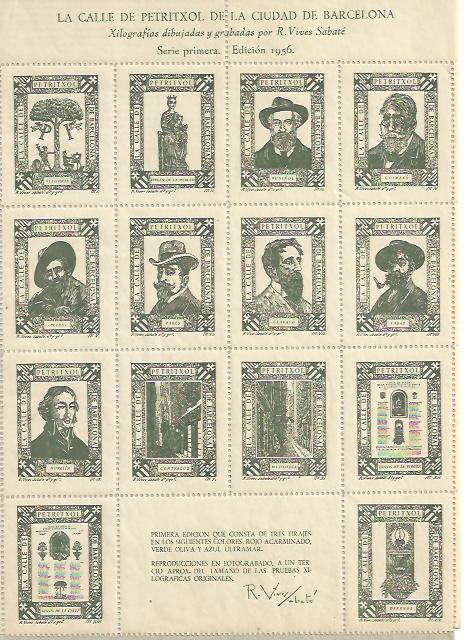 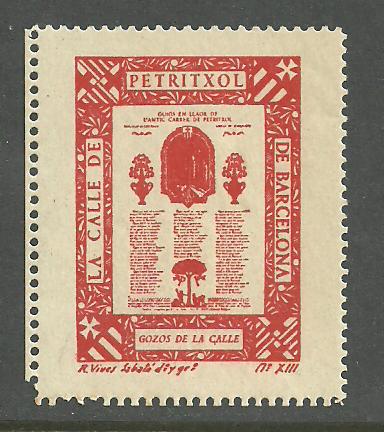 |
|
Send note to Staff
|
| Edited by Cursus - 09/15/2012 07:14 am |
|
|
Pillar Of The Community
Canada
6525 Posts |
|
|
Still a fascinating and very relevant thread. Thanks so much Cersus. I hope you don't mind my imposing a couple of newly found Spanish labels into your mix and asking for your imput. The first I believe translates as welfare service. Can you give me any more information? What is the symbol on the upper left corner? 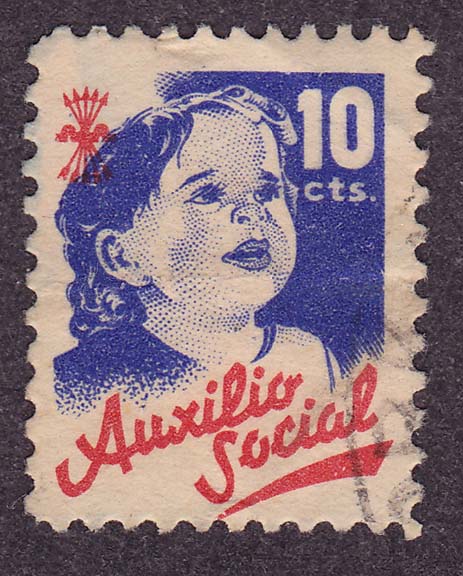 This esperanto label seems to have been cut from a cover. I only include it because you had shown some esperanto material earlier. 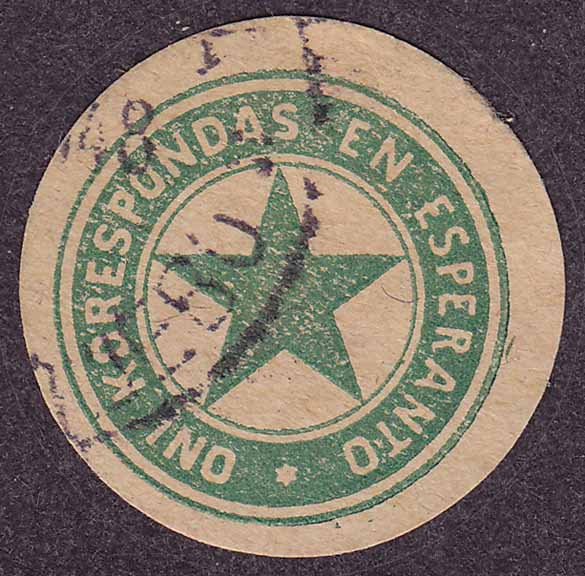 Thanks for any information you can give. |
|
Send note to Staff
|
|
|
Pillar Of The Community
2343 Posts |
|
|
Hi James!
Thank you very much for your, always welcomed, comments.
As for the cinderellas that you're showing, although the first one is Spanish, not Catalan (which are the subject of this thread), I can give you some information.
The round Esperanto label, is from the common type used in years 1920 to 1950. The postmark, seems to point a 1948 usage.
The first one is a 1940 decade welfare stamp issued by the Spanish fascist party "Falange Española y de las Jons", wich in 1936 raised with Franco against the democratic Spanish Republic. Its use was "voluntary", on the dictatorship understanding of the word. Falling on using it when "advised", could mean that the letter "was lost" or that you might be labeled as "unfriendly to the regime", which wouldn't be very good for your health...
The Falange symbol, which became that of the Spain 1939/1975 ruling party, is a yoke and 5 arrows. It comes from 15 century kings Ferdinand II of Catalonia and Isabel I of Castile. "Y" for "yoke" (in Spanish "yugo") comes from the old spelling of "Ysabel" (Elisabeth in English), while the arrows ("flechas" in Spanish), stand for king Ferdinand's initial.
Ferdinand and Isabel mariage in 1476 is considered by Spanish (in fact, Castilian!) nationalism as the symbol of the Spanish nationhood. This is actually false, as it was just a personal union, keeping all Iberian kingdoms (Catalonia, Castile, Aragon, València, Sicily, Naples) its statehood and constitutions.
In fact, Ferdinand was considered by Castilians a foreign king, who was asked to leave Castile after Isabel's death and that maried again (to Germana de Foix) to have heirs to keep his own kingdoms (Catalonia, Aragon, Valencia, Naples and Sicily) away from Castile. Sorrily, he had a son but he died very early. Otherwise, we had saved many problems.
This, Spanish nationalist don't tell... |
|
Send note to Staff
|
|
|
Valued Member
283 Posts |
|
|
No one can explain it better! Thankyou Cursus |
|
Send note to Staff
|
| Edited by malamute67 - 09/15/2012 12:26 am |
|
|
Pillar Of The Community
Canada
6525 Posts |
|
|
Brilliant Cursus, thankyou. Sorry to hijack your thread. Keep up the amazing work! |
|
Send note to Staff
|
|
|
Replies: 1,052 / Views: 231,773 |
|




 Posted 09/04/2012 3:37 pm