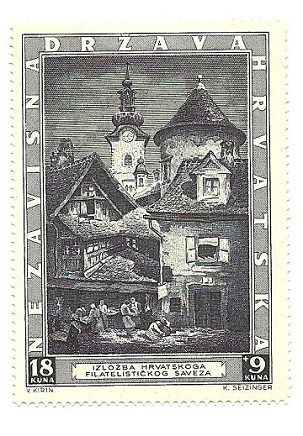
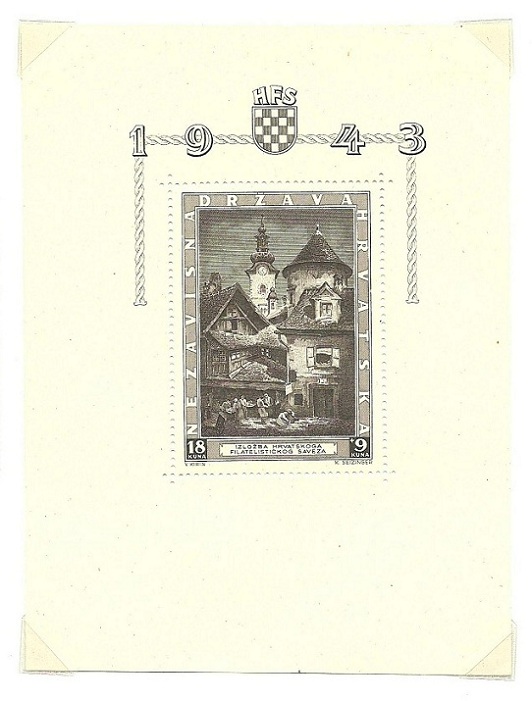
One of my favourite stamps.
I have to duck off to work, but here is a babelfish
translation I think I have of the stamp
I'll have to return to edit it
Artwork Vladimir Kirin IIRC
12/09/1943 - 3rd Philatelic Exposure - Zagreb The 3rd philatelic exposure of Zagreb
took place from the 12 to September 15, 1943. The overload was created on this
occasion for the benefit of the Croatian Philatelic Alliance which was the sponsor and
who supported the costs of them. The stamp as well as the block were sold only in one
special counter of the post office in the enclosure of the exposure. A part of the
original emission (440 000 specimens for the stamp, 118 000 for the block) was
reserved or sold before the Croatian or foreign merchants and with various philatelic
associations. 120 000 stamps were overloaded "Hrvatsko More" (Croatian sea) and
were sold in all the post offices of the country. The original plan of emission
envisaged the emission of this stamp from the 5 to September 12, 1943, but it was
deferred from the 12 to September 15, 1943 to agree with the capitulation of Italy and
the recovery of Dalmatie. This stamp, as well as the block were emitted at the time of
the 3rd philatelic exposure of Zagreb. It was drawn starting from an old painting by
Prof Vladimir Kirin, was engraved by Prof Karlo Seizinger and was printed in Vienna.
It represents the church Sainte Marie and the cloister of Cisterciens in Zagreb in 1650.
The Cisterciens order is a Roman catholic monastic order. It was founded in Cîteaux
(Coast-in Or), in Latin Cistercium, in 1098, by a group of monks Benedictines of the
abbey of Molesme under the direction of St Robert. The first cistercians wished to
return to a community which strictly followed the monastic rule definite by Benoît
saint towards 540. They adopted a strict asceticism, regarded the exercise of manual
work as an element of the monastic rule and rejected the feudal incomes. The
successor of St Robert, St Albéric, obtained from the pope Pascal II the recognition of
his kind in 1100. The charter of Charity, first constitution of the order cistercian, is
allotted to St Étienne Harding, the third abbot (English) of Cîteaux: all the houses of
the order were to follow the same rule and were visited each year by the abbot
founder! All the abbots cistercians were to find once at Cîteaux per annum. St Bernard
de Clairvaux, entered to the monastery of Cîteaux in 1112, became the first abbot of
Clairvaux in 1115. Theologist, mystic and the most influential preacher of his time, he
was the true person in charge for the rapid expansion of the order. With its death, in
1153, there existed more than 300 monasteries cistercians, including 168 founded
directly by Clairvaux. At the end of the Middle Ages, one counted more than 700
cistercians abbeys! The order had been spread in almost all Europe and the countries
of Raising. In XIIe century, which is regarded as their golden age, the cistercians
became the most influential order within the catholic Church, thus succeeding the
Benedictines of Cluny. They exerted episcopal functions and papal legates, and
occupied the majority of the post offices of the Roman curia (government of the
Church). They also contributed in a decisive way to the economic and agricultural
development of Europe of the Middle Ages, in particular by the production and the
marketing of cereals and wool. They also contributed to the rise of the Gothic
architecture through all Europe and devoted much time to gather and copy
manuscripts intended for their libraries. As the order of developed and thrived, the
cistercians gave up some their ascetic principles of the origins. The order then knew a
period of decline starting from XIIIe century, which was followed of a monastic and
spiritual revival to XVIIe. Most remarkable was the group of Our-injury of the Trap
door, rested by Armand de Rancé in 1664. These monks, generally called Trappists,
founded finally a separated order, that of the "cistercians of strict observance", distinct
from the order from origin, that of the "cistercians of common observance". The
stamp was emitted in sheet of 40 stamps, and the block in board of 6 blocks. the
engraver affixed his mark "S" as well in the stamp in sheet in the block: in position 22
of the sheets, ' appears itself in the window open to the top of the door of the house;
on the fifth block of each board, ' appears itself on the sign on the left of the door. Had
with the bad cleaning of the board by the printer, there are many defects of
impression: the stamp seems to show a torrential rain on the Zagreb old man. with ' on
the right window, with the top of the door ' on the right window, with the top of the
door with ' on the sign on the left of the door ' on the sign on the left of the door The
postal office of the emitted exposure a special seal with the emblem of Croatian
Philatelic Alliance and the subject of the exposure. With this special seal, was
obliterated not only the mail sent by other post offices, but also 10 000 philatelic
memories of Croatian Philatelic Alliance. These philatelic memories present the
original dates of the philatelic exposure (from the 5 to September 12, 1943) and not
the real dates. There were 15 ministerial albums in which one can find a chart
maximum and a signed envelope memory of the hand of the engraver (Prof karlo
Seizinger) and of the creator of the stamp (Vladimir Kirin), 12/09/1943 - Return to
Croatia of Dalmatie The day when Italy capitulated, the Croatian and German troops
invaded the part of the Croatian coast annexed by Italy in 1941 (the distric of Kupa
with the town of Susak and Dalmatie of north). These territories became immediately
a part of the Croatian State. Entrainée by this happy conclusion of the Croatian
history, the administration of the stations immediately overloaded in Zagreb 120 000
stamps of the 3rd philatelic exposure of Zagreb with the fateful date of September 8,
1943 and distributed them in the whole of the post offices of the country. After the
defeat of Yugoslavia vis-a-vis to the powers of the Axis, Ante Pavelich immediately
taken capacity in Croatia, including Bosnia-Herzégovine. The new Croatian state thus
made up was shared between Germany and Italy, the latter annexing a great part of the
Dalmatian coast. After the capitulation of Italy in 1943, the agreements concluded
between Croatia and fascistic Italy were regarded as broken. Croatia thus annexed the
Dalmatian territories (Istrie, Rijeka, Zadar, islands...) in the NDH. Dalmatie was then
the starting point of democratic rising against the Oustachi capacity directed by Tito:
the ZAVNOH (the Council Antifascist for the National Release of Croatia). As on the
stamp not overloaded, one finds the mark of the engraver in position 22 of each sheet
in the left window open to the top of the door. The impression of the overload caused
a certain error count: overload in the medium or in bottom of the stamp instead of in
top; overload reversed in top or bottom; double exposure of the overload, one in top
and one in bottom; double overload with that of bottom reversed. The colors of the
overload can also undergo several variations: either carmine, or blue-black,
resembling a normal inscription then on the stamp. One also connait stamps with the
omitted horizontal serration. ' on the right window, with the top of the door, on the
stamp in bottom on the right
|





 Posted 08/08/2011 7:04 pm