Stamp Community Family of Web Sites
Thousands of stamps, consistently graded, competitively priced and hundreds of in-depth blog posts to read


Stamp Community Forum
 
Username:
Password:
Save Password
Forgot your Password?

This page may contain links that result in small commissions to keep this free site up and running.

Welcome Guest! Registering and/or logging in will remove the anchor (bottom) ads. It's Free!

Identifying Greece Hermes Stamps

Previous Page | Next Page    
 
To participate in the forum you must log in or register.
Author Previous TopicReplies: 94 / Views: 40,535Next Topic
Page: of 7
Pillar Of The Community
1448 Posts
Posted 04/06/2012   8:36 pm  Show Profile Bookmark this reply Add Jkjblue to your friends list  Get a Link to this Reply
Vasia - I hope you won't mind identifying some more Hermes Heads.


Here's the story..

I collect world wide classical era- in other words I'm a generalist- , and I would like to put the Hermes Heads into the Greece section of the album. Now I can read the catalogue as well as anyone (Scott, Hellas), but I have no actual experience evaluating the Hermes Heads, except what I have picked up the last several days by reading this thread, reviewing catalogue info, and looking at Internet sites.

Most of this collection is already in a Scott Greek album, but I have no knowledge if the previous collector was good at this.


I already suspect some of the identifications may not be right.

Some of the Hermes Heads are really no problem, as they have a unique color, or the Cream paper/Back Numbers/No Back Numbers are fairly easy to identify. (I'm aware that the 1L & 2L never have had back numbers.)

So I won't bother you with those.

But the rest are an I.D. problem.

Since I would like your independent thought on this, I'll identify the stamp(s) as Unknown #1/Unknown Back #1 etc. (I'll include the back if it is part of the I.D. process.)

For the "thin" stamps or "mesh" stamps I will identify what I can with the paper...

Here goes....


Unknown #1 Back


Unknown #1


Unknown #2


Unknown #3 Back


Unknown #3


Unknown #4 Back


Unknown #4


Unknown #5 Back


Unknown #5


Unknown #6 Back


Unknown #6


Unknown #7 Back


Unknown #7

Enough for now.

Vasia, what do you think?


(Anyone else is certainly welcome to chime in)
Send note to Staff  Go to Top of Page
Classical era collecting with the Blues
http://bigblue1840-1940.blogspot.com/
Valued Member
Greece
226 Posts
Posted 04/08/2012   02:22 am  Show Profile Bookmark this reply Add vasia to your friends list  Get a Link to this Reply
A brief reminder first! All the printings of the Large Hermes Heads in the 1861-1886 period were made from the same plates (one for each value) of 150 cliches. So the identification of the different printings is based on a number of parameters:

(a) the overall impression of the stamp's design, as determined by the successive wear of the plates (fine or coarse lines of shading, spandrels, etc) or by the details of the printing method (presence or absence of relief, etc).

(b) The appearance of the control numbers on the back of the stamps.

(c) The type of paper used for some printings (for example, the so-called Meshed paper)

(d) Particular color shades used only in some printings.

There are more elaborate classification techniques, involving the localization of particular ink spots (due to inadequate cleaning of the plates) and the calculation of distances between elements of the value tablet (requiring a computer program and more suitable for plating), but I will not get into those to keep matters relatively () simple.
Send note to Staff  Go to Top of Page
Valued Member
Greece
226 Posts
Posted 04/08/2012   03:12 am  Show Profile Bookmark this reply Add vasia to your friends list  Get a Link to this Reply
Here we go then - my attempt at identification, NOT expertization, of Jkjblue's stamps.

Unknown #1 - 5 lepta Paris Printings (Hellas 3, Scott 3).

Distinguishing characteristics: absence of control number, lines of shading on the cheek dotted at the ends, very clean spandrels. Pitty for the touched margins and the tear (?) at left.

Unknown #2 - 1 lepton 1880-1886 printings (Hellas 53, Scott 43 - i.e incorporated in the previous printings).

Distinguishing characteristics: cream paper, overall very coarse impression, colour which does not exist in the 1875-1880 printings on cream paper, 188_ cancellation date).

Unknown #3 - 5 lepta 1875-1880 printings (Hellas 49, Scott 45).

Distinguishing characteristics: cream paper, presence of control number, overall very coarse impression.

Unknown #4 - 10 lepta 1868-1869 "Cleaned Plates" printings (Hellas 26, Scott 26).

Distinguishing characteristics: the more flat appearance of the head (as compared to the previous printings), the more even shading of the control number.

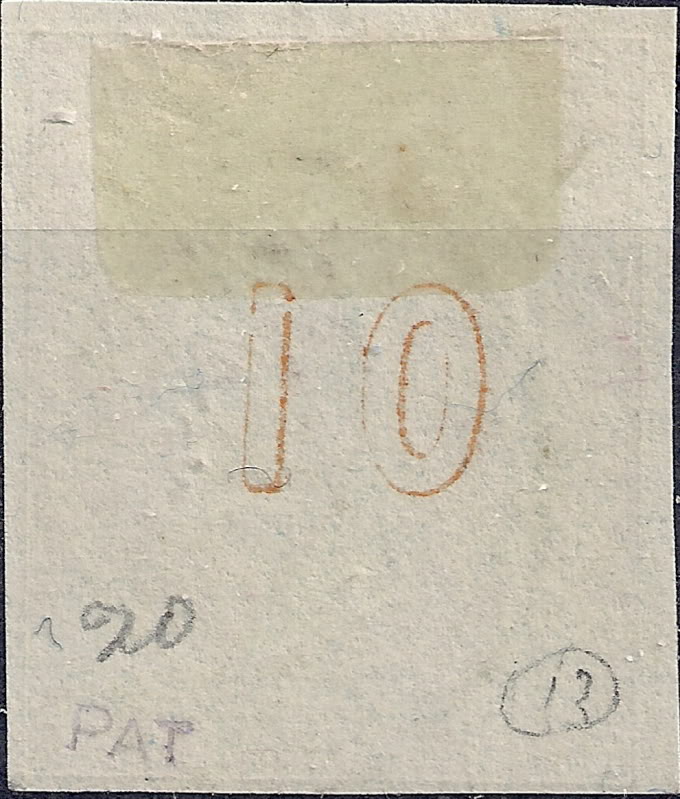
Please note that your stamp has the variety "Inverted zero" in the control number. This can be detected by the differential shading of left and right sides of the inner and outer ovals of the numeral. Below is a regular zero from a stamp of the 1862-1867 "Consecutive Athens" printings for comparison. Check for example the inner oval of the "0": in the regular zero the left side of the inner oval is more shaded than the right side, in the "inverted zero" the opposite is true (this scan also allows you to see the lighter shading of the earlier issues, as compared to the Cleaned Plates):


The "inverted zero" variety is rather common in the late "Cleaned Plates" printings, occuring in 46 of the 150 positions of the plate! BUT there is one position in the plate where this variety is combined with an additional one: the so-called "distant control numbers" - i.e the distance between the two digits is 3.1 mm instead of 2.1 mm. This would be a scarce error and I think it is worth trying to figure out if it exists on your stamp.

More to follow....

Send note to Staff  Go to Top of Page
Edited by vasia - 07/28/2017 11:16 am
Pillar Of The Community
1448 Posts
Posted 04/08/2012   5:57 pm  Show Profile Bookmark this reply Add Jkjblue to your friends list  Get a Link to this Reply
Vasia-

First, I'm grateful to you for helping identify these Hermes Heads.
Thank You, Thank you !


Quote:
Unknown #1 - 5 lepta Paris Printings (Hellas 3, Scott 3).

Distinguishing characteristics: absence of control number, lines of shading on the cheek dotted at the ends, very clean spandrels. Pitty for the touched margins and the tear (?) at left.


I thought this was a Paris printing. For the generalist, the characteristics outlined above are helpful indeed.


Quote:
Unknown #2 - 1 lepton 1880-1886 printings (Hellas 53, Scott 43 - i.e incorporated in the previous printings).

Distinguishing characteristics: cream paper, overall very coarse impression, colour which does not exist in the 1875-1880 printings on cream paper, 188_ cancellation date).


I think this shows why the Hermes Heads are so difficult to determine for the generalist, especially Scott based. Hellas 53 is part of the 1880-86 printings,but Scott only lists a 1L for 1875 with major color gray brown-Scott 43. There is a Scott 43c red brown color though.

To me then, looking at the color, the best approximation is Hellas 53c-red brown.

I was suspicious this was a later printing, mainly because of the cancellation. Of interest, this stamp was in the Scott Greece specialty album under the consecutive printings (Scott 16 Hellas 15b).


Quote:
Unknown #3 - 5 lepta 1875-1880 printings (Hellas 49, Scott 45).

Distinguishing characteristics: cream paper, presence of control number, overall very coarse impression.
'
I was quite sure this was not in the right place in the Greece specialty album (Consecutive 1862-67) because of the obvious cream paper, and the 5 lepta consecutive printing is supposed to have a greenish cast to the paper. So Scott 45 looks right to me, even as a generalist.


Quote:
Unknown #4 - 10 lepta 1868-1869 "Cleaned Plates" printings (Hellas 26, Scott 26).

Distinguishing characteristics: the more flat appearance of the head (as compared to the previous printings), the more even shading of the control number.

Please note that your stamp has the variety "Inverted zero" in the control number. This can be detected by the differential shading of left and right sides of the inner and outer ovals of the numeral. Here is a regular zero from a stamp of the 1862-1867 "Consecutive Athens" printings for comparison (this scan also allows you to see the lighter shading of the earlier issues, as compared to the Cleaned Plates):


This I wasn't expecting. It was in the specialty album in 1862-67 Consecutive printings Scott 19 10L orange/blue. But it belongs in the 1868 Cleaned plates Scott 26 pale orange/bluish.

Clearly, I'm not good at picking up a cleaned plate.
Vasia- Is one of the characteristics of the cleaned plates a wider appearance to the shading compared to the earlier issues?


I do see the inverted zero now that you have pointed it out to me.

So far the album is 1/4 in accuracy.

Thanks so much Vasia!
Send note to Staff  Go to Top of Page
Classical era collecting with the Blues
http://bigblue1840-1940.blogspot.com/
Valued Member
Greece
226 Posts
Posted 04/09/2012   02:02 am  Show Profile Bookmark this reply Add vasia to your friends list  Get a Link to this Reply
Hello, Jim

some additional points regarding the 10 lepta "Cleaned Plates" stamp:

1. The Hermes Head, presumably due to wear of the plate and the absence of a relief, appears broader, more flat than in the "Consecutive Athens" printings. At the level of my familiarity with the issue, this is not always an easy characteristic to use.

2. The control numbers on the back are coarser tnan in the previous printings, appearing somewhat "squashed" and with considerably less difference in shading between left and right sides. I think you can see some such differences between the control numbers on your stamp and my "Consecutive Athens" stamp.

3. In the case of your stamp the existence of the inverted "0" would exclude the "Consecutive Athens" printings, in which the particular variety does not exist.

4. In the case of your stamp the 1870 cancellation date from a busy post-office like PEIRAIEYS (Piraeus) would most probably automatically point to an 1868-1869 printing.

I am not quite sure what you mean by "wider appearance to the shading compared to the earlier issues". Please let me know.

Once again, I think it might be useful if you can measure the distance between the 2 digits of the control number, to see if you have the additional variety of "distant control numbers". I know we are talking about a 1mm difference , but it is worth the try!

By the way, more specialist catalogues and studies give a range of shades for the 10 lepta "Cleaned Plates" from pale orange to pale red-orange to red-orange (compared to the "pale orange" of Scott).

I will post my opinion on the remaining stamps within a day or so.
Send note to Staff  Go to Top of Page
Edited by vasia - 04/09/2012 08:36 am
Pillar Of The Community
1448 Posts
Posted 04/09/2012   09:23 am  Show Profile Bookmark this reply Add Jkjblue to your friends list  Get a Link to this Reply
Vasia-you are a genius!

Regarding the 10 lepta "Cleaned Plates" stamp

The postmark (Now I see it!), and the inverted "0" (Which didn't exist on the Consecutive printings from your in-depth knowledge) clearly would point to the 1868 cleaned plates issue, to say nothing of the "flat" appearing Hermes Head.

The more even shading of the control number (not wider appearance) is what I should look for also.

I measured the gap between the numbers, and it is the usual 2.1 mm.

Looking forward to your next installment.
Send note to Staff  Go to Top of Page
Classical era collecting with the Blues
http://bigblue1840-1940.blogspot.com/
Edited by Jkjblue - 04/09/2012 09:30 am
Valued Member
Greece
226 Posts
Posted 04/11/2012   11:15 am  Show Profile Bookmark this reply Add vasia to your friends list  Get a Link to this Reply
And on to the remaining 3 Large Hermes Heads:

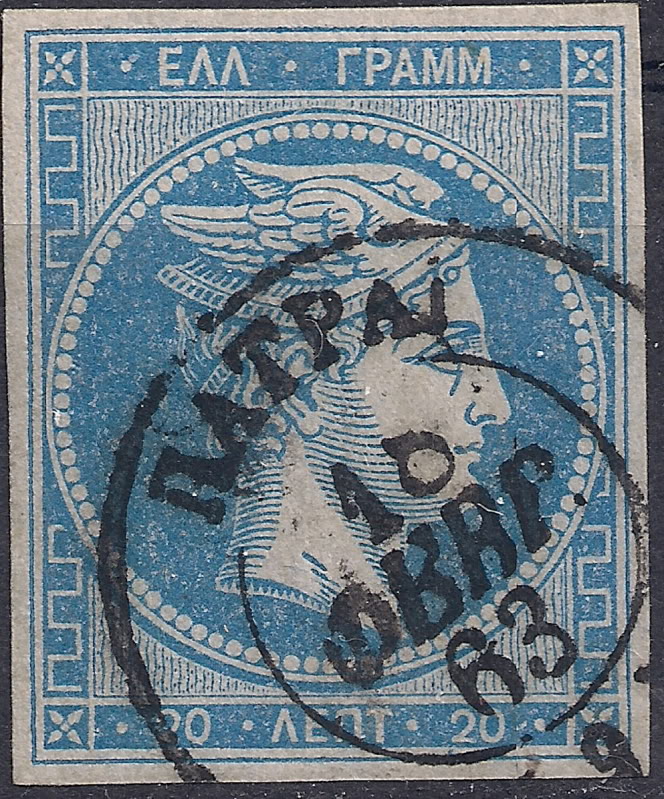
Unknown #5 - 20 lepta sky-blue, 1862-1867 (early) Consecutive Athens Printings (Hellas 19a, Scott 20).

Distinguishing characteristics: the sky-blue color + the relief of the white parts of the head, particularly around the nostrils and the lips + the fine spandrels + the fine control number (see earlier discussion).

Note that some of these early printings of the "Consecutive Athens printings" do not exhibit the solid background of the medallion characteristic of the later printings of the 1862-1867 period. Below is one of my copies with a February 1863 cancellation, looking very similar to your stamp:


Unknown #6 - 40 lepta, 1862-1867 Consecutive Athens Printings (Hellas 20Ib, Scott 21).

Distinguishing characteristics: fine control number with distinct difference in shading between left and right sides (see the "0"), solid background of medallion.

There appears to exist some relief (please do check), but less pronounced than in the previous 20 lepta stamp. As the impressions of the "Consecutive Athens Printings" multiplied in the 1862-1867 period, the wearing of an underlay used in the printing press under the paper apparently caused a gradual disappearance of the relief.

Unknown #7 - 80 lepta, 1862-1867 Consecutive Athens Printings (Hellas 22a, Scott 22a).

Distinguishing characteristics: as above for the other "Consecutive Athens Printings" stamps.

Please note my earlier discussion in this thread about the characteristic enlarged "0" of the later (1873) 80 lepta (mistakenly classified by Scott under the "Cleaned Plates" as #29).
Send note to Staff  Go to Top of Page
Edited by vasia - 07/28/2017 11:18 am
Pillar Of The Community
1448 Posts
Posted 04/11/2012   1:40 pm  Show Profile Bookmark this reply Add Jkjblue to your friends list  Get a Link to this Reply
Thanks Vasia!

I have learned a lot.

Not enough to feel confident with these particular issues, but, through repetition and your guidance, I'm beginning to see a pattern.

Of interest, the 20l,40l and 80l were properly placed in the Greece Scott Specialized album by the previous collector.

When you say "relief", is it the soft smudge markings evident over the white portions of the face?
Send note to Staff  Go to Top of Page
Classical era collecting with the Blues
http://bigblue1840-1940.blogspot.com/
Valued Member
Greece
226 Posts
Posted 04/11/2012   2:26 pm  Show Profile Bookmark this reply Add vasia to your friends list  Get a Link to this Reply
Hello once again, Jim

I do enjoy discussing the Large Hermes Heads!

The term "relief" refers to the fact that due to the printing method used (you can read more here: http://hermesheads.home.comcast.net/~hermesheads/) the white portions of the head (or at least some areas of them) appear to extend above the surface of the paper. I think that your 20 lepta stamp shows such a relief around the nose and mouth - you can also probably detect it from the back.If you look closely at the back of my 10 lepta stamp I posted earlier, you can see the relief of the front portion of the Hermes face to the left of the figure "1".

Hope this helps somewhat!
Send note to Staff  Go to Top of Page
Pillar Of The Community
1448 Posts
Posted 04/11/2012   4:00 pm  Show Profile Bookmark this reply Add Jkjblue to your friends list  Get a Link to this Reply

So actual relief- a three dimensional face.

http://hermesheads.home.comcast.net/~hermesheads/


That is an aspect I will need to examine more.

Appreciate the reference Vasia!
Send note to Staff  Go to Top of Page
Classical era collecting with the Blues
http://bigblue1840-1940.blogspot.com/
Pillar Of The Community
1448 Posts
Posted 06/18/2012   4:20 pm  Show Profile Bookmark this reply Add Jkjblue to your friends list  Get a Link to this Reply

1861 Scott 3 5 Lepta yellow green/greenish "Hermes", Paris print


Vasia-

My blog is up and running on the Hermes Heads.....

http://bigblue1840-1940.blogspot.co...s-heads.html

Thanks again for all the great help sorting out these most difficult (for the general collector) stamp issues.
Send note to Staff  Go to Top of Page
Classical era collecting with the Blues
http://bigblue1840-1940.blogspot.com/
Pillar Of The Community
719 Posts
Posted 03/11/2013   12:19 am  Show Profile Bookmark this reply Add stamps101 to your friends list  Get a Link to this Reply
Hi vasia,

I have revisited my Hermes collection and have gone back over this thread quite carefully. Thanks again for your help! There are a few that I am still missing your opinion on and if you have a few minutes I'm wondering if you can comment on them. Here they are:


Just need the stamp on the right.

Here is the back:


------------------------------------------------
------------------------------------------------


Both of these


------------------------------------------------
------------------------------------------------


------------------------------------------------
------------------------------------------------


------------------------------------------------
------------------------------------------------

Sorry this one is a bit confusing because of how I took the photos.


These pictures are of the fronts of the stamps I am unsure of.

.
.
The back of the stamp on the right side here is the back of the first stamp above (far left)

.
.
These are the backs of the next middle two

.
.
The backside on the left matches the far right face side above.
Send note to Staff  Go to Top of Page
Edited by stamps101 - 03/11/2013 12:22 am
Pillar Of The Community
719 Posts
Posted 03/11/2013   12:29 am  Show Profile Bookmark this reply Add stamps101 to your friends list  Get a Link to this Reply
What currency is the Hellas catalogs? I picked up a set for further study but it does not indicate. I am guessing Euros?
Send note to Staff  Go to Top of Page
Valued Member
Greece
226 Posts
Posted 03/11/2013   02:05 am  Show Profile Bookmark this reply Add vasia to your friends list  Get a Link to this Reply
Hellas catalogue prices are in Euros. I will try to give an opinion on your remaining Hermes Heads in the days to come.
Send note to Staff  Go to Top of Page
Pillar Of The Community
719 Posts
Posted 03/13/2013   8:33 pm  Show Profile Bookmark this reply Add stamps101 to your friends list  Get a Link to this Reply
Thanks for the info re: Hellas catalog.
Here's my last Hermes that I forgot to upload:

Send note to Staff  Go to Top of Page
Page: of 7 Previous TopicReplies: 94 / Views: 40,535Next Topic  
Previous Page | Next Page
 
To participate in the forum you must log in or register.

Go to Top of Page

Disclaimer: While a tremendous amount of effort goes into ensuring the accuracy of the information contained in this site, Stamp Community assumes no liability for errors. Copyright 2005 - 2026 Stamp Community Family - All rights reserved worldwide. Use of any images or content on this website without prior written permission of Stamp Community or the original lender is strictly prohibited.
Privacy Policy / Terms of Use    Advertise Here
Stamp Community Forum © 2007 - 2026 Stamp Community Forums
It took 0.25 seconds to lick this stamp. Powered By: Snitz Forums 2000 Version 3.4.05