| Author |
 Replies: 94 / Views: 41,535 Replies: 94 / Views: 41,535 |
|
|
|
Pillar Of The Community
725 Posts |
|
|
I actually haven't started Russia yet as I am still finishing a bunch of other stuff I had on the go (i am bad for half starting things!)
Soon hopefully!
And thank you again for all your help |
Send note to Staff 
|
|
|
Valued Member
Greece
233 Posts |
|
|
Regarding your 80 lepta (letter m): The 80 lepta Large Hermes Heads were printed in three different periods: 1. Paris prints (Scott 6) 2. Athens Consecutive Prints (Scott 15 and 22) with orange and carmine control numbers respectively. 3. 1873-1875 printings (Scott 29). These printings are often included under the so-called "Cleaned Plates" 1868-1869 issue, although they were printed significantly later. The most distinctive characteristic of these late 80 lepta is the "0" of the control number, which is usually thicker than the "8" (due to greater wear of the "0" digits which were used successively in several values). I cannot say decisively whether the "0" on your stamp is thicker than the "8":  Below is the back and front of my Scott 29 for comparison purposes: 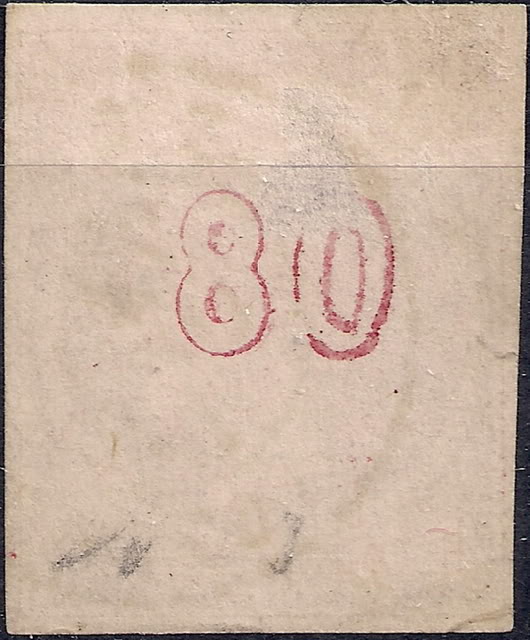 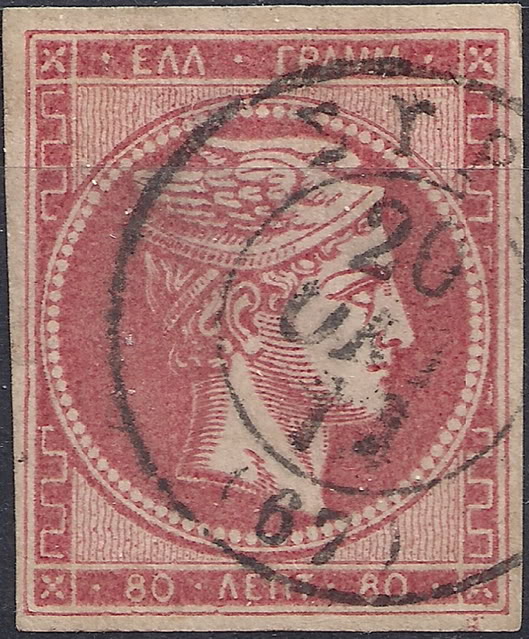 |
|
Send note to Staff
|
| Edited by vasia - 07/28/2017 11:13 am |
|
|
Valued Member
Greece
233 Posts |
|
|
Coming now to your unidentified 40 lepta (letter e):  The cancellation date can serve as a guide here. It is quite an early one: 17th October 1863 from Athens. During this period one mostly encounters the use of the following 40 lepta: 1. Earliest impressions of the Consecutive Printings (the so-called "May 1862" issue), i.e Scott 14 - Hellas 20IA. Mauve in shade. Probably printed in early 1863, not in 1862. 2. Subsequent impressions of the Consecutive Printings, red mauve to mauve, i.e Scott 21 - Hellas 20Ia. Also printed in early 1863. Occassionally, one can find stamps from the Provisional Athens printings being used in 1863. However, given the busy post-office of origin of your stamp and the relief of the white areas, which I think is present (a characteristic of the early Consecutive Printings), I would venture to say that your stamp belongs to one of the 2 categories above. |
|
Send note to Staff
|
| Edited by vasia - 12/18/2011 12:45 pm |
|
|
Pillar Of The Community
725 Posts |
|
|
Wow, now that is a detailed summary! I never would have thought about the post office as an indicator |
|
Send note to Staff
|
|
|
Valued Member
Greece
233 Posts |
|
|
Regarding your remaining 20 lepta (letter w):  There are 2 characteristics that make me think that your stamp might belong to the 1871-1876 "Meshed Paper" issue, rather than to the later issues on cream paper: 1. The whitish appearance of the paper (at least on the scan). 2. The slight transparency of the paper evident from the back. But the only definitive proof would be the existence of the meshed paper itself. If you examine your stamp with a strong light behind it, can you see the characteristic mesh (net)? Also, can you make out the year date on the cancellation (it is right over the ear of the Hermes Head)? |
|
Send note to Staff
|
|
|
New Member
Greece
1 Posts |
|
|
Vasia, congratulations from me, about your Knowledge.
I am collecting stamps over thirty years, (I am 39 years old) and the current year, (2011), only Large Hermes Heads.
Now, my only interest are the Large Hermes Heads. |
|
Send note to Staff
|
|
|
Pillar Of The Community
USA
9748 Posts |
|
|
Vasia, I also appreciate your patience with the topic..i am a lifelong collector and I did not realize there were so many Hermes ! Hope to hear more from you in the future ! |
|
Send note to Staff
|
APS 070059 Life Member International Society of Guatemala Collectors I.S.G.C. #853 |
|
|
Pillar Of The Community
United States
7104 Posts |
|
|
Vasia is a magician with these. It is interesting to read along. I'm not tempted to dig mine out, mind you, but it is nice to see experts at work.  |
|
Send note to Staff
|
|
|
Valued Member
Greece
233 Posts |
|
|
apollon, philb, Cjd, thank you all for the kind words, but I would reserve the title of the expert for some of the fellow collectors who have spent many years studying this issue. It is true that I have been reading on it quite extensively, but the field appears so vast that sometimes I feel overwhelmed.  Maybe some of you can also show us some of your Large Hermes Heads, so that we can keep up this interesting thread after the identifications of the previous lot of stamps101 are finished (2-3 remaining). |
|
Send note to Staff
|
|
|
Pillar Of The Community
USA
9748 Posts |
|
|
vasia I will take a look in my worldwide collection...i am sure I have nothing too rare....but we do appreciate the knowledge of our peers...i belong to an international group that studies the stamps and covers of Guatemala..we do have books and a magazine but there is so much in the heads of the aging members that may be lost !! |
|
Send note to Staff
|
APS 070059 Life Member International Society of Guatemala Collectors I.S.G.C. #853 |
|
|
Valued Member
Greece
233 Posts |
|
|
Coming now to the two remaining unidentified 1 lepton stamps, I need to stress from the outset that some of the 1 lepton stamps are quite a nightmare to identify, given the absence of control numbers on the back of all issues.  I will make an effort with these two, but please do not consider this an expertization. The first (letter g) is, I think, more straightforward: 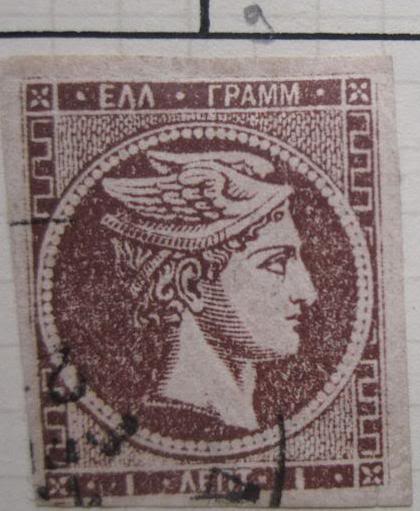 Given the coarse appearance of the Hermes Head, the absence of some shading details on the neck and the incomplete frame arould portions of the stamp, I would classify the stamp as belonging to the 1880-1886 printings (Scott unlisted, Hellas 53). The second one (letter p) is somewhat more complicated: 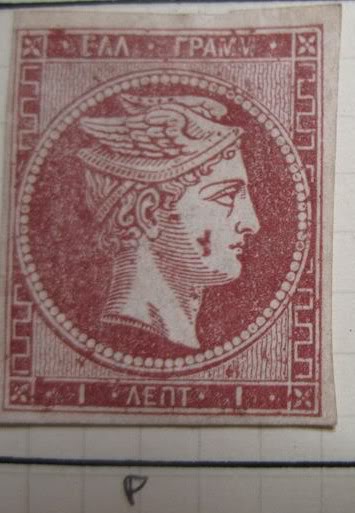 Given the appearance of the medallion (white grains / spots) and the rather bright appearance of the spandrels, I would be leaning towards classifying this stamp to the 1868-1869 "Cleaned Plates" issue (Scott 23, Hellas 23). The earlier "Consecutive Athens Printings" usually have a solidly-colored medallion. However, there is one aspect on the stamp that worries me and makes me question my ID: the presence of many ink spots all over the design, even on Hermes' image. This does not sit well with the characteristics of a "Cleaned Plate" stamp - the actual cleaning of the plates was necessitated by such ink spots created by dried ink on the plate. So, this 1 lepton has to remain with a question mark!  |
|
Send note to Staff
|
| Edited by vasia - 07/28/2017 11:15 am |
|
|
Pillar Of The Community
725 Posts |
|
|
Thanks again vasia, I will look at these this weekend and will look for the mesh design for the other one as well |
|
Send note to Staff
|
|
|
Pillar Of The Community
United States
6668 Posts |
|
|
Here is one I'm hoping to get some help on. I believe it is an Athens Print, no numbers on back  |
|
Send note to Staff
|
|
|
Pillar Of The Community
United States
6668 Posts |
|
|
And for posterity, a few others I have. I doubt there is anything Earth shattering in the group but if any grab anyone's attention, let me know and I'll scan the individual one. The 2 Blue ones have the number 20 on the back the others have no numbers.  |
|
Send note to Staff
|
| Edited by stallzer - 01/14/2012 9:09 pm |
|
|
Valued Member
Greece
233 Posts |
|
|
Hello, stallzer. All the 1 lepton and 2 lepta Hermes Heads (be it Paris or Athens printings) have NO control numbers on back. So the characteristics of the control numbers cannot be used here to identify the particular printing, something which makes these 2 values even more troublesome (but interesting, nevertheless) than the rest of the Hermes Heads. Judging by the overall coarse appearance of your 1 lepton stamp, I would be tempted to classify it in the 1880-1886 printings (Scott unlisted, Hellas 53). To the same issue belong the 4 stamps in your second scan that have no control number on back: (2 x 20l rosine-aniline) Scott 56a, Hellas 59IIa 10 lepta orange Scott 54, Hellas 56 5 lepta green Scott 53, Hellas 55 On all these stamps I am not making an effort to identify any of a possible number of different shades that the specialized catalogues are listing. |
|
Send note to Staff
|
|
|
Replies: 94 / Views: 41,535 |
|




 Posted 12/13/2011 1:14 pm


