| Author |
 Replies: 146 / Views: 48,530 Replies: 146 / Views: 48,530 |
|
|
|
Pillar Of The Community
7838 Posts |
|
|
Located in Belgium, the Caves of Remouchamps has among its many wonders the longest subterranean river known in the world. Here is an image of a stamp depicting a scenic spot in the caves, designed by Belgian artist Hermann Verbaere (1906-1993), engraved by Constant Spinoy, and issued by Belgium on October 23, 1976 to promote tourism, Scott No. 961. - nethryk  |
Send note to Staff 
|
|
|
Valued Member
Australia
426 Posts |
|
|
Pillar Of The Community
1508 Posts |
|
|
Pillar Of The Community
7838 Posts |
|
|
Back to Belgium: Neptune's Grottoes, also known as the Caves of Adugeoir, are located near the village of Petigny (Couvin), in the southern province of Namur. Here is an image of a stamp depicting a boat full of sightseers and a waterfall in Neptune's Grottoes, engraved by Paul Verheyden, and issued by Belgium on June 17, 1991 to (you guessed it!) promote tourism, Scott No. 1403. - nethryk  |
|
Send note to Staff
|
|
|
Pillar Of The Community
7838 Posts |
|
|
Dachstein Ice Caves, designed by Adalbert Pilch, combined engraved by Rudolf Toth and photogravure, and issued by Austria on June 11, 1987 as one of a set of six stamps depicting Austrian scenery, Scott No. 1351. - nethryk  |
|
Send note to Staff
|
|
|
Pillar Of The Community
7838 Posts |
|
|
Baradla Cave, the largest stalactite cave in Europe, located in Aggtelek National Park, designed by Zoltán Nagy, printed by photogravure, and issued by Hungary in 1964 to promote tourism, Scott No. 1581. - nethryk  |
|
Send note to Staff
|
|
|
Pillar Of The Community
7838 Posts |
|
|
Here is an image of an airmail stamp depicting prehistoric art (horses) from Lascaux cave, designed and engraved by Claude Durrens, and issued by Monaco on December 15, 1970, Scott No. C77. - nethryk  |
|
Send note to Staff
|
| Edited by nethryk - 10/09/2012 08:53 am |
|
|
Pillar Of The Community
7838 Posts |
|
|
Here are images of the two stamps in a set depicting limestone formations in Slovak caverns, designed and engraved by Martin Cinovský, and issued by Slovakia on June 12, 1997, Scott Nos. 271 & 272. - nethryk Domica Cavern in the Slovak Karst  Ochtinská Aragonite Cave  |
|
Send note to Staff
|
|
|
Pillar Of The Community
Slovenia
838 Posts |
|
|
Postojna Cave - Underground Post Office - joint issue with Austria (2013) 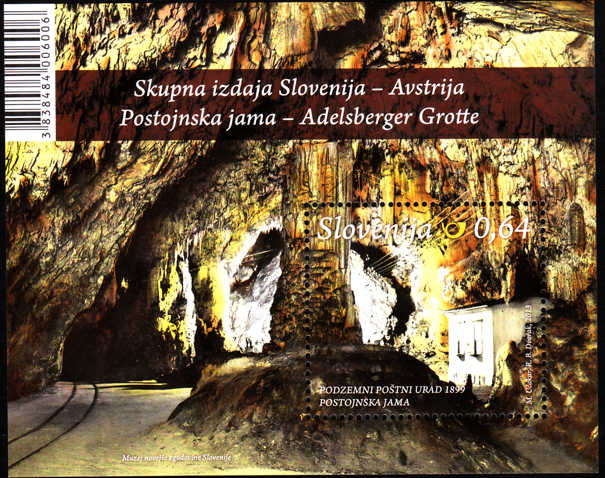 Postojna Cave Postojna Cave is the most famous cave in Europe, welcoming half a million visitors each year. In its 200-year tradition of tourism, the cave`s beautiful dripstone formations have been admired by 35 million people, including 150 monarchs. The cave extends for 21 kilometres. Tours of the cave have been possible for 141 years via the cave railway. It is a cradle of biospeleology, and an area with the greatest diversity of cave fauna in the world, since in addition to the proteus or "human fish", it is home to the first cave beetle, Leptodirus hochenwartii, and 100 other species of cave fauna. On 15 August 1899, next to the Dance Hall, 500 metres from the entrance to the cave, the first underground post office in the world was opened. It used the postmark "ADELSBERGER GROTTE - POSTOJNSKA JAMA". |
|
Send note to Staff
|
| Edited by primoz - 12/14/2013 4:50 pm |
|
|
Pillar Of The Community
Slovenia
838 Posts |
|
|
Postojna Cave, stalagmite Briliant
 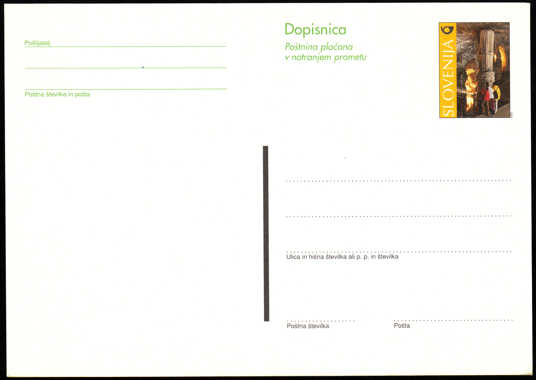
...........................................................................postal card with printed stamp

..............................................................................meter stamp
Postojna Cave is the greatest tourist attraction in Slovenia and one of the world's largest karst monuments. The most beautiful stalagmite in the Postojna cave is approximately 5-metre-tall stalagmite called the Brilliant. |
|
Send note to Staff
|
| Edited by primoz - 01/11/2014 3:51 pm |
|
|
Pillar Of The Community
Slovenia
838 Posts |
|
|
Cave animals of the Dinaric karst
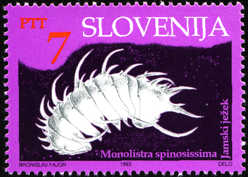 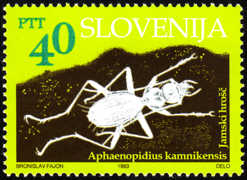 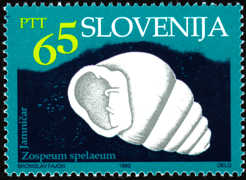
.................monolistra spinosissima.....................aphaenopidius kamnikensis..............................zospeum spelaeum
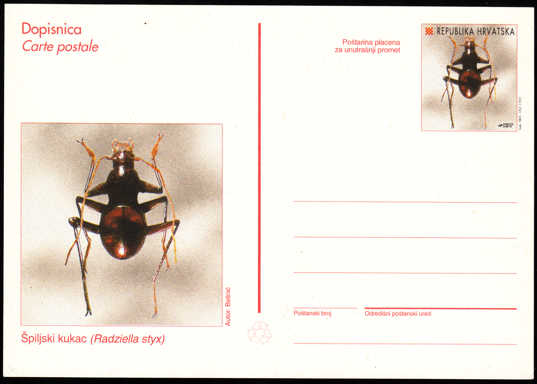
........................................................radziella styx
Long-Spined Cave Isopod Crustacean (monolistra spinosissima) is one centimetre long small animals crawl that lives on the bottom of small cave lakes and brooks. They feed on organic gravel, clay and bacterial colonies.
Cave beetle (aphaenopidius kamnikensis) was discovered as late as 1980 in Kamni¹ka jama cave what is the only known habitat to date. With its extraordinarily long feelers and legs Aphaenopidius is the largest cave beetle in Slovenia, measuring only 12 mm in length.
Cave Snail (zospeum spelaeum) is tiny subterranean snails. The first cave snail was found in the Postojnska cave in 1835. Today in Slovenia are known 10 species and 6 subspecies of these snails.
The Cave Beetle (radziella styx) is an endemic species of the Mediterranean, found in caves of the mountain Biokovo in year 1983.
see also: https://goscf.com/t/15250&whichpage=5#298171
|
|
Send note to Staff
|
| Edited by primoz - 02/09/2014 12:37 pm |
|
|
Pillar Of The Community
7838 Posts |
|
|
Lurgrotte Cave, Austria's largest stalactite cave, Peggau, Styria, designed by Austrian artist Ferdinand Dorner, combined engraved by Gerhart Schmirl and photogravure, and issued by Austria on April 29, 1994, Scott No. 1496. - nethryk  |
|
Send note to Staff
|
| Edited by nethryk - 02/10/2014 07:45 am |
|
|
Pillar Of The Community
Slovenia
838 Posts |
|
|
©kocjan caves, Slovenia 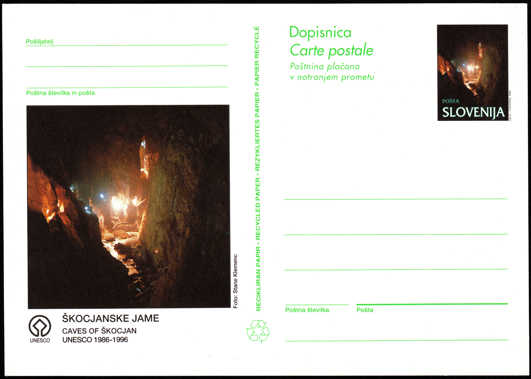 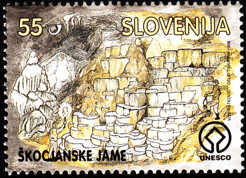 ...................................................................................................................................................... ......................................................................................................................................................limestone pools ©kocjan Caves represents the most significant underground phenomena in both the Karst region and Slovenia. Together with the underground stream of the Reka River, they represent one of the longest karst underground wetlands in Europe. The Reka River disappears underground at Velika Dolina into ©kocjan Caves and then flows underground for 34 km surfacing near Monfalcone (Italy). Feature of the caves are extremely diverse stalactite forms including limestone pools, and larger stalactites in the Great Hall, whith Giant stalagmites. ©kocjan Caves was entered on UNESCO`s list of natural and cultural world heritage sites in 1986. |
|
Send note to Staff
|
|
|
Valued Member
United States
332 Posts |
|
|
Hello, friends! Here's a stamps series from Romania, with "mine flowers" ("flori de mina", in Romanian)--crystals (or crystalline solids) found in mines ("artificial, man-made caves", right?). 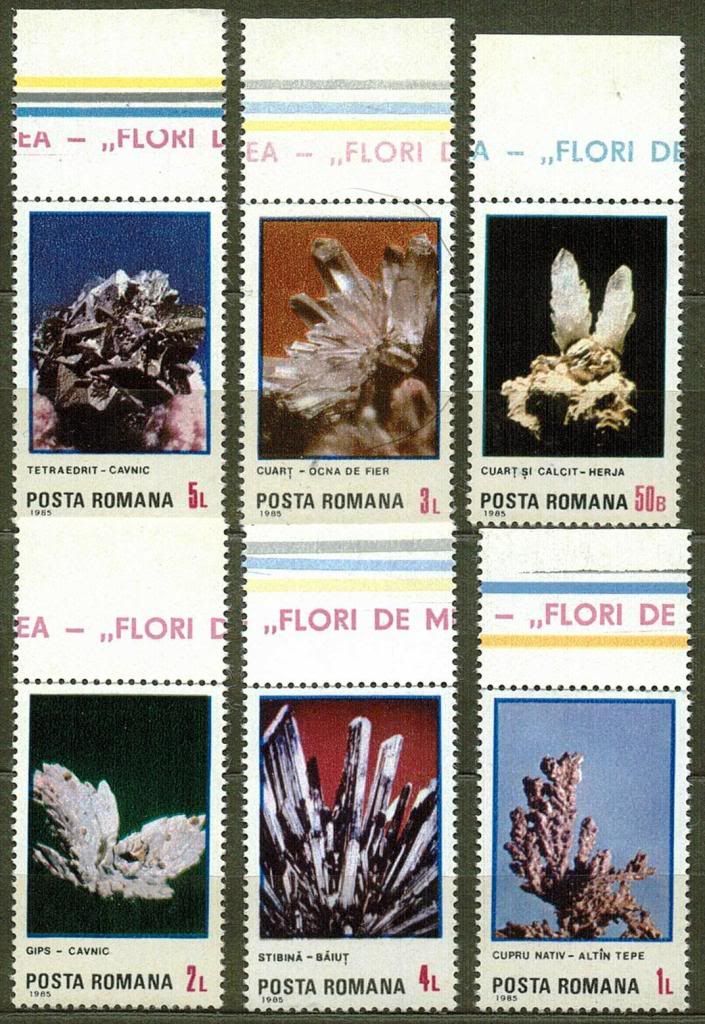 |
|
Send note to Staff
|
|
|
Valued Member
United States
332 Posts |
|
|
"Emil Racovi#539;#259; (Romanian pronunciation: [e#712;mil #712;rakovit#865;s#601;]; also spelled Racovitza; 15 November 1868 – 17 November 1947) was a Romanian biologist, zoologist, speleologist, explorer of Antarctica and the first biologist in the world to study the arctic life." "Emil Racovi#539;#259; continued his research, contributing to speleology and exploring over 1,400 caves in France, Spain, Algeria, Italy, and Slovenia. He is considered to be, together with René Jeannel, one of the founders of biospeleology. He was particularly interested in isopoda, of which he discovered many." - wikipedia Maximum card from Romania, showing Emil Racovi#539;#259;, Ph.D. Notice the postmark, too.  |
|
Send note to Staff
|
| Edited by DC3 - 03/02/2014 1:08 pm |
|
|
Replies: 146 / Views: 48,530 |
|




 Posted 01/11/2012 1:49 pm