Stamp Community Family of Web Sites
Thousands of stamps, consistently graded, competitively priced and hundreds of in-depth blog posts to read


Stamp Community Forum
 
Username:
Password:
Save Password
Forgot your Password?

This page may contain links that result in small commissions to keep this free site up and running.

Welcome Guest! Registering and/or logging in will remove the anchor (bottom) ads. It's Free!

Russia Covers

Previous Page
 
To participate in the forum you must log in or register.
Author Previous TopicReplies: 24 / Views: 7,484Next Topic
Page: of 2
Pillar Of The Community
719 Posts
Posted 01/20/2012   11:45 am  Show Profile Bookmark this reply Add stamps101 to your friends list  Get a Link to this Reply
That one is definitely one of my favourite pieces in the collection. Thanks for info yet again!

If I get my scanner working I'll scan a better copy of that one.

Out of curiousity, did they find that the disinfection worked? How did they disinfect? I notice the envelope has a look about it as if it was rubbed with something. Alcohol perhaps?
Send note to Staff  Go to Top of Page
Valued Member
Greece
226 Posts
Posted 01/20/2012   12:13 pm  Show Profile Bookmark this reply Add vasia to your friends list  Get a Link to this Reply
stamps101,

I am not aware of the specific procedure used in Odessa for disinfection of mail. The standard practice in other places was the fumigation of mail articles, either by opening them or slitting them. Fumigation "was effected by sulphur fumes, but later letters were disinfected using nascent oxygen from the addition of formaldehyde to potassium permanganate".

There is an interesting exhibit on the subject of disinfection of mail in Russia on the site of Rossica, but it deals with a later period (1897-1914):

http://www.rossica.org/v_gallery/di...ted_mail.php
Send note to Staff  Go to Top of Page
Valued Member
Greece
226 Posts
Posted 01/21/2012   04:25 am  Show Profile Bookmark this reply Add vasia to your friends list  Get a Link to this Reply
Some information on the following 4 pieces (from top to bottom and from left to right):


1. 28th April 1891 - from a location in Estlyandskaya province (undecipherable / probably in present-day Estonia) to a doctor in the Wiedicon district of Zurich, Switzerland. Franked correctly at 10k.

2. October 1879 - Postal stationery card posted on board a (railway) Travelling Post Office (TPO) to Warsaw (arrival postmark of 20/10/1879). Two interesting postmarks:

a) 3-line date TPO postmark with inscription "Pochtoviy vagon No ?" (==postal wagon no).
b) special round mark, used in Warsaw to indicate time of delivery of correspondence: "8 ch(asov) / vech(era)" = 8 o'clock / evening.

3. Picture postcard with view of Riga, present-day Latvia. No posting details provided.

4. 4th March 1935 - Registered cover from Leningrad (3rd district sub-office) to Melbourne, Australia. Standard international "R" label. The violet "RECOMMANDE" mark is of private origin. Franked correctly at 35k.

Nothing out of the ordinary in these pieces, except maybe the round mark of Warsaw. The TPO number should be visible if you look closer.
Send note to Staff  Go to Top of Page
Edited by vasia - 01/21/2012 12:18 pm
Valued Member
Greece
226 Posts
Posted 01/21/2012   05:52 am  Show Profile Bookmark this reply Add vasia to your friends list  Get a Link to this Reply
Thank you, BAYERN1kreuzer

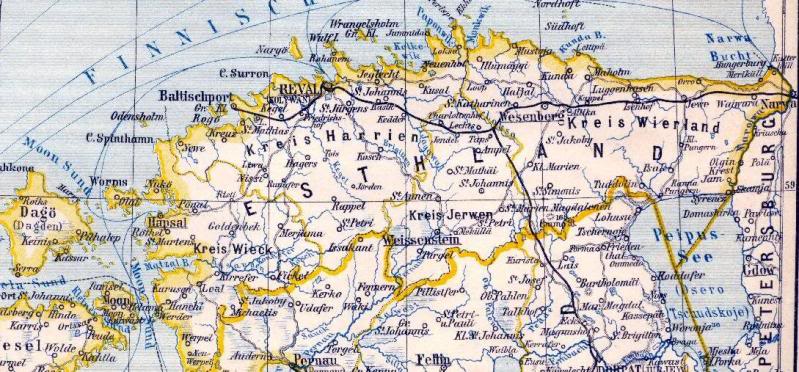
Here is the map of Estlyandskaya guberniya with Reval as its capital:


Now stamps101 would have to decipher the origin of the cover, possibly Wesenberg, if we judge by the ...nberg ending of the cancel.
Send note to Staff  Go to Top of Page
Edited by vasia - 07/27/2017 12:12 pm
Valued Member
Greece
226 Posts
Posted 01/22/2012   10:09 am  Show Profile Bookmark this reply Add vasia to your friends list  Get a Link to this Reply
Another interesting cover in your collection:


Posted in 1902 (undecipherable date) in the Russian post-office in Tientsin, China to Paris, France and re-directed from there to Liverpool (arrival postmark of 17/11/1902).

The opening of the Trans-Siberian mail route promised to accelerate the transmission of correspondence to and from the north of China. In August 1902 a letter from Tientsin took about 28 days to be delivered to Liverpoool if forwarded via Siberia. At the same time, the transmission of mail via Brindisi or Vancouver usually took 36-40 days. Therefore, the routing via Siberia saved at least a week.

Mail had to be marked accordingly for transmission via the Trans-Siberian railway. In the case of this letter, this is done by the red cachet (unclear if it is of post-office or private origin) with the insciption: "Via Port Arthur and Siberia (to) France".

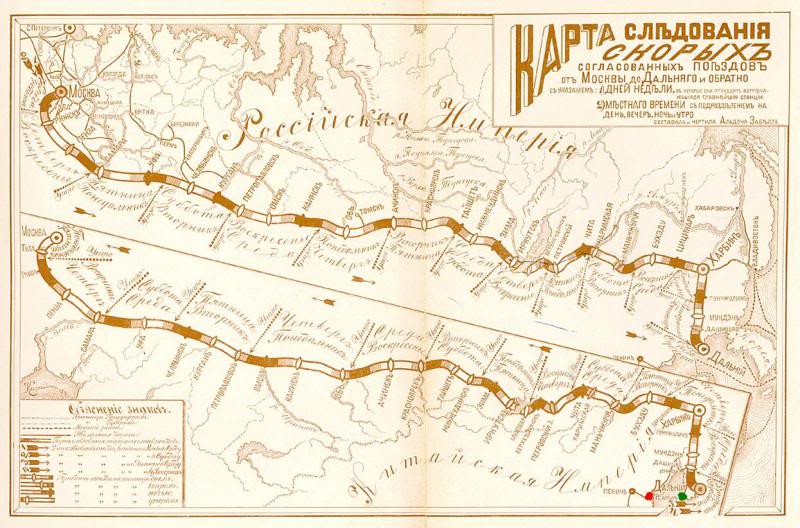
So your letter travelled along the following route: Tientsin-Port Arthur-(nearby)Dalny-Kharbin-along the Chinese Eastern Railway to Manchuli-via the Trans-Siberian Railway to Moscow and beyond.

A condensed overview of its journey can be seen in the following map of the rail route as it existed in 1903:


In the lower map, Tientsin is marked with a red dot, Port Arthur with a green one.

Does the cover bear any other franking besides the 5k Offices in China on the front?
Send note to Staff  Go to Top of Page
Edited by vasia - 07/27/2017 12:14 pm
Valued Member
Greece
226 Posts
Posted 01/30/2012   06:52 am  Show Profile Bookmark this reply Add vasia to your friends list  Get a Link to this Reply
A few comments regarding the following cover of stamps101:


Russia introduced registration labels quite late in 1899. The first registration labels to be used in 1899 (and in isolated instances in the couple of years that followed) had a provisional character, in the sense that there was no mention of "Registration" on these labels (no large "Z" or "R"). An exception were the registration labels used in Moscow, which from 1899 had a large "R" on the left side of the label (see the cover above).

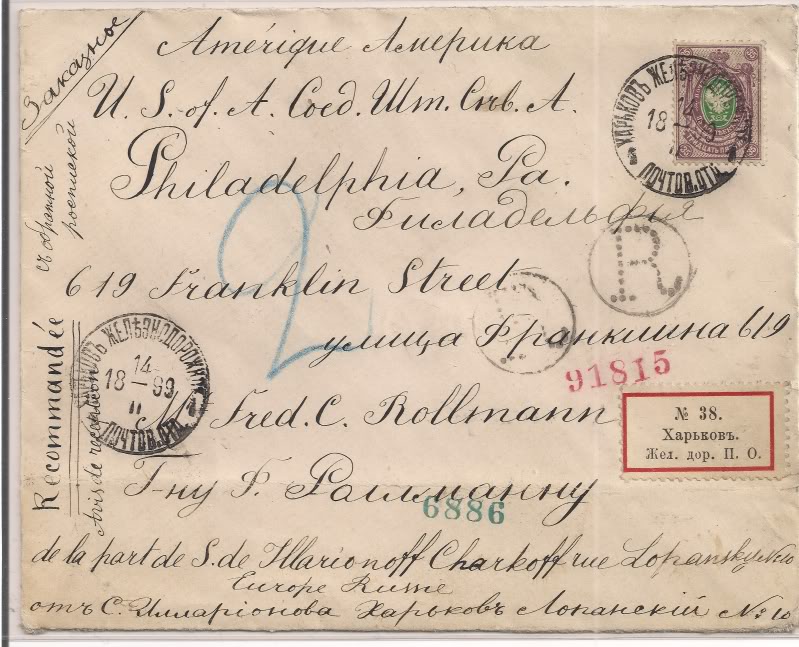
Below is a cover in my collection with a 1899 provisional label from the Kharkhov railway station:


In the field of provisional labels, this 1899 Kharkov label is unusual in two respects:
a) It is perfed (most are imperf).
b) It has a red border (most are black-bordered).

You can read interesting information about these 1899 labels in the following 2 articles from the Rossica Journal:

http://ufdc.ufl.edu/UF00020235/00065/24j
http://ufdc.ufl.edu/UF00020235/00066/67j

P.S. How is your work with the Russia collection moving along, stamps101?


Send note to Staff  Go to Top of Page
Edited by vasia - 07/27/2017 12:15 pm
Valued Member
Greece
226 Posts
Posted 03/08/2012   05:33 am  Show Profile Bookmark this reply Add vasia to your friends list  Get a Link to this Reply
stamps101,

any progress with your Russia collection??
Send note to Staff  Go to Top of Page
New Member
Germany
2 Posts
Posted 02/28/2017   07:08 am  Show Profile Bookmark this reply Add traumsand to your friends list  Get a Link to this Reply
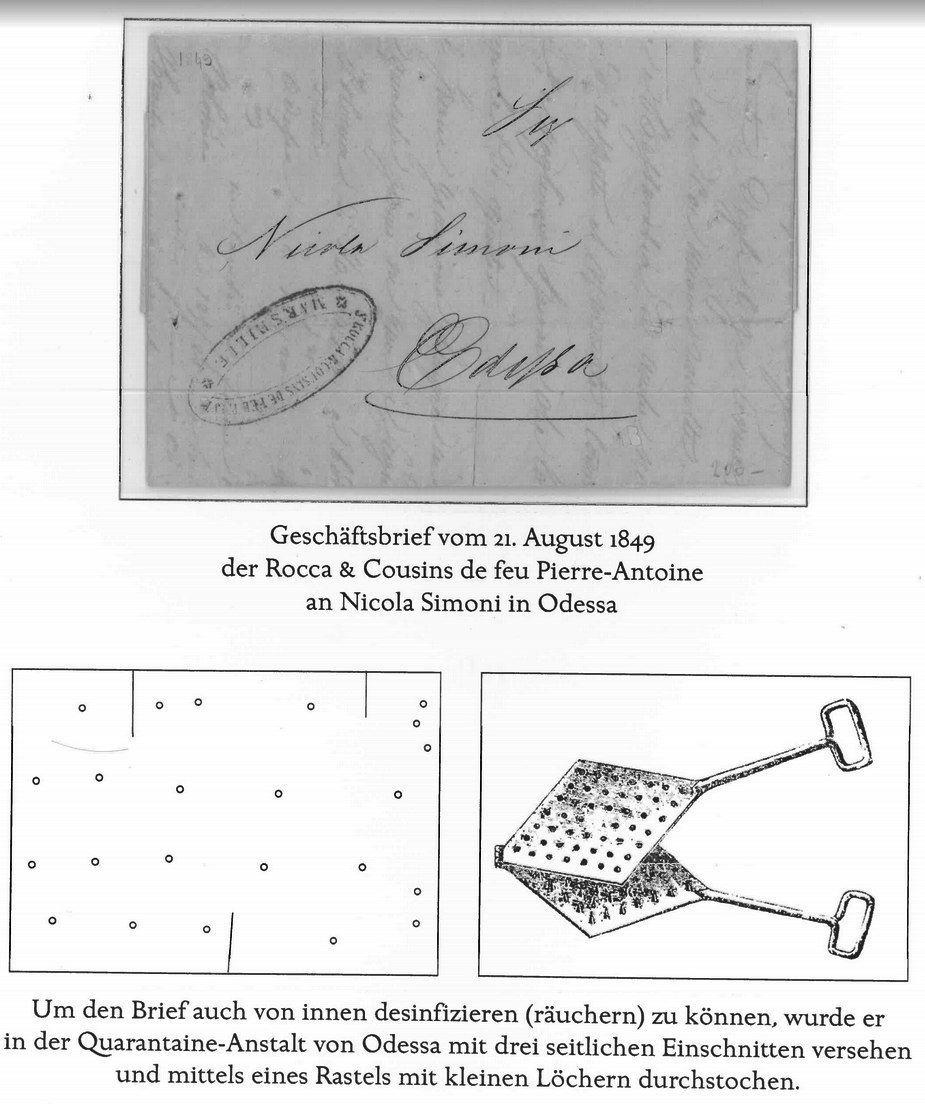
Letter sent from Marseille to Odessa. The letter has pineholes and slits for fumigation and was disinfected at Odessa.


Send note to Staff  Go to Top of Page
Valued Member
United States
122 Posts
Posted 05/07/2017   5:38 pm  Show Profile Bookmark this reply Add jonathan to your friends list  Get a Link to this Reply
Regarding disinfecting procedures, this thread makes apparent that grading experts need to be more explicit when tossing around philatelic homonyms like "clean".


Quote:
In the expertizing world, "clean" is not a description that is seen on certificates; it is not specific enough. If there are flaws, they need to be described in detail on the certificate.

However, it is a term that expertizers use among themselves, most often in combination with the word "too", as in "too clean." This refers not to condition or desirability so much as to the physical appearance and genuineness of the cover — and it is not a compliment.


quote from: http://www.linns.com/news/us-stamps...t-exist.html

Please forgive me if humor is not appropriate here, but I couldn't help making the connection…
Send note to Staff  Go to Top of Page
Page: of 2 Previous TopicReplies: 24 / Views: 7,484Next Topic  
Previous Page
 
To participate in the forum you must log in or register.

Go to Top of Page

Disclaimer: While a tremendous amount of effort goes into ensuring the accuracy of the information contained in this site, Stamp Community assumes no liability for errors. Copyright 2005 - 2026 Stamp Community Family - All rights reserved worldwide. Use of any images or content on this website without prior written permission of Stamp Community or the original lender is strictly prohibited.
Privacy Policy / Terms of Use    Advertise Here
Stamp Community Forum © 2007 - 2026 Stamp Community Forums
It took 0.19 seconds to lick this stamp. Powered By: Snitz Forums 2000 Version 3.4.05