|
This page may contain links that result in small commissions to keep this free site up and running.

Welcome Guest! Registering and/or logging in will remove the anchor (bottom) ads. It's Free!
To participate in the forum you must log in or register.
| Author |
 Replies: 244 / Views: 100,105 Replies: 244 / Views: 100,105 |
|
Pillar Of The Community
7838 Posts |
|
|
I agree with backroads (per his comment today in the Literary stamps thread): Poets do deserve their own thread! If possible, please include a sample of poetry (along with an English translation!) with your posts. Here is one a great one to start things off: Anatole France (1844-1924), a French poet, journalist, and novelist, was a member of the Académie française, and won the Nobel Prize for Literature in 1921. Here are images of a semi-postal stamp depicting Anatole France, designed and engraved by Antonin Delzers, and issued by France on June 16, 1937, Scott No. B49, Y&T No. 343. Also, here is a short poem from Anatole France's 1873 anthology, Les Poèmes dorés (Golden Poems), and my own attempt at a translation. - nethryk    |
|
Send note to Staff
|
| Edited by nethryk - 01/27/2012 12:10 pm |
|
|
|
|
Pillar Of The Community
7838 Posts |
|
|
Jens Hendrik Oliver Djurhuus (1881-1948), whose pen name was Janus Djurhuus, was first Faroese poet to write modern and lyrical poetry. His poetic works are permeated with his knowledge of ancient Greek and Latin classical literature, his national romantic tendencies, his passion for the Faroese language, and his knowledge of Old Norse literature. Djuhuus is called the "father of modern Faroese poetry." Here is an image of a stamp designed after a photo of Djurhuus, engraved by Czeslaw Slania, and issued by the Faroes on May 28, 1984, Scott No. 110, Facit No. 103, plus a translation of his 1914 poem, Atlantis. - nethryk   |
Send note to Staff 
|
|
|
Pillar Of The Community
7838 Posts |
|
|
Sidney Lanier (1842-1881) developed a unique style of poetry written in logaoedic dactyls, which was strongly influenced by the works of the Anglo-Saxon poets. Here is an image of a stamp designed after a portrait of Lanier by artist William Arthur Smith, engraved by Edward P. Archer (vignette) and Kenneth C. Wiram (lettering), and issued by the USA on the 130th anniversary of Lanier's birth, February 3, 1972, Scott No. 1446. - nethryk   |
|
Send note to Staff
|
|
|
Pillar Of The Community
7838 Posts |
|
|
Giuseppe Parini was an Italian Enlightenment satirist and poet of the neoclassic period. Here are images of a stamp designed and engraved by Antonio Ciaburro after an original lithograph portrait by Francesco Rosaspina (1762-1841), issued by Italy on October 2, 1999, Scott No. 2308. Also, here is an excerpt from Parini's 1763 poem, Il Giorno (The Day), consisting of ironic instructions to a young nobleman as to the best method of spending his mornings. - nethryk    |
|
Send note to Staff
|
| Edited by nethryk - 01/27/2012 12:08 pm |
|
|
Pillar Of The Community
7838 Posts |
|
|
Charles Cros (1842-1888), French poet, humorous writer, and inventor. He is perhaps most famous as the man who almost, but not quite, invented the phonograph. Here is an image of a semi-postal stamp honoring Charles Cros, designed and engraved by Pierre Forget, and issued by France on December 3, 1977, Scott No. B502, Y&T No. 1956. I have also included a short selection of Cros's poetry from his 1873 collection, Le coffret de santal (The Sandalwood Chest), along with my own translation. - nethryk 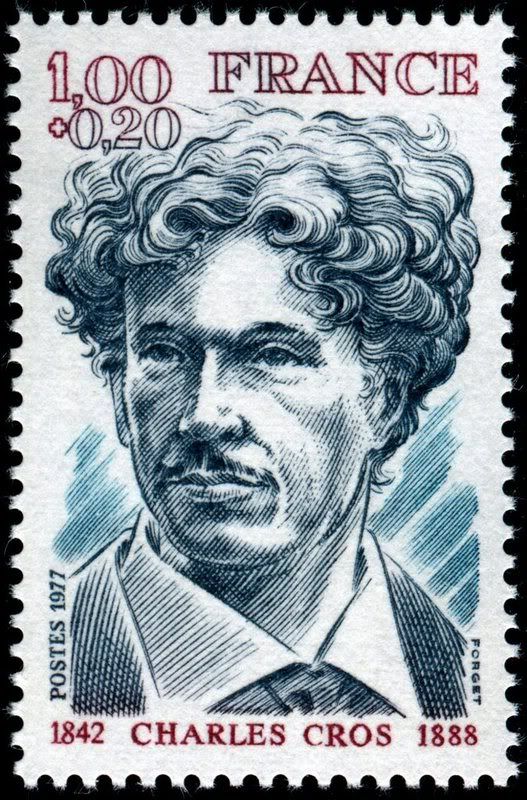   |
|
Send note to Staff
|
| Edited by nethryk - 01/27/2012 12:08 pm |
|
|
Pillar Of The Community
Canada
6525 Posts |
|
|
Carl Sandburg 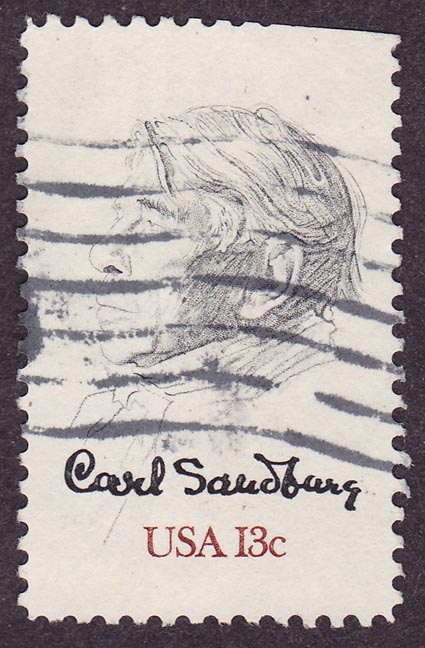 MAG I WISH to God I never saw you, Mag. I wish you never quit your job and came along with me. I wish we never bought a license and a white dress For you to get married in the day we ran off to a minister And told him we would love each other and take care of each other Always and always long as the sun and the rain lasts anywhere. Yes, I'm wishing now you lived somewhere away from here And I was a bum on the bumpers a thousand miles away dead broke. I wish the kids had never come And rent and coal and clothes to pay for And a grocery man calling for cash, Every day cash for beans and prunes. I wish to God I never saw you, Mag. I wish to God the kids had never come. |
|
Send note to Staff
|
|
|
Pillar Of The Community
Canada
6525 Posts |
|
|
German poets Friedrich von Schiller 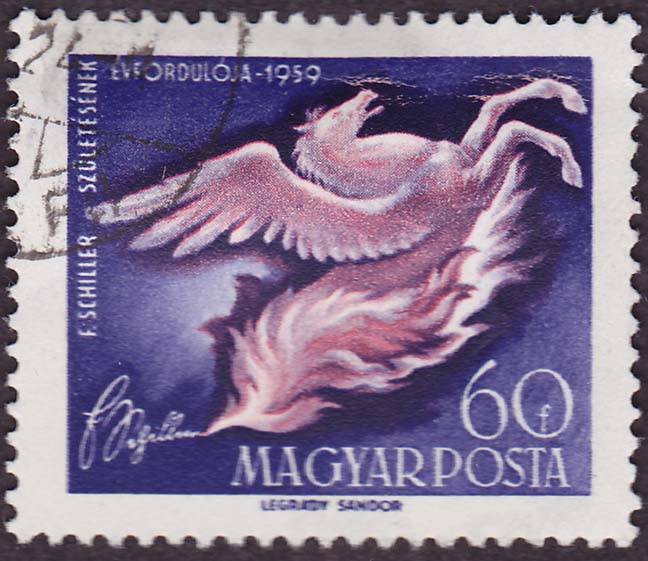 -on Hungary 1959 SC# 1258 and Agnes Miegel 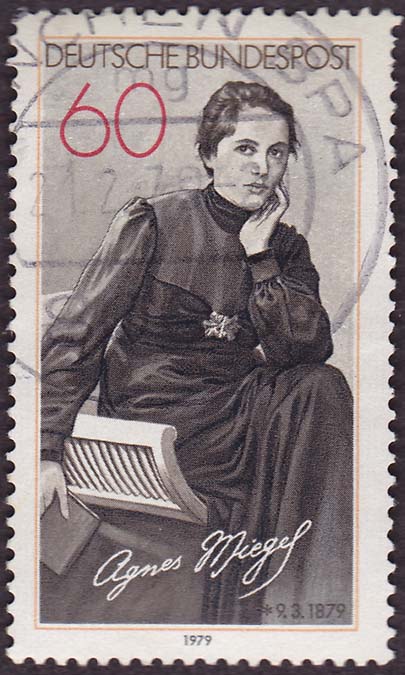 -Germany 1979 SC#1287 Sorry, no poetry. |
|
Send note to Staff
|
|
|
Pillar Of The Community
1508 Posts |
|
|
As always I have a story to tell with my stamp postings. Some are good, some not so good but they have one thing in common. They take me back on a trip into my past,on a world round trip or just somewhere in my mind where life is enjoyable... My father in law, dad, was an attorney and he took a year's assignment in Alaska to look for gold in the Yukon. At any dinner, any chance he would get, he would share the poem of Sam McGee. I have a book from R. Service, a Christmas present from him here at my desk.....and to make a long story short, here is the poem's opening and closing of Sam McGee... Robert Service There are strange things done in the midnight sun, by the men who moil for gold; The Arctic trails have their secret tales That would make your blood run cold; The Northern Lights have seen queer sights, But the queerest they ever did see Was that night on the marge of Lake Lebarge I cremated Sam McGee.  Nice postings Gentlemen. I am getting me a glas red wine and will enjoy the reading  |
|
Send note to Staff
|
|
|
Pillar Of The Community
Canada
2574 Posts |
|
|
Pillar Of The Community
1508 Posts |
|
|
A litte closer to my roots: Frankfurt - Germany Johann Wolfgang von Goethe It looks like the stamps reflect Goethes age at 20 and 30 years(?) Found this stamp today.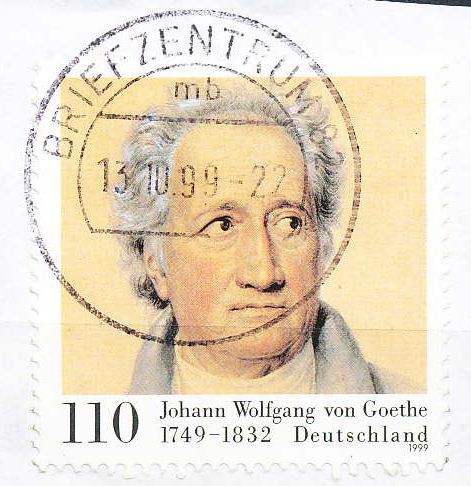 Looks like a new version of the stamp above!One of his poems one learns in school Looks like a new version of the stamp above!One of his poems one learns in schoolIch ging im Walde So vor mich hin, Und nichts zu suchen, Das war mein Sinn. Im Schatten sah ich Ein Blümlein stehn, Wie Sterne blinkend, Wie Äuglein schön. Ich wollt es brechen, Da sagt' es fein: Soll ich zum Welken Gebrochen sein? Mit allen Wurzeln Hob ich es aus, Und trugs zum Garten Am hübschen Haus. Ich pflanzt es wieder Am kühlen Ort; Nun zweigt und blüht es Mir immer fort. Johann Wolfgang von Goethe (1749-1832) Could not find a translation so here is mine (I ain't no Goethe) I was walking in the woods with nothing on my mind. In the shadow I saw a little flower blooming, blinking like the stars,. And shining like beautiful eyes. As I bent down to pick it up, It said to me: Am I destined to wilt and die? So I dug it up with all it's roots And carried it to the garden by my beautiful house….. …. planted it again in a shady place and again it branches and blossoms for me at all times… |
|
Send note to Staff
|
| Edited by fifia - 01/28/2012 6:09 pm |
|
|
Pillar Of The Community
Canada
1084 Posts |
|
|
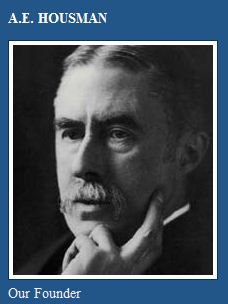
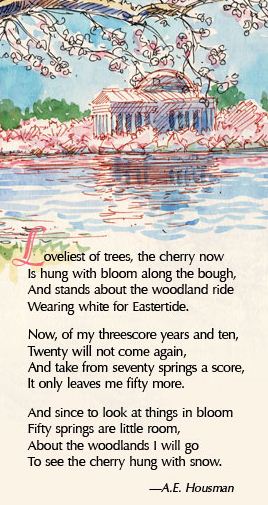
I went looking to see if Eric Housman had been on a stamp but was not successful. Does anyone known if he has? |
|
Send note to Staff
|
|
|
Pillar Of The Community
Canada
2574 Posts |
|
|
cynical
In Scott 2007 on cd I search for "housman" in Great britain and I got no result. |
|
Send note to Staff
|
|
|
Pillar Of The Community
1508 Posts |
|
|
Pillar Of The Community
Canada
923 Posts |
|
|
Since this fellow started the theme, I will add the poem. It's from memory, mind you, so there may be errors. I spent many years coaching classes in memorization and choral speaking for Remembrance Day ceremonies, so have it pretty much indelibly printed on my brain.  In Flanders fields the poppies blow Between the crosses, row on row, That mark our place; and in the sky The larks, still bravely singing, fly Scarce heard amid the guns below. We are the Dead. Short days ago We lived, felt dawn, saw sunset glow, Loved and were loved, and now we lie, In Flanders fields. Take up our quarrel with the foe: To you from failing hands we throw The torch; be yours to hold it high. If ye break faith with us who die We shall not rest, though poppies grow In Flanders fields. |
|
Send note to Staff
|
|
|
Pillar Of The Community
7838 Posts |
|
|
Way to go, everyone! Let's keep the verses flowing... Johannes V. Jensen (1873-1950) was a Danish author and poet who was awarded the Nobel Prize in Literature in 1944. Here is an image of a stamp featuring a portrait of Jensen, designed by Danish artist Poul Christensen (1917-1977), engraved by Czeslaw Slania, and issued by Denmark on February 22, 1973 to commemorate the poet's birth centenary, Scott No. 517, Facit No. 565, plus a sample of Jensen's poetry. - nethryk 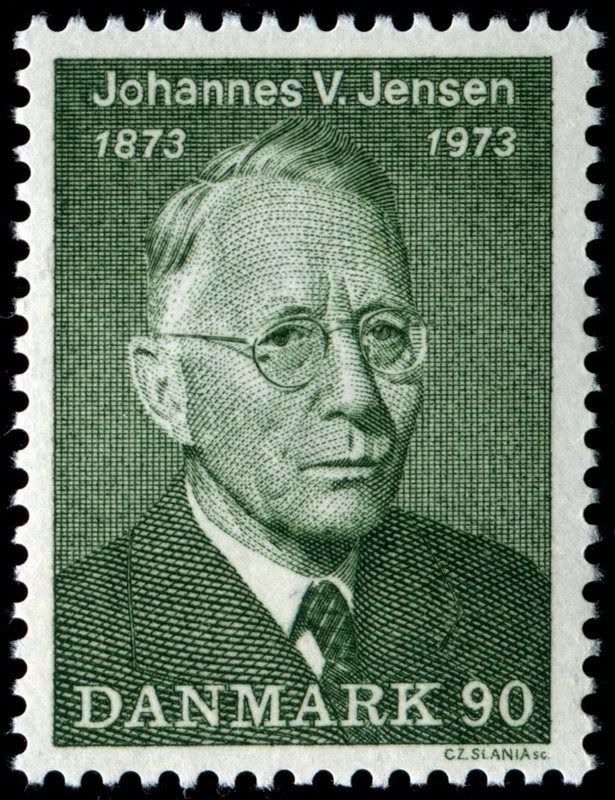 Solstice song Solstice songOur sun has now grown cold, we are in winter's hold the days are waning. Now, past the deepest night, our hope burns bright – yes, hope burns bright, for now the sun will right, now light will soon return, the days again are gaining. The lovely fir tree green betokens summer's screen of woods imposing. In Christmas candlelight like star-hosts bright, yes, star-hosts bright, sun's wonder is in sight and all the yellow flower-suns that now are dozing. The fir-tree's charry scent gives air to summers spent and each newcomer. Cool Danish years all swing, dance in a ring, yes, in a ring round an eternal spring. Let all souls also sing of Denmark's lovely summer! Translated by John Irons |
|
Send note to Staff
|
| Edited by nethryk - 02/10/2013 08:58 am |
|
|
Pillar Of The Community
1508 Posts |
|
|
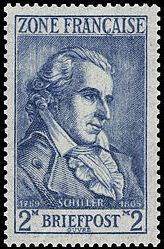 Johann Christoph Friedrich von Schiller (10 November 1759 – 9 May 1805) Johann Christoph Friedrich von Schiller (10 November 1759 – 9 May 1805) was a German poet, philosopher, historian, and playwright. During the last seventeen years of his life (1788–1805), Schiller struck up a productive, if complicated, friendship with already famous and influential Johann Wolfgang von Goethe. They frequently discussed issues concerning aesthetics, and Schiller encouraged Goethe to finish works he left as sketches. This relationship and these discussions led to a period now referred to as Weimar Classicism. They also worked together on Xenien, a collection of short satirical poems in which both Schiller and Goethe challenge opponents to their philosophical vision. Nänie (the German form of Latin nenia, meaning "a funeral song") is a composition for SATB chorus and orchestra, op. 82 by Johannes Brahms, which sets to music the poem Nänie by Friedrich Schiller. Brahms composed the piece in 1881, in memory of his deceased friend Anselm Feuerbach. Nänie is a lamentation on the inevitability of death; the first sentence, Auch das Schöne muß sterben, translates to "Even the beautiful must die." An average performance has a duration of approximately 15 minutes. It is one of the most rarely performed pieces by Brahms mostly due to its difficulty, leaving only more experienced choirs able to perform The text follows:Auch das Schöne muß sterben! Das Menschen und Götter bezwinget, Nicht die eherne Brust rührt es dem stygischen Zeus. Einmal nur erweichte die Liebe den Schattenbeherrscher, Und an der Schwelle noch, streng, rief er zurück sein Geschenk. Nicht stillt Aphrodite dem schönen Knaben die Wunde, Die in den zierlichen Leib grausam der Eber geritzt. Nicht errettet den göttlichen Held die unsterbliche Mutter, Wann er am skäischen Tor fallend sein Schicksal erfüllt. Aber sie steigt aus dem Meer mit allen Töchtern des Nereus, Und die Klage hebt an um den verherrlichten Sohn. Siehe! Da weinen die Götter, es weinen die Göttinnen alle, Daß das Schöne vergeht, daß das Vollkommene stirbt. Auch ein Klagelied zu sein im Mund der Geliebten ist herrlich; Denn das Gemeine geht klanglos zum Orkus hinab. English translation:Also Beauty must perish! What gods and humanity conquers, Moves not the armored breast of the Stygian Zeus. Only once did love come to soften the Lord of the Shadows, And at the threshold at last, sternly he took back his gift. Nor can Aphrodite assuage the wounds of the youngster, That in his delicate form the boar had savagely torn. Nor can rescue the hero divine his undying mother, When, at the Scaean gate now falling, his fate he fulfills. But she ascends from the sea with all the daughters of Nereus, And she raises a plaint here for her glorified son. See now, the gods, they are weeping, the goddesses all weeping also, That the beauteous must fade, that the most perfect one dies. But to be a lament on the lips of the loved one is glorious, For the prosaic goes toneless to Orcus below. |
|
Send note to Staff
|
| Edited by fifia - 01/27/2012 8:30 pm |
|
|
Replies: 244 / Views: 100,105 |
|
|
To participate in the forum you must log in or register. | |
Disclaimer: While a tremendous amount of effort goes into ensuring the accuracy of the information contained in this site, Stamp Community assumes no liability for errors. Copyright 2005 - 2026 Stamp Community Family - All rights reserved worldwide. Use of any images or content on this website without prior written permission of Stamp Community or the original lender is strictly prohibited.
Privacy Policy / Terms of Use Advertise Here |
| Stamp Community Forum |
© 2007 - 2026 Stamp Community Forums |
| It took 0.25 seconds to lick this stamp. |
 |
|
|
|


 Posted 01/27/2012 11:16 am