Stamp Community Family of Web Sites
Thousands of stamps, consistently graded, competitively priced and hundreds of in-depth blog posts to read


Stamp Community Forum
 
Username:
Password:
Save Password
Forgot your Password?

This page may contain links that result in small commissions to keep this free site up and running.

Welcome Guest! Registering and/or logging in will remove the anchor (bottom) ads. It's Free!

Poets' Corner

Previous Page | Next Page    
 
To participate in the forum you must log in or register.
Author Previous TopicReplies: 244 / Views: 98,771Next Topic
Page: of 17
Pillar Of The Community
7838 Posts
Posted 01/28/2012   09:56 am  Show Profile Bookmark this reply Add nethryk to your friends list  Get a Link to this Reply
Niccolň Ugo Foscolo (1778-1827) was an Italian poet, writer, and revolutionary. Here is an image of a stamp featuring a portrait of Ugo Foscolo, designed and engraved by Tullio Mele, and issued by Italy on April 23, 1979, Scott No. 1363, plus an 1813 portrait in oil of Foscolo (from which I believe Mele may well have been working) by French painter François-Xavier-Pascal Fabre (1766-1837), and a sample of Foscolo's poetry (in translation).

- nethyrk


To The Night

Maybe because you always have appeared
The image of that fatal rest to me,
O night! You come towards me so dear!
Escorted by the summer clouds with glee
And by the gentle breezes full of cheer,

Or from the snowy air you come sending
That long, uneasy darkness to the world,
O summoned night, upon the earth descending,
The darkest secrets of my heart you hold.

At sight of you my mind begins to wander
To the eternal void beyond the sky;
And all along the wretched time meanders
And with it all my worries; meanwhile I
Stand looking at your peace that calms the torment
Within my raging spirit lying dormant.

- Ugo Foscolo

Translator unknown.
Send note to Staff  Go to Top of Page
Edited by nethryk - 12/24/2012 08:56 am
Pillar Of The Community
USA
646 Posts
Posted 01/28/2012   10:47 am  Show Profile Bookmark this reply Add kuhli to your friends list  Get a Link to this Reply


France Preseren
(3 December 1800 – 8 February 1849)


A Wreath of Sonnets (4/14)
in his native Slovenien
Mokrócvetéce rožce poezije
ocitajo tó, kar se v prsih skriva.
Srce mi je postalo vrt in njiva,
kjer seje zdéj ljubezen elegije.

Njih sonce tí si. V oknu domacije,
ne da te najti, luc ti ljubezniva!
v gledišu, na sprehodih sreca kriva,
ne v krajih, kjer plesavk vrsta se vije.

Kolikokratov me po mesti žene
zagledat tebe želja; ne odkrije
se men' obraz lepote zaželene.

V samoti iz oci mi solza lije,
zatorej pesmi tebi v cast zložene
iz krajov niso, ki v njih sonce sije.

translated to English
These tear-stained flowers of a poet's mind,
Culled from my bosom, lay it wholly bare;
My heart's a garden: Love is sowing there
Sad elegies each with my longing signed.

You are their sun whose radiance, purblind,
I seek in vain at home and everywhere,
In theatre, on promenade and square,
Midst revels where the chains of dancers wind.

How often through the town with watchful eyes
I wander, praying for a fate more kind,
Yet catch no glimpse of that elusive prize.

I shed my tears to loneliness confined:
Hence all these songs which from my love arise;
They come from where no man can sunshine find.

/edit/of course, the forum filter slaughters to accented letters. sorry about that. replaced them all without the accents, so it may look a little wierd.
Send note to Staff  Go to Top of Page
Edited by kuhli - 01/28/2012 10:56 am
Pillar Of The Community
2333 Posts
Posted 01/28/2012   12:06 pm  Show Profile Bookmark this reply Add Cursus to your friends list  Get a Link to this Reply
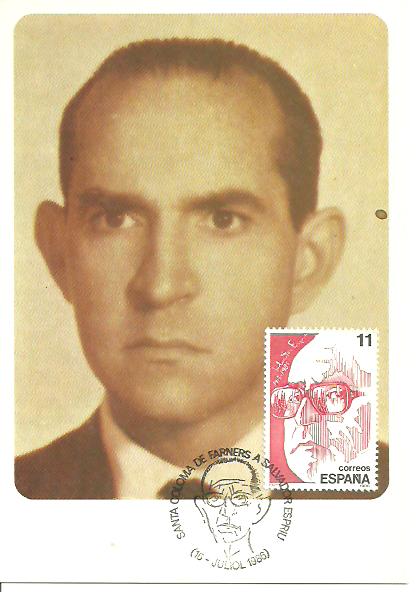
Salvador Espriu was born in Santa Coloma de Farners, Catalonia in 1913. The son of an attorney, his childhood was divided between his home town, Barcelona, and Arenys de Mar, a village on the Mediterranean coast. At the age of sixteen, he published his first book, Israel. In 1930 he entered the University of Barcelona, where he studied law and ancient history. While traveling (1933) to Egypt, Greece and Palestine, he became acquainted with the countries that originated the great classical myths, and which would be so influential in his work. During the Spanish civil war he was mobilised and served in military accounting.
Choosing the "internal exile" in Barcelona, he became one of the main voices of Catalan National Resistance to Franco fascist regime's attempts to destroy Catalan Language and Culture.

Translated into several languages, Espriu's work has obtained international recognition, most notably the Montaigne prize (1971). He was also given the Award of Honour of Catalan Letters (1972), the Ignasi Iglesias prize (1980), the City of Barcelona Prize (1982) and the Gold Medal of the Generalitat de Catalunya (1982). He was awarded honorary doctor's degrees by the universities of Toulouse and Barcelona. He died in Barcelona in 1985, and was buried in the Arenys de Mar cemetery, which gives name to his poem Cementiri de Sinera.


INICI DE CŔNTIC EN EL TEMPLE

Ara digueu: "La ginesta floreix,
arreu als camps hi ha vermell de roselles.
Amb nova falç comencem a segar
el blat madur i, amb ell, les males herbes."
Ah, joves llavis desclosos després
de la foscor, si sabíeu com l'alba
ens ha trigat, com és llarg d'esperar
un alçament de llum en la tenebra!
Perň hem viscut per salvar-vos els mots,
per retornar-vos el nom de cada cosa,
perquč seguíssiu el recte camí
d'accés al ple domini de la terra.
Vŕrem mirar ben al lluny del desert,
davallŕvem al fons del nostre somni.
Cisternes seques esdevenen cims
pujats per esglaons de lentes hores.
Ara digueu: "Nosaltres escoltem
les veus del vent per l'alta mar d'espigues."
Ara digueu: "Ens mantindrem fidels
per sempre més al servei d'aquest poble."


BEGINNING OF CANTICLE IN THE TEMPLE from "Les cançons d'Ariadna" (Literal translation by Magda Bogin)

Now say: "The broom tree blooms,
everywhere the fields are red with poppies.
With new scythes we'll thresh
the ripened wheat and weeds."
Ah, young lips parting after dark,
if you only knew how dawn
delayed us, how long we had to wait
for light to rise in the gloom!
But we have lived to save your words,
to return you the name of every thing,
so that you'd stay on the straight path
that leads to the mastery of earth.
We looked beyond the desert,
plumbed the depth of our dreams,
turned dry cisterns into peaks
scaled by the long steps of time.
Now say: "We hear the voices
of the wind on the high sea of crested grain."
Now say: "We shall be ever faithful
to the people of this land."

Send note to Staff  Go to Top of Page
Pillar Of The Community
Germany
1714 Posts
Posted 01/28/2012   1:00 pm  Show Profile Bookmark this reply Add scotzm to your friends list  Get a Link to this Reply


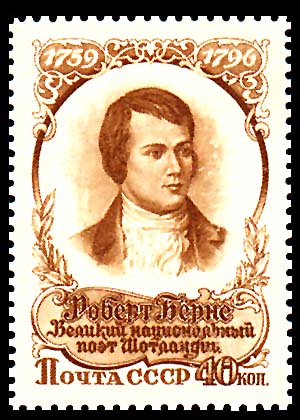
Scottish poet Robert Burns was designated a "peoples poet" in the USSR and they were the first country to issue a stamp of him.

But pleasures are like poppies spread,
You seize the flow'r, its bloom is shed;
Or like the snow falls in the river,
A moment white-then melts forever.


Send note to Staff  Go to Top of Page
Pillar Of The Community
Canada
1084 Posts
Posted 01/28/2012   2:33 pm  Show Profile Bookmark this reply Add cynical to your friends list  Get a Link to this Reply
Timbres: thanks for doing the Housman search. It sure illustrates the value of the Scott catalogue on CD.

I guess its safe to say he hasn't made it onto a stamp. I remember snippets of his poems. One in particular sticks in my head because I used it for the eulogy at my mother's funeral. Absent a stamp but the opportunity to bump the thread the lines went roughly like this:

And sure enough beneath the trees
There walks another love with me
And overhead the aspen heaves
Its rainy sounding silver leaves
And I spell nothing in their stir
But now perhaps they speak to her
Send note to Staff  Go to Top of Page
Bedrock Of The Community
Australia
38679 Posts
Posted 01/28/2012   6:42 pm  Show Profile Bookmark this reply Add rod222 to your friends list  Get a Link to this Reply

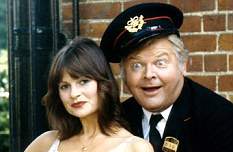
A tribute to the English Poet Benny Hill,
kept of stamps because the wimpish Brits
feel he was politically incorrect.


You could hear the hoof beats pound
As they raced across the ground
And the clatter of the wheels
As they spun round and round
And he galloped into Market Street
His badge upon his chest
His name was Ernie
And he drove the fastest milkcart in the west

Now Ernie loved a widow
A lady known as Sue
She lived all alone in Linley Lane
At number twenty two
They said she was too good for him
She was haughty, proud and chic
But Ernie got his cocoa there
Three times every week
They called him Ernie (Ernie)
And he drove the fastest milkcart in the west

Send note to Staff  Go to Top of Page
Pillar Of The Community
7838 Posts
Posted 01/30/2012   07:36 am  Show Profile Bookmark this reply Add nethryk to your friends list  Get a Link to this Reply
Sándor Petofi (1823-1849) was a Hungarian poet and liberal revolutionary. He is considered as Hungary's national poet and he was one of the key figures of the Hungarian Revolution of 1848. Here is an image of a semi-postal stamp depicting the death of Petofi in the Battle of Segesvár, designed by F. Halbing, printed by lithogravure, and issued by Hungary on January 23, 1923 to commemorate the poet's birth centenary, Scott No. B75, SG No. 409, plus a literal translation of the first stanza of Petofi's inspirational work, Nemzeti dal.

- nethryk


The National Poem

On your feet, Magyar, the homeland calls!
The time is here, now or never!
Shall we be slaves or free?
This is the question, choose your answer! -
By the God of the Hungarians
We vow,
We vow, that we will be slaves
No longer!
Send note to Staff  Go to Top of Page
Edited by nethryk - 01/30/2012 07:40 am
Pillar Of The Community
Germany
1714 Posts
Posted 01/30/2012   1:42 pm  Show Profile Bookmark this reply Add scotzm to your friends list  Get a Link to this Reply
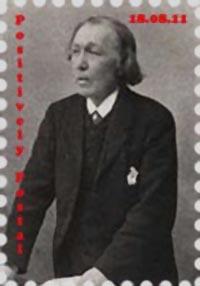
Probably the worst poet ever and never given a stamp...until now.


William Topaz McGonagall

Here is a shortened version (thankfully) of his epic poem...
The Tay Bridge Disaster

Beautiful Railway Bridge of the Silv'ry Tay!
Alas! I am very sorry to say
That ninety lives have been taken away
On the last Sabbath day of 1879,
Which will be remember'd for a very long time.

... many verses deleted...(they really are bad)...

It must have been an awful sight,
To witness in the dusky moonlight,
While the Storm Fiend did laugh, and angry did bray,
Along the Railway Bridge of the Silv'ry Tay,
Oh! ill-fated Bridge of the Silv'ry Tay,
I must now conclude my lay
By telling the world fearlessly without the least dismay,
That your central girders would not have given way,
At least many sensible men do say,
Had they been supported on each side with buttresses,
At least many sensible men confesses,
For the stronger we our houses do build,
The less chance we have of being killed.
Send note to Staff  Go to Top of Page
Pillar Of The Community
1508 Posts
Posted 01/30/2012   2:29 pm  Show Profile Bookmark this reply Add fifia to your friends list  Get a Link to this Reply
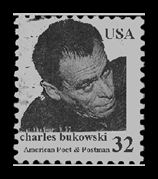
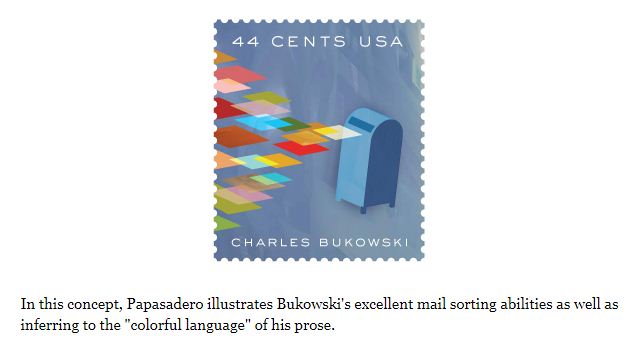
Henry Charles Bukowski (born Heinrich Karl Bukowski; August 16, 1920 – March 9, 1994)
was an American poet, novelist and short story writer. His writing was influenced by the social, cultural and economic ambience of his home city of Los Angeles. It is marked by an emphasis on the ordinary lives of poor Americans, the act of writing, alcohol, relationships with women and the drudgery of work. Bukowski wrote thousands of poems, hundreds of short stories and six novels, eventually publishing over sixty books. In 1986 Time called Bukowski a "laureate of American lowlife".

I guess this is a real stamp.


and this was a proposal since he was a postal worker until the age of 49.


Here is part of one of his poems. You have to google him....

Drunk and writing poems
at 3:15 a.m.

some people tell me that I'm
famous.

what am I doing alone
drunk and writing poems at
3:18 a.m.?

I'm as crazy as I ever was
they don't understand
that I haven't stopped hanging out of 4th floor
windows by my heels-
I still do
right now
sitting here


Send note to Staff  Go to Top of Page
Edited by fifia - 01/30/2012 2:32 pm
Pillar Of The Community
United States
3568 Posts
Posted 01/30/2012   3:10 pm  Show Profile Bookmark this reply Add jhlovell to your friends list  Get a Link to this Reply
There must be a Tennyson or Poe lover out there somewhere. Longfellow's Evangeline where are you, but thank you for not doing all of Scott's Lady of the Lake. Great stuff all!
Send note to Staff  Go to Top of Page
Edited by jhlovell - 01/30/2012 3:13 pm
Pillar Of The Community
7838 Posts
Posted 01/31/2012   09:20 am  Show Profile Bookmark this reply Add nethryk to your friends list  Get a Link to this Reply
Another winner of the Nobel Prize for Literature (and the first non-European Nobel laureate): Rabindranath Tagore (1861-1941), a Bengali polymath who reshaped his region's literature and music. Here is an image of a stamp featuring a portrait of Tagore, designed by Swedish graphic artist Lasse Söderberg (1941- ), engraved by Arne Wallhorn, and issued by Sweden on December 10, 1973, Scott No. 1030, Facit No. 852, plus a c.1909 photo of Tagore (probably the model for the stamp's design), and a free-verse translation of a sample of his poetry.

- nethryk


Song VII of Gitanjali

My song has put off her adornments.
She has no pride of dress and decoration.
Ornaments would mar our union; they would come
between thee and me; their jingling would drown thy whispers.
My poet's vanity dies in shame before thy sight.
O master poet, I have sat down at thy feet.
Only let me make my life simple and straight,
like a flute of reed for thee to fill with music
Send note to Staff  Go to Top of Page
Edited by nethryk - 12/24/2012 08:57 am
Pillar Of The Community
7838 Posts
Posted 02/05/2012   10:17 am  Show Profile Bookmark this reply Add nethryk to your friends list  Get a Link to this Reply
Taras Hryhorovych Shevchenko (1814-1861) was a Ukrainian poet, artist and humanist. His literary heritage is regarded to be the foundation of modern Ukrainian literature and, to a large extent, the modern Ukrainian language. Here is an image of a stamp featuring a portrait of Shevchenko, designed by Soviet artist Yuri A. Lukianov, engraved by Tatiana Mihailovna Nikitina, and issued by Russia on March 1, 1964 to commemorate the 150th anniversary of the poet's birth, Scott No. 2855, Zagorski No. 2906, plus an 1859 photo of Shevchenko which may have been the model for the stamp's design, and a translation of his 1845 poem Zapovit ("Testament"), which enjoys a status second only to Ukraine's national anthem.

- nethryk


Testament

When I am dead, bury me
In my beloved Ukraine,
My tomb upon a grave mound high
Amid the spreading plain,
So that the fields, the boundless steppes,
The Dnieper's plunging shore
My eyes could see, my ears could hear
The mighty river roar.

When from Ukraine the Dnieper bears
Into the deep blue sea
The blood of foes ... then will I leave
These hills and fertile fields --
I'll leave them all and fly away
To the abode of God,
And then I'll pray .... But till that day
I nothing know of God.

Oh bury me, then rise ye up
And break your heavy chains
And water with the tyrants' blood
The freedom you have gained.
And in the great new family,
The family of the free,
With softly spoken, kindly word
Remember also me.

— Taras Shevchenko,
25 December 1845, Pereiaslav
Translated by John Weir, Toronto, 1961

Send note to Staff  Go to Top of Page
Edited by nethryk - 12/24/2012 08:57 am
Pillar Of The Community
1508 Posts
Posted 02/08/2012   6:30 pm  Show Profile Bookmark this reply Add fifia to your friends list  Get a Link to this Reply
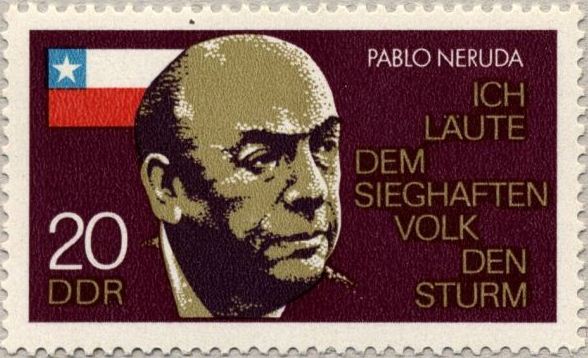
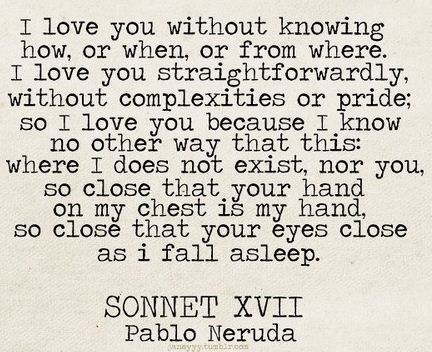
Pablo Neruda (July 12, 1904 – September 23, 1973)
was the pen name and, later, legal name of the Chilean poet, diplomat and politician Neftalí Ricardo Reyes Basoalto. He chose his pen name after Czech poet Jan Neruda.


Send note to Staff  Go to Top of Page
Pillar Of The Community
1508 Posts
Posted 02/09/2012   09:20 am  Show Profile Bookmark this reply Add fifia to your friends list  Get a Link to this Reply
Christian Johann Heinrich Heine (13 December 1797 – 17 February 1856)

was one of the most significant German poets of the 19th century. He was also a journalist, essayist, and literary critic. He is best known outside Germany for his early lyric poetry, which was set to music in the form of Lieder (art songs) by composers such as Robert Schumann and Franz Schubert. Heine's later verse and prose is distinguished by its satirical wit and irony. His radical political views led to many of his works being banned by German authorities. Heine spent the last 25 years of his life as an expatriate in Paris.


Das Fräulein stand am Meere
Und seufzte lang und bang.
Es rührte sie so sehre
der Sonnenuntergang.

Mein Fräulein! Sein sie munter,
Das ist ein altes Stück;
Hier vorne geht sie unter
Und kehrt von hinten zurück.

A mistress stood by the sea
sighing long and anxiously.
She was so deeply stirred
By the setting sun

My Fräulein!, be gay,
This is an old play;
ahead of you it sets
And from behind it returns.


Send note to Staff  Go to Top of Page
Pillar Of The Community
7838 Posts
Posted 02/11/2012   09:16 am  Show Profile Bookmark this reply Add nethryk to your friends list  Get a Link to this Reply
fifia - Thanks for sharing your excellent posts about Pablo Neruda and Christian Johann Heinrich Heine!

Andrej Sládkovic; (1820-1872) was a Slovak poet, critic, publicist and translator. Here is an image of a stamp featuring a portrait of Sládkovic, designed by Slovak painter and graphic artist Albín Brunovský (1935-1997), engraved by Josef Hercik, and issued by Czechoslovakia on June 14, 1972 to commemorate the centenary of the poet's death, Scott No. 1819. Also, here is an image of an 1872 portrait of Sládkovic by Slovak painter and sculptor Jozef Božetech Klemens (1817-1883), and the first stanza (in Slovakian) of Sládkovic's romantic narrative poem, Marína (1846), for which I have unfortunately been unable to obtain an intelligible translation into English. Perhaps our good friend florian would be good enough to provide one?

- nethryk


Send note to Staff  Go to Top of Page
Edited by nethryk - 07/25/2013 10:01 am
Page: of 17 Previous TopicReplies: 244 / Views: 98,771Next Topic  
Previous Page | Next Page
 
To participate in the forum you must log in or register.

Go to Top of Page

Disclaimer: While a tremendous amount of effort goes into ensuring the accuracy of the information contained in this site, Stamp Community assumes no liability for errors. Copyright 2005 - 2026 Stamp Community Family - All rights reserved worldwide. Use of any images or content on this website without prior written permission of Stamp Community or the original lender is strictly prohibited.
Privacy Policy / Terms of Use    Advertise Here
Stamp Community Forum © 2007 - 2026 Stamp Community Forums
It took 0.2 seconds to lick this stamp. Powered By: Snitz Forums 2000 Version 3.4.05