|
This page may contain links that result in small commissions to keep this free site up and running.

Welcome Guest! Registering and/or logging in will remove the anchor (bottom) ads. It's Free!
To participate in the forum you must log in or register.
| Author |
 Replies: 244 / Views: 100,104 Replies: 244 / Views: 100,104 |
|
|
|
Pillar Of The Community
1508 Posts |
|
|
Margit Kaffka (10 June 1880 – 1 December 1918) was a Hungarian writer and poet. 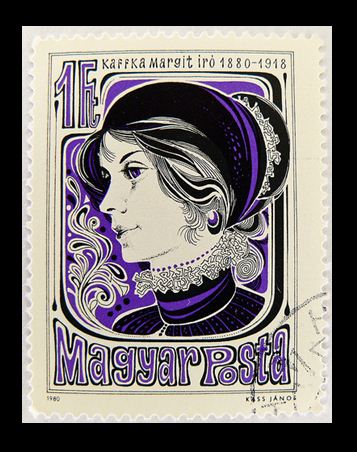 Called a "great, great writer" by Endre Ady, she was one of the most important female Hungarian authors, and an important member of the Nyugat generation. Her writing was inspired by József Kiss, Mihály Szabolcska, and the writers' group of the periodical Hét. FÉNYBENTudom, hogy a tavasz nem tart örökké, Hogy elmúlnak mind a derûs napok, Hogy a dal, hogy a tavasz idehagynak, És õsz fejemmel magam maradok. Zörgõ avarban, ködös alkonyattal, A darvak búcsúzása idején Ráérek majd jövõk titkát keresni, S borongva sírni emlékek ködén. De ki töpreng édes tavaszi reggel Fagyos pusztákon, hulló levelen, - Mikor csillámos, szõke napsugárral Végigragyogja útját a jelen... 1901 No English translation available  |
Send note to Staff 
|
| Edited by fifia - 02/16/2012 12:53 pm |
|
|
Pillar Of The Community
1508 Posts |
|
|
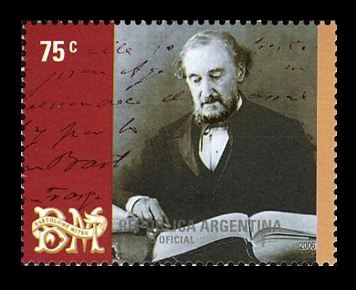 Bartolomé Mitre Martinez (1821-1906) Bartolomé Mitre Martinez (1821-1906)was an Argentine statesman, military figure, and ranks as one of Argentina's greatest writers. He was the president of Argentina from 1862 to 1868. When forced into exile, he worked as a soldier and journalist in Uruguay, Bolivia, Peru, and Chile. Mitre founded La Nación, one of South America's leading newspapers. He wrote the best 19th-century accounts of South America's wars of independence and published many works, amongst which are: Historia de Belgrano y de la Independencia Argentina [History of Belgrano and of the Argentine Independence] (1857; fifth edition in four volumes, 1902) Historia de San Martín y de la Emancipatión Sud-Americana [History of San Martín and the Emancipation of South America] He also wrote poetry and fiction (Soledad: Novela Original). He translated Dante's La Divina Commedia (The Divine Comedy) into Spanish. To mark the centennial of his death, Argentina issued a 75-centavo stamp showing Mitre the writer at work (Argentina, Scott #2368). |
|
Send note to Staff
|
|
|
Pillar Of The Community
7838 Posts |
|
|
Carl Gustaf Verner von Heidenstam (1859-1940) was a Swedish poet and novelist, and a laureate of the Nobel Prize in Literature in 1916. Most of Heidenstam's works are passionate depictions of Swedish character, life, and traditions. Here is an image of a stamp featuring a profile portrait of Heidenstam, stars and a gnarled tree by a reflecting lake, designed by Swedish graphic artist and illustrator Stig Åsberg (1909-1968), engraved by Arne Wallhorn, and issued by Sweden on July 6, 1959 for the poet's birth centenary, Scott No. 541, Facit No. 503A, plus an image of a 1931 oil portrait of Heidenstam by Swedish artist Johan Krouthén (1858–1932), and a special Valentine's Day selection, "The Trap", in Swedish and in English translation, from Ensamhetens tankar ("Thoughts in Loneliness"), published in Heidenstam's collection Vallfart och vandringsår ("Pilgrimage and Wandering"), 1888. - nethryk   XII. Jag snärjer I en snara, var viss, du får mig kär! Men just när du skall svara dig själv en dag så här: "Jag får väl ge den styggen mitt hjärta som han tiggt;" då vänder jag dig ryggen och gör en munter dikt. XII. A cunning trap I'm laying. Your love I have truly sought, But just as you will be saying Deep down in your inmost thought: "I'll give the bad man his due then, My heart that he's begged so long;" I'll turn my back on you then And make a merry song. |
|
Send note to Staff
|
| Edited by nethryk - 07/25/2013 10:02 am |
|
|
Valued Member
United States
333 Posts |
|
|
 Valdés, Gabriel de la Concepción ("Plácido") Sex: Male Born: Matanzas, Cuba 1809 Died: Cuba 1844 Activity/Profession: Poet, Print Journalist, Murder Victim 1809–1844 Cuban poet, journalist, patriot, and martyr best known for his protest poems and his alleged involvement in the Conspiración de las Escalera. Gabriel de la Concepción Valdés, more generally known by his pseudonym "Plácido," was born in Matanzas to a white mother, the Spanish dancer Concepción Vásquez, and a black father, Diego Ferrer Matoso. Plácido was abandoned as an infant, left at an orphanage on April 6, 1809; a note found with him was inscribed with the name "Gabriel de la Concepción." He was given the last name Valdés, and the phrase "al parecer, blanco" ("appears white") was inscribed on his baptism certificate. In his Biografías Americanas (1906), Enrique Piñeyro laments the fact that Plácido's remorseful father retrieved him soon after abandoning him; if he had not reclaimed his son, Plácido would have "lost any trace of his previous servile condition." As it was, Piñeyro says, his father's retrieval of him "condemned the poor thing to a perpetual inferior situation, to an irredeemable fortune." Even free blacks in 1840s Cuba enjoyed little economic and social mobility; however, Plácido's paternal grandmother taught him to read and write. At the age of fourteen, Plácido began working as a cashier in a publishing house. The pay was meager, and the few books and periodicals the business managed to publish were strictly regulated by colonial censorship. Plácido abandoned the press to become a peinetero apprentice, crafting women's haircombs from tortoiseshell. Known for his improvisational skills as a poet, in 1837 he started contributing a daily poem to the newspaper La Aurora de Matanzas. His "poetry of occasion"—laudatory poems commissioned for distinguished members of society—supplemented his income. In 1838 Plácido published Poesías, followed in 1842 by a collection of letrillas and epigramas entitled El Veguero. In that same year, a promotion at La Aurora enabled him to dedicate his professional efforts to literary pursuits and his personal ones to married life with a new wife. The "nearly white" poet clearly established his political and ethnic affiliations when he married a woman "de pura sangre africana" (of pure African blood). Many Spanish epic poems compared Spain's empire to that of Rome. In this vein, poems like "Death of Caesar," or the following verses from "Juramento"—which challenged imperial rule and which many Cubans knew by heart—set the stage for Plácido's impending demise: "to be an eternal enemy of the tyrant … / and to die at the hands of an executioner / if necessary to break the yoke" (Ser enemigo eterno del tirano … / Y morir a las manos de un verdugo / Si es necesario por romper el yugo.) In 1844 Plácido was executed by colonial troops, accused of participating in a plot to organize a slave revolt in the state of Matanzas and ultimately to win independence for Cuba. Many blacks, slaves and free alike, were brought in for questioning, tortured, and executed. The purge nearly wiped out the leaders of Cuba's free black population, and in the aftermath of the Conspiración de la Escalera, prominent mulattoes like journalists Rafael Serra y Montalvo ("the Cuban Booker T. Washington"), politician and activist Juan Gualberto Gómez, and Antonio Maceo y Grajales, a general in the independence forces, would continue to be the focus of white fears of blacks. Plácido himself was tried partly on the basis of his verse. Three of his most famous poems, "Adiós a mi lira" (Goodbye to My Lyre), "Despedida a mi madre" (Farewell to My Mother), and "Plegaria a Dios" (Prayer to God), are said to have been written in prison only a few days before his death. Though Plácido's fame increased after his death, he was renowned during his lifetime. His work has received a varied reception. One Spanish critic compared him to Luis de Góngora y Argote, a pillar of seventeenth-century baroque poetry. Some honor Plácido simply for the heroic circumstances of his death; others deem his verse "inferior," citing a lack of education. Most critics remark on his versatility both in style and form. His themes ranged from love to religion to liberty, and his styles included the didactic, elegiac, patriotic, improvised, and satiric. Nor did he limit his choice of form; he composed ballads, letrillas, redondillas, octavas, and décimas in the "popular" styles and "learned" verse in odes and sonnets. Some critics, like Richard Jackson, argue that Plácido should be celebrated both as a poet and a national hero. Lucky |
|
Send note to Staff
|
|
|
Pillar Of The Community
7838 Posts |
|
|
lucky - Thanks for posting that comprehensive entry about Plácido. Jirí Wolker (1900-1924) was a Czech poet (of so-called "proletarian poetry"), journalist and playwright. He was also one of the founding members of KSC, the Communist Party of Czechoslovakia, in 1921. He died of tuberculosis at the age of 24. Here is an image of a stamp featuring a portrait of Wolker, designed by A. Nauman, engraved by Ladislav Jirka, and issued by Czechoslovakia on November 25, 1954, Scott No. 672, SG No. 847, plus a rough English translation of Wolker's self-written epitaph. - nethryk  Here lies Jirí Wolker, a poet, who loved the world and for Justice he fought. Before we could whip out his heart to fight, died - young, twenty-four years. - Jirí Wolker, 1924 |
|
Send note to Staff
|
| Edited by nethryk - 02/20/2012 09:53 am |
|
|
Valued Member
United States
76 Posts |
|
|
Sing we now of Publius Vergilius Maro, (October 15, 70 BC – September 21, 19 BC), known to us as Vergil, the author of The Aeneid. His other works are The Eclogues and The Georgics. Here are Vatican City Scott #685-686, in honor of the 2000th anniversary of his birth: 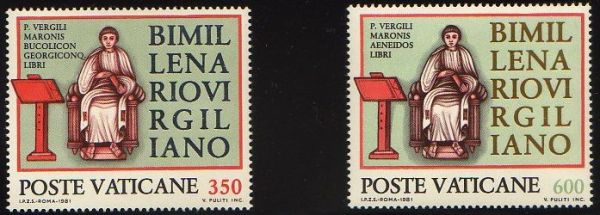 Arma virumque cano, Troiae qui primus ab oris Italiam, fato profugus, Laviniaque venit litora, multum ille et terris iactatus et alto vi superum saevae memorem Iunonis ob iram; multa quoque et bello passus, dum conderet urbem, inferretque deos Latio, genus unde Latinum, Albanique patres, atque altae moenia Romae. Arms, and the man I sing, who, forc'd by fate, And haughty Juno's unrelenting hate, Expell'd and exil'd, left the Trojan shore. Long labors, both by sea and land, he bore, And in the doubtful war, before he won The Latian realm, and built the destin'd town; His banish'd gods restor'd to rites divine, And settled sure succession in his line, From whence the race of Alban fathers come, And the long glories of majestic Rome. - Translated by John Dryden |
|
Send note to Staff
|
|
|
Valued Member
United States
76 Posts |
|
|
Dante Alighieri (1265-1321). Author of the Divine Comedy and Father of the Italian language. Vatican City, Scott #410-413, mounted on a White Ace page: 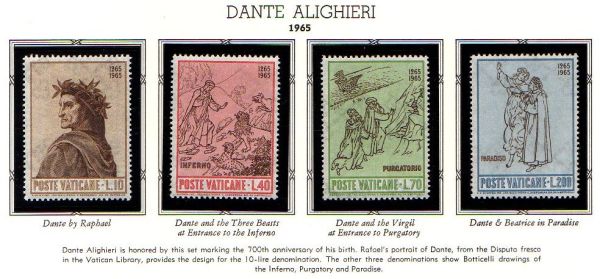 And USA, Scott #1268: 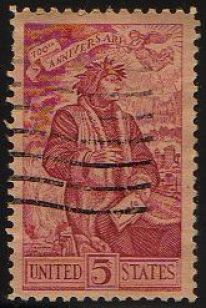 |
|
Send note to Staff
|
|
|
Pillar Of The Community
7838 Posts |
|
|
Per Daniel Amadeus Atterbom (1790-1855) was a Swedish romantic poet and a member of the Swedish Academy. Here is an image of a stamp featuring a profile portrait of Atterbom and a flower arrangement, designed by Swedish illustrator Stig Åsberg (1909-1968), engraved by Sven Ewert, and issued by Sweden on July 21, 1955 to commemorate Atterbom's birth centenary, Scott No. 484, Facit No. 476, plus a contemporary lithograph of the poet, and the first stanza (in translation) from Atterbom's poem "Linnea," from his 1836 collection Blommor ("The Flowers"). - nethryk   Linnea LinneaThe dark trees shudder From the gray mountain's hat; Silently asking sprites and elves, If the heat does stifle still. And coolness conjures them out And through the woods there passes A light and clear divine thought, In the Nordic summer's night. - Per Daniel Amadeus Atterbom, 1836 |
|
Send note to Staff
|
| Edited by nethryk - 12/24/2012 08:55 am |
|
|
Pillar Of The Community
Canada
6525 Posts |
|
|
Edgar Allen Poe 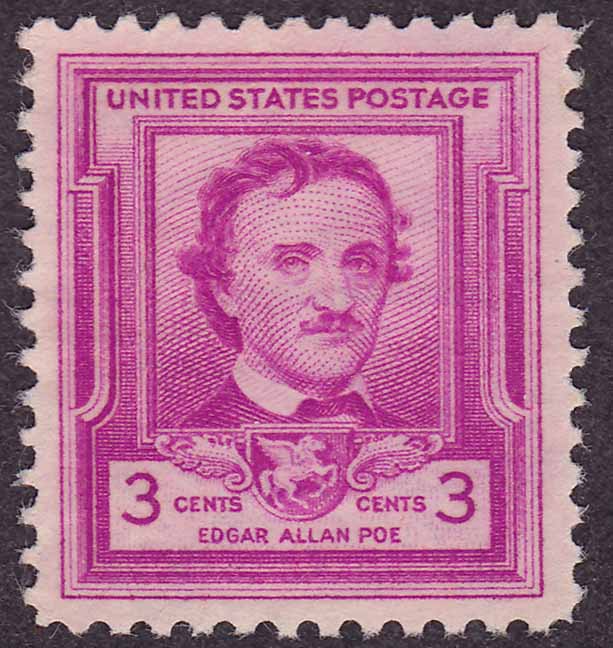 A Dream Within a Dream Take this kiss upon the brow! And, in parting from you now, Thus much let me avow- You are not wrong, who deem That my days have been a dream; Yet if hope has flown away In a night, or in a day, In a vision, or in none, Is it therefore the less gone? All that we see or seem Is but a dream within a dream. I stand amid the roar Of a surf-tormented shore, And I hold within my hand Grains of the golden sand- How few! yet how they creep Through my fingers to the deep, While I weep- while I weep! O God! can I not grasp Them with a tighter clasp? O God! can I not save One from the pitiless wave? Is all that we see or seem But a dream within a dream? |
|
Send note to Staff
|
| Edited by jamesw - 03/01/2012 10:06 am |
|
|
Pillar Of The Community
7838 Posts |
|
|
Lekhnath Paudyal (1885-1966) was the founding father of 20th century Nepali poetry. Paudyal's poems adhered to the old-fashioned conventions of Sanskrit poetics ( kavya) but also suggested a more spontaneous and emotional spirit. Here is an image of a stamp featuring a portrait of Lekhnath Paudyal, printed by photogravure, and issued by Nepal on December 12, 1966, Scott No. 198, SG No. 211, plus a translation of a short but elegant poem in which a swallow explains the transient nature of existence to the poet. Note: I don't know why Paudyal is wearing what appears to be a piece of cloth or paper along with a tika (dot) on his forehead in this portrait. Perhaps one of our SCF members of the Hindu faith can explain? - nethryk  Gaunthaliko Chiribiri Gaunthaliko Chiribiri ("The Chirruping of a Swallow") You say this house is yours, I say that it is mine, To whom in fact does it belong? Turn your mind to that! Lekhnath Paudyal, 1935 |
|
Send note to Staff
|
| Edited by nethryk - 03/04/2012 08:12 am |
|
|
Pillar Of The Community
7838 Posts |
|
|
Mihai (also Mihail) Eminescu (1850-1889) was a poet, novelist and journalist, often regarded as the most famous and influential Romanian poet. Here is an image of a stamp featuring a portrait of Eminescu, designed by A. Ionescu- Iasi and I. Mihaiescu, printed by lithogravure, and issued by Romania on May 10, 1964, Scott No. 1643, plus a photo of Eminescu taken in 1869, and a translation of the first four stanzas of Eminescu's masterpiece, a love poem entitled Luceafarul ("The Morning Star," i.e., Venus), published in 1883. - nethryk   The Morning Star The Morning StarThere was, as in the fairy tales, As ne'er in the time's raid, There was, of famous royal blood A most beautiful maid. She was her parents' only child, Bright like the sun at noon, Like the Virgin midst the saints And among stars the moon. From the deep shadow of the vaults Her step now she directs Toward a window; at its nook Bright Morning-star expects. She looks as in the distant seas He rises, darts his rays And leads the blackish, loaded ships On the wet, moving, ways. Mihai Eminescu, 1883 |
|
Send note to Staff
|
| Edited by nethryk - 12/24/2012 08:55 am |
|
|
Pillar Of The Community
7838 Posts |
|
|
Peter Rosegger (1843-1918) was an Austrian poet from the province of Styria. Here is an image of a stamp featuring a portrait of Rosegger, designed by Adalbert Pilch, engraved by Alfred Nefe, and issued by Austria on June 26, 1968, Scott No. 814, Michel No. 1267, plus a photo portrait of Rosegger ca. 1900 by Franz Josef Böhm (1874-1938), and a brief sample of Rosegger's poetry. - nethryk   The Other, Too, Is You (Auch der andre, der bist du) The Other, Too, Is You (Auch der andre, der bist du) What once Earth to me presented she's already asking back; comes to take what she had granted, grasping tender speck by speck. Strange: the more of hurts I carried the more beauty showed the land; What I fought for, gains of merit, softly falling from my hand. And the lighter I am getting, the more heavily I walk: "Can't you, from your moistened setting, spare me, Earth? I beg you, talk!" "No, I cannot spare you, Brother, need you for the other one; out of you I'll feed the other: let him also see the sun. But relax and do not rue: For the Other, too 'tis You!" From Mein Lied, by Peter Rosegger, translated by Walter Aue (1911) |
|
Send note to Staff
|
| Edited by nethryk - 12/24/2012 08:56 am |
|
|
Valued Member
United States
91 Posts |
|
|
Interview with a bookworm
by Norman Riger
We're very dumb and cannot read,
but the paper in books is what we need.
Dry books on shelves we always abhor.
Store your books on a damp basement floor,
or outside during a heavy downpour.
Never sell your books to any store.
copyright by Norman Riger
Never put off for tomorrow what you can get out of doing today.
|
|
Send note to Staff
|
|
|
Valued Member
Chile
54 Posts |
|
|
Gabriela Mistral was the pen name of the Chilean poet Lucila Godoy Alcayaga, the first Spanish-American writer to win the Nobel Prize (1945). She enjoyed a continental reputation as a humanitarian and educator, and, together with several other writers, contributed greatly to postmodernist verse. 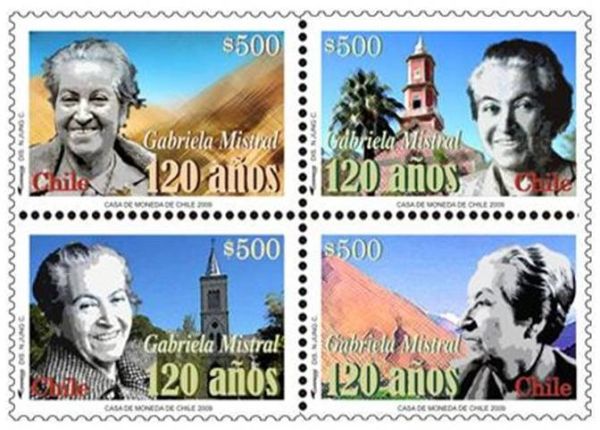 Mistral's poems deal with nature, biblical motifs, death, platonic love, and especially love of children and of the dispossessed; they are permeated by feelings of sadness, compassion, asceticism, unsatisfied maternal longing, and communion with the land. 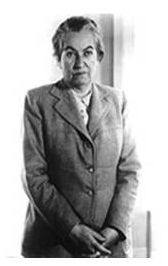 Tiny Feet Tiny FeetA child's tiny feet, Blue, blue with cold, How can they see and not protect you? Oh, my God! Tiny wounded feet, Bruised all over by pebbles, Abused by snow and soil! Man, being blind, ignores that where you step, you leave A blossom of bright light, that where you have placed your bleeding little soles a redolent tuberose grows. Since, however, you walk through the streets so straight, you are courageous, without fault. Child's tiny feet, Two suffering little gems, How can the people pass, unseeing. Our great Gabriela! Regards from Chile  José |
|
Send note to Staff
|
|
|
Pillar Of The Community
7838 Posts |
|
|
radiola - Excellent post! Thanks for sharing. Here is an image of an engraved stamp also honoring Gabriela Mistral, issued by Chile on January 10, 1958, Scott No. 300, SG No. 460. - nethryk  |
|
Send note to Staff
|
|
|
Replies: 244 / Views: 100,104 |
|
|
To participate in the forum you must log in or register. | |
Disclaimer: While a tremendous amount of effort goes into ensuring the accuracy of the information contained in this site, Stamp Community assumes no liability for errors. Copyright 2005 - 2026 Stamp Community Family - All rights reserved worldwide. Use of any images or content on this website without prior written permission of Stamp Community or the original lender is strictly prohibited.
Privacy Policy / Terms of Use Advertise Here |
| Stamp Community Forum |
© 2007 - 2026 Stamp Community Forums |
| It took 0.26 seconds to lick this stamp. |
 |
|
|
|


 Posted 02/11/2012 5:46 pm


