| Author |
 Replies: 6 / Views: 2,299 Replies: 6 / Views: 2,299 |
|
|
Valued Member
United States
187 Posts |
|
|
I noticed on this stamp that the top frame line does not go all the way across. Is this normal or not? Other end points outward which I see is common on many other PEI stamps so I assume is normal. Maybe the double top frame line is a re-entry?   |
|
Send note to Staff
|
| Edited by bwdavis - 03/20/2012 11:19 am |
|
|
|
|
Pillar Of The Community
Canada
1227 Posts |
|
|
bwdavis, I checked my three copies of this stamp and all have a single frame line across the top. I also think that your stamp may be a re-entry. |
Send note to Staff 
|
|
|
Valued Member
Canada
60 Posts |
|
|
Sorry bwdavis, My copy has one straight line all the way across the top. |
|
Send note to Staff
|
|
|
Valued Member
Canada
215 Posts |
|
|
Here's mine bwdavis I too have a similar stamp. Mine also has dots along left margin and a faint line at the bottom margin. I see in your pic that the dots on left margin might be there also. Very interesting must try to find more info on this. Did you try sending to reentery.com?? 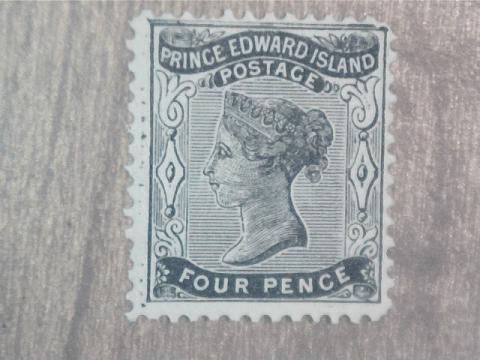 |
|
Send note to Staff
|
|
|
Valued Member
Canada
450 Posts |
|
|
Looks like a lovely constant plating variety.
The January 23, 2010 Eastern Auctions "Crossing" Collection, Lot 21 shows the same example (dots down left side and extra frameline at top), from the right hand margin.
Someone should do (or already has done?) a plating of this stamp. I wonder if it is possible to plate the entire pane? |
|
Send note to Staff
|
|
|
Valued Member
United States
187 Posts |
|
|
re image from Northener0 Your image also shows the line above the D in EDWARD that mine has thanks for your image and reply bwdavis  |
|
Send note to Staff
|
| Edited by bwdavis - 03/21/2012 2:47 pm |
|
|
Valued Member
United States
187 Posts |
|
|
Reply from Ralph E. Trimble
I'm sorry to report that this is not a re-entry. These stamps were
typographed, which is basically the opposite of line engraving. Re-entries occur only on engraved stamps, due to a misapplication of the transfer roll on the plate.
Typographed stamps were printed from plates made up of a number of cliches which were usually 'grown' on a lead mould by electroplating. The cliches were then either bound together in a frame holding the number of cliches needed for a full plate, or they were soldered together before being used to print. The areas where the cliches came together were often raised, like the raised areas of the cliches that did the actual printing. These were sometimes flattened out by hammering, or they were simply left alone. These raised areas, mostly in the form of lines, would then pick up ink and print, resulting in the type of line you see on your stamp. These are extremely common on typographed stamps and indeed are often mistaken for re-entries.
I hope this helps.
Oh, interestingly, a few hours after your email was written, I received another email from a James Melcher with a scan of PEI #9 with the same line, asking the same question. Are you two fellows working together??? I will be copying my reply above to him, as well.
Best wishes,
Ralph
Ralph E. Trimble FRPSC
President, Philatelic Specialists Society of Canada
PSSC RPSC BNAPS RPSL CPSGB CCNY APS APEX EFOCC AIEP VGGPRF
Director, Board of Directors, The V.G. Greene Philatelic Research Foundation
Member of The Greene Foundation Expert Committee
Unitrade Specialized Editorial Associate
|
|
Send note to Staff
|
| Edited by bwdavis - 03/25/2012 10:08 am |
|
| |
Replies: 6 / Views: 2,299 |
|




 Posted 03/20/2012 10:08 am


