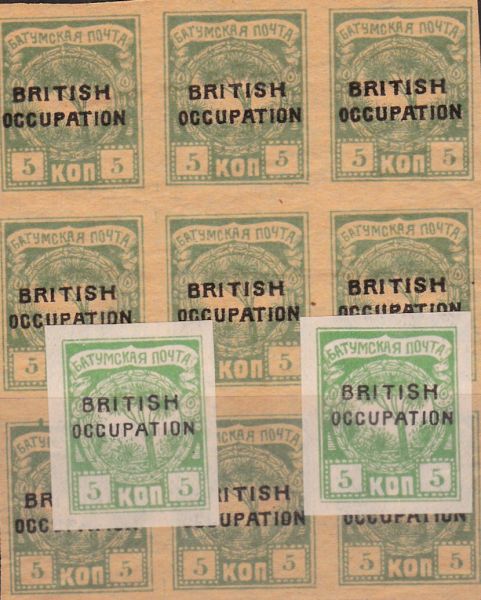
I'm preparing a Batum "common" forgery post which will appear in November in the Big Blue blog, but here is a teaser.

Note: Forgery naming nomenclature is tricky, as each author has their own system (Hughes, Ashford, Ceresa).
My naming nomenclature here is based on this nice site...
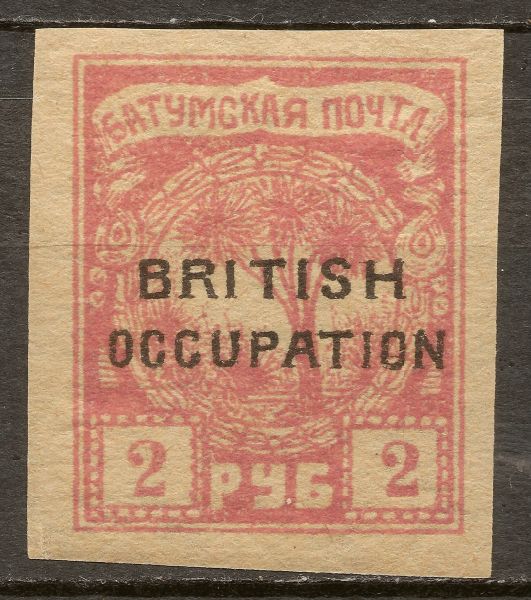
http://www.numonesidentifier.com/country/1/ 1919 Scott 17 2r salmon pink (Genuine)
"Scott 17" Type II ForgeryThe left stamp shows the genuine 2r salmon pink.
The right stamp has a forgery overprint associated with a Type II forgery stamp.
Some of the characteristics of the forgery overprint as compared to the genuine are...
• The lower portion of the "B" is larger
• The front leg of the "R" is more curved than the original
• The "I" is raised compared to the "R", and seems slightly tilted
• The "S" is larger
• The "H" does not have the little serifs
• The "U" seems tilted
• No serifs on the "A", "T", and "N" of "Occupation"
Since forgery overprints are always found on forgery stamps (And genuine overprints are always found on genuine stamps), it follows that the left stamp is genuine, and the right stamp is a forgery.
But let's examine a "Ruble" denomination without the overprint.
 1919 Scott 4 1r red brown (Genuine)
"Scott 4" Type II ForgeryNote that the "Ruble" values have 7 dots over the right value tablet for both the genuine and Type II forgery stamp, so no help there. The "Kopeck" values have a 6 dot (genuine) vs 7 dot (Forgery I & II) difference, so quite easy to differentiate.
Still, the Type II forgery has a few obvious differences compared to the genuine.
• White paper
• What I call the "curved branch" sign. Note the third branch (of the six branches) counting from the left is quite curved (compared to the genuine), and the space between the third and forth branch is hence narrow. This field mark is quite easy to pick up. This is true for all Type II forgeries (Kopeck and Ruble).
There are a myriad of other differences which I will explore on my blog (and other forgeries), but the differences noted above should help.

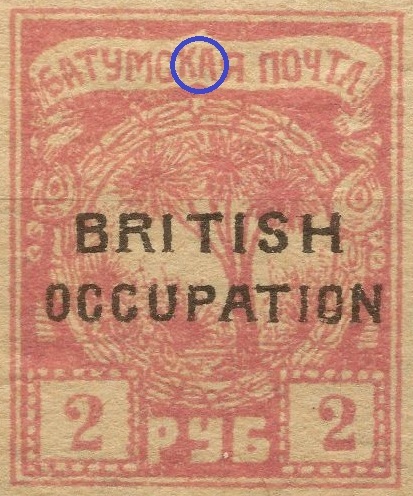
In regards to the KA being joined...
One will note that my example is joined, while danko's example is not joined.
What's with that?

The 6 subject transfer block for the 2 Ruble value (Scott 17) shows 4 with the KA joined, 2 not joined. Reviewing all the Ruble values for the 1919 "British occupation" issue (Scott 16-20), finds 20 subject images with KA joined, 10 not joined. Therefore the "joined KA" sign is inconsistent.

(1993, R.J. Ceresa's "The Postage Stamps of Russia 1917-23, Volume 4. Transcaucasia, Parts 13-16, British Occupation of Batum")
IMHO, Danko, your 2r salmon pink looks genuine.





 Posted 08/03/2012 10:58 pm




 k
k