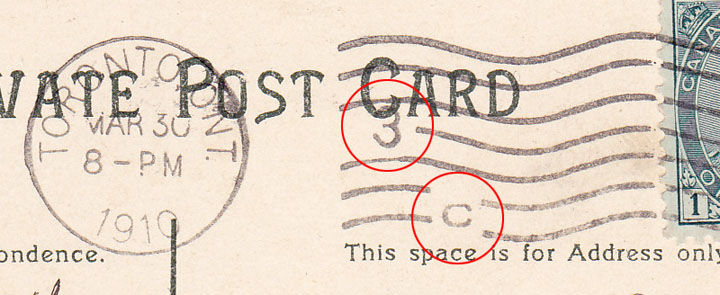
I'm not sure if Canada used the same numbering method as in the US, but in most cases the number (as in the center of the wavy lines) usually represented the machine number.
There are various reasons for the letter in the lower part of the killer cancel. One city uses the reference "C" for letters designated for delivery within the "city"; others used the "T" to represent "transit" or "mail in transit" from the city to another post office; and "R" stood for "received" as in incoming mail from outside the city slated for delivery within the city designated in the CDS.
Of course those aren't the only letter "designators" ever used and it may be that other cities may have used other identifiers, but that's one explanation. Note that the maker of the machine cancels intentionally provided spacing and "slugs" to be inserted in those areas presumably for the convenience of local postal officials to insert the desired machine numbers and designators so they could be modified and applied for various purposes.
Thanks wt1. I do have another with an R in the waves. However, this Toronto marked card with the C was being sent out of the city to Ravenna Ontario, a couple of hundred kms north west. So perhaps Toronto used a different system for their letter code.
The cancel in an International model G1 (machine 3). International used 4 service indicators T-Transit, R-Received, D-Delivered to Post Office, C-Collected (by carrier or from box).
Disclaimer: While a tremendous amount of effort goes into ensuring the accuracy of the information contained in this site, Stamp Community assumes no liability for errors. Copyright 2005 - 2026 Stamp Community Family - All rights reserved worldwide. Use of any images or content on this website without prior written permission of Stamp Community or the original lender is strictly prohibited. Privacy Policy / Terms of UseAdvertise Here





 Posted 10/28/2012 8:21 pm