| Author |
 Replies: 10 / Views: 6,200 Replies: 10 / Views: 6,200 |
|
|
Pillar Of The Community
Canada
6525 Posts |
|
|
Just received a WWII cover recently purchased from our compatriot djd. Admittedly I bought it for the anti-Japanese label that appears on the front. The image of course is a very nasty cartoon of a Japanese soldier about to slip on a banana peel. Classic slapstick put down. But what I don't understand is the banana peel is labeled 'Material Conservation' Can someone explain that one to me? 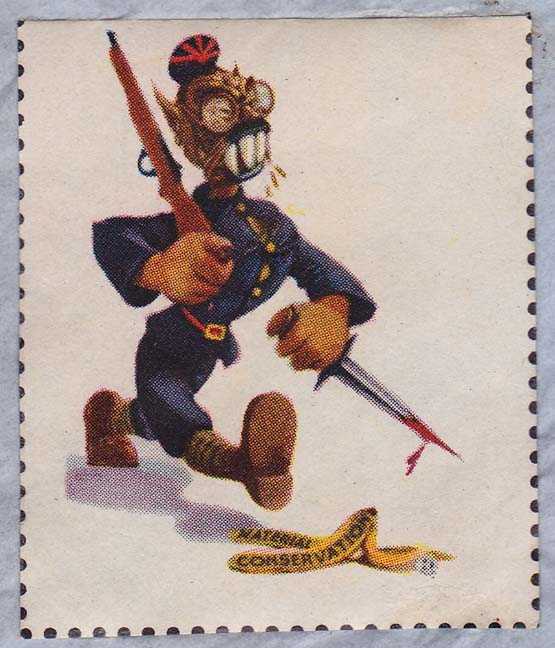 |
|
Send note to Staff
|
|
|
|
|
Pillar Of The Community
Canada
6525 Posts |
|
|
Here's a little additional info on this gentleman. He is the Tokio Kid.
According to the Website 'Homefront Digest' (Vol. 1 No. 9
April 2006):
Following the attack on Pearl Harbor, Douglas Aircraft, the southern California company responsible for a great deal of aircraft production, including the B-17 and B-24, introduced the memorable propaganda caricature known as the Tokio Kid. The Tokio Kid appeared on the back cover of the monthly Douglas publication titled Douglas Airview during 1942 and 1943. The cartoon image featured a monster-like Japanese villain with fangs thanking American workers for breaking tools, working slowly, or wasting materials and time. The image can also be found in poster format. This is another classic image from the war years when examining propaganda.
That would explain the Material Conservation peel. |
Send note to Staff 
|
|
|
Pillar Of The Community
United Kingdom
1356 Posts |
|
|
Is it to do with conserving resources to go to the war effort? In the UK in wartime there was encouragement to save, and recycle, what they could (although I'm sure it wasn't called recyling then!). Especially things like metal which could go towards armaments.
Edit - looks like its something along those lines according to that info, James |
|
Send note to Staff
|
| Edited by stampgal - 11/13/2012 2:04 pm |
|
|
Pillar Of The Community
Canada
6525 Posts |
|
|
Excellent guess stampgal.
On closer examination of the 'label' it is not a label at all! The perfs are printed (black dots). The envelope paper is quite thin and holding it up to the light I can see printing on the other side of the 'Kid'.
So it would seem this cinderella had been cut out of the back of the Douglas Airview and pasted onto the cover.
Hows that for wartime recycling! |
|
Send note to Staff
|
|
|
Pillar Of The Community
United Kingdom
1356 Posts |
|
|
Pillar Of The Community
United States
898 Posts |
|
|
Thanks for posting and sharing this. I actually had my eye on that cover, but never know quite what the protocol is here, and (1) didn't know what kind of bid increment is appropriate, and (2) didn't want to outbid someone on here. (It's a more personal place than the usual auction.) So my hesitation was your success! I was a history major in college (with an Asian studies concentration), and did a thesis focusing on the history of anti-Asian propaganda in the western US from the mid-19th to the mid-20th century. Although I've mostly been collecting stamps, over the years I've also ended up with a quite a collection of World War II anti-Japanese patriotic covers. (Someday I'll get them scanned and uploaded to a website.) I had never seen that cinderella before (and now we know why, since it was a clipping pasted on the envelope!), and so it caught my eye. Thanks for sharing it here, and for the additional research! Well done!  -- Dave |
|
Send note to Staff
|
|
|
Pillar Of The Community
United States
1179 Posts |
|
|
The WWII Patriotic Label illustrating "The Tokio Kid" was taken from a sheet of 24 labels. During WWII the public was encouraged to "waste nothing" -- "waste" was considered as helping the enemy; waste included food; gas, energy; metal scrap; rubber (tires); aluminum, etc. During the same period the public was issued "Ration Books" for similar commodity purchases. What we consider a "nasty" carton today was considered "politically correct" after December 7, 1941. The item is true postal history. View it in context of time, purpose and history. |
|
Send note to Staff
|
|
|
Pillar Of The Community
United States
1179 Posts |
|
|
The WWII Patriotic Label illustrating "The Tokio Kid" was taken from a sheet of 24 labels. During WWII the public was encouraged to "waste nothing" -- "waste" was considered as helping the enemy; waste included food; gas, energy; metal scrap; rubber (tires); aluminum, etc. During the same period the public was issued "Ration Books" for similar commodity purchases. What we consider a "nasty" carton today was considered "politically correct" after December 7, 1941. The item is true postal history. View it in context of time, purpose and history. |
|
Send note to Staff
|
|
|
Pillar Of The Community
Canada
6525 Posts |
|
|
Thanks for the post Hal. I'd love to see some of the actual labels. However this one was cut from the back of the magazine. Guess the hunt is on for the real thing. And how timely to bring it up today, December 7. Happy anniversary (incidentally, my wife and I met on this day in 2001, which was also the 60th anniversary of the attack. A memorable day all around  ) |
|
Send note to Staff
|
|
|
Pillar Of The Community
United States
1497 Posts |
|
|
During the Second World War, Douglas Aircraft built the DC-3 (C-47 in the USAAF) and the SBD Dauntless divebomber, which won the Battle of Midway for the US. Other aircraft include the A-20 Havoc and A-26 Invader. The B-17 was built by Boeing and the B-24 by Consolidated.
Regards, Robert |
|
Send note to Staff
|
|
|
Pillar Of The Community
United States
3247 Posts |
|
|
I'm thinking that by Americans conserving vital materials so they could be used for the war effort, we could bring down the Japanese/Axis. The "bringing down" would be Tokio Kid actually stepping on the peel and collapsing.
Interesting to see this, especially in this day of being politically correct, even if it means burying your head in the sand. We need to learn from history, not hide it away so we can make the same mistakes again... |
|
Send note to Staff
|
|
| |
Replies: 10 / Views: 6,200 |
|




 Posted 11/13/2012 1:43 pm


