| Author |
 Replies: 25 / Views: 4,910 Replies: 25 / Views: 4,910 |
|
Pillar Of The Community
Australia
2156 Posts |
|
|
Does anyone know anything about the use of micrometers in philately? I've recently come across quite a few examples of stamps on very thick or very thin paper. Clearly, I need to be able to take exact measurements. But all the micrometers listed for sale on ebay seem intended for engineering purposes or measuring objects. What do philatelists use? And where can I get one too? |
|
Send note to Staff
|
|
|
|
|
Pillar Of The Community
United States
5894 Posts |
|
|
Pillar Of The Community
Australia
2156 Posts |
|
|
Pillar Of The Community
United States
5894 Posts |
|
|
Pillar Of The Community
United States
2547 Posts |
|
|
Being a journeyman tool and die maker and the owner of a prototype tooling shop I have done a lot of measuring. I would like to present some information for your consideration.
In metrology it is important to understand the causes of measurement error. The 3 types of error that you must be concerned with are targeting, discrimination and R&R (repeatability and reproducibility).
Discrimination is the smallest unit that the instrument can read. Since paper thickness variations (at least with early U. S.) is about .01mm. We always try to use a 10:1 discrimination or the preferred instrument for measuring the paper would be able discrimination of .001mm. You will find that this may be cost prohibitive and you can back off to a 5:1 or .002mm.
The next is targeting this is how closely the measuring instrument can indicate true size. We have a special class on measuring that is commonly call low durometer measurement. This is simply the measuring of soft or easily compressible materials such as soft paper. The main concern is that excessive gage pressure will deform the material and give an off target measurement. When measuring soft paper you don't want to compress the fiber.
The last is R&R this is how well you can replicate a measurement. If you want to see how this works simply measure a stamp 20 times without looking at the micrometer reading, using only the "feel". When you think you have the measurement then look and record it. Do this 20 times on the same stamp. Unless you are very experienced in measuring you will probable see a variation of .01mm or more. In other words your variation equals the normal difference in the papers. So what size is it?
This problem becomes worse when you add in the targeting problem. When gauging paper your contact force should be in the range of 2-4 grams contact pressure.
You can use a snap type thickness gage that will help with the R&R but the gage pressure is still too great and the outcome measurement will be less than the actual paper thickness.
There is a simple solution that is to use a dial indicator with the return spring removed and a 2 gram pressure weight added to the top of the spindle. Mount it on a test stand and your problems are solved.
If you must use a micrometer always make sure that the anvil is on the face and the rotating spindle is to the back to help reduce the occurrence of scuffing.
|
Send note to Staff 
|
|
|
Pillar Of The Community
Australia
2156 Posts |
|
|
Thanks for the information, Russ. You wrote, "When measuring soft paper you don't want to compress the fiber."
Yes, this is what I'm worried about. But what alternative do I have?
You wrote, "There is a simple solution that is to use a dial indicator with the return spring removed and a 2 gram pressure weight added to the top of the spindle. Mount it on a test stand and your problems are solved."
I am not a technical person by any means. I don't even understand this, and, even I were able to purchase a dial indicator (whatever that is), I probably would not be capable of making these ajustments unassisted.
Sometimes, everything about philately just seems to be so bloody hard! |
|
Send note to Staff
|
|
|
Pillar Of The Community
United States
2547 Posts |
|
|
Bedrock Of The Community
Australia
38679 Posts |
|
|
Use your thumb and finger, as opening a very small bottle top,
twist the spindle of the micrometer as lightly as you would be
running your thumb gently across sandpaper.
When the spindle stops turning and your thumb and finger glide around the spindle
that should be correct.
Repeat a few times and you should get a repeat reading.
The resistance of your thumb and finger, should be as light as a feather.
You should be able to find a common reading at 1000th of an inch
In the shop where you intend to buy one, have the assistant show you
perhaps.
After a few times you'll wonder what the fuss was all about.
It's really easy, and fun, measure your hair.
|
|
Send note to Staff
|
| Edited by rod222 - 11/13/2012 9:01 pm |
|
|
Pillar Of The Community
United States
7103 Posts |
|
|
I have a Mitutoyo digital micrometer that is commonly used by people in the paper business to match paper weights. I don't use it very often.
Actual thickness measurements for stamps are hard to find. If you only have one stamp, and you don't have the measurements of the possible options, the device isn't especially helpful.
If you have thick and thin examples, a device is rarely necessary to tell them apart.
They are interesting to have, and there are other uses besides stamps, but I wouldn't want to oversell their usefulness (at least for my needs, and my resources).
|
|
Send note to Staff
|
|
|
Pillar Of The Community
Australia
2156 Posts |
|
|
Russ, thanks for your trouble. I've found an image of a dial indicator online, but, as it doesn't show it actually being used, I have no idea how it could be used to measure something. Please tell me it's simple! rod222, I'll probably just get one off ebay, so there'll be no one to show me how to use it. ... In any case, what kind of store sells a dial indicator? (Or a micrometer, for that matter.) Cjd, in both Australian stamps and German/Austrian stamps, paper thickness can be a significant matter. Perhaps this isn't the case with US stamps, I don't know, but the other day I read about a thick paper variety of the 3 heller 1980 Austrian series being discovered and I think it was listed for 800 Euros. I have a lot of these on paper, so it looks like it might be worth my while soaking them. I would of course need to be able to provide measurements if I turned out to have one and wanted to sell it. |
|
Send note to Staff
|
| Edited by jimjamtwo - 11/13/2012 9:09 pm |
|
|
Pillar Of The Community
United States
7103 Posts |
|
|
A micrometer will give you very precise measurements. I haven't found a lot of usefulness for the precision, but your mileage may vary.
Basically, I haven't found it necessary to run and grab it to tell thicker and thinner papers apart. I could see where the instant confirmation given by a number might give some peace of mind, though.
|
|
Send note to Staff
|
|
|
Pillar Of The Community
Australia
2156 Posts |
|
|
Cjd, how would you rate the Mitutoyo digital micrometer that you use?
Is there a risk of damaging the stamp in the process of measuring it? |
|
Send note to Staff
|
|
|
Pillar Of The Community
United States
7103 Posts |
|
|
It is great. No chance of damaging a stamp. It is very gentle, very quick. You could go through fifty stamps in a few minutes.
It wouldn't measure the diameter of a soap bubble, but it won't crush paper. |
|
Send note to Staff
|
|
|
Pillar Of The Community
Australia
2156 Posts |
|
|
Bedrock Of The Community
Australia
38679 Posts |
|
|
This is a std micrometer (outside) micrometer (as opposed to an inside micrometer which measures bore sizes). The bottom arrow is the barrel which you wind clockwise to close in on the article (extremely lightly) with nothing between the anvils, and the barrel wound in, the lines should line up (top arrow) if they do not, cheap or been dropped, no matter just be aware of the reading. each engraved line represents 1/1000th of an inch (or metric as the case may be) That's it cannot comment on quality etc. I wouldn't be spending much myself. 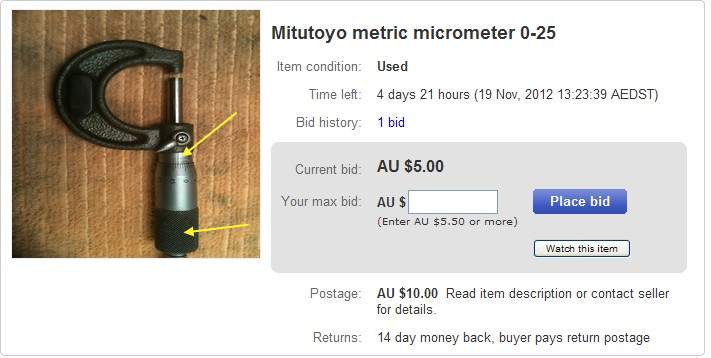 |
|
Send note to Staff
|
|
|
Pillar Of The Community
Australia
2156 Posts |
|
|
Thanks for the information and the ebay alert, rod222. I did do an ebay search, but for some reason I did not come across that listing. |
|
Send note to Staff
|
|
|
Replies: 25 / Views: 4,910 |
|




 Posted 11/13/2012 5:30 pm


