| Author |
 Replies: 7 / Views: 1,704 Replies: 7 / Views: 1,704 |
|
|
Valued Member
23 Posts |
|
|
|
|
Pillar Of The Community
2361 Posts |
|
|
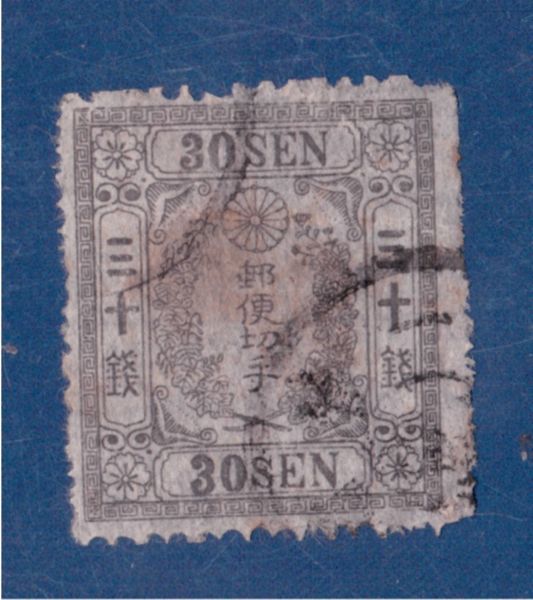
The "30 SEN" are in different sizes and different fonts, it strikes me as a counterfeit.
In any case, I don't see the syllabic box, so that rules out #31, 39, and 49, leaving #18. |
Send note to Staff 
|
|
|
Pillar Of The Community
United States
898 Posts |
|
|
I'm with Doug in thinking that that one's a forgery, both because of what he said, and also because the Japanese characters, especially in the vertical boxes on the left and right sides, don't look right.
Because Japanese stamps of this era were heavily forged and produced for "tourist sheets" (souvenirs for foreigners), I've heard that the forgeries outnumber genuine copies by somewhere between 100:1 and 1000:1, so the odds of having a forgery are quite good. And adding to that, in addition to the Japanese forgers for the tourist market, there were the usual suspects in Europe also forging the early Japanese stamps, too. I don't have the reference material in front of me to confirm this, but yours looks more like a European forgery to me, although I could well be wrong about that, too.
Everything Japan for Scott 1-54A is a minefield. I know dealers who sell Japanese collections who don't even count those stamps as a basis for valuing the collections (and I've bought them that way, too).
-- Dave |
|
Send note to Staff
|
|
|
Pillar Of The Community
United States
8605 Posts |
|
|
Its maybe a real stamp ,with a telegraph cancel and damaged perfs ,and a stain in the center . I like it with the inverted "S " in sen on the top.But it has very little value. |
|
Send note to Staff
|
| Edited by floortrader - 12/23/2012 8:59 pm |
|
|
Pillar Of The Community
United States
6756 Posts |
|
|
No, it's definitely a forgery. I just don't know who made it. Here is a genuine non-syllabic example: 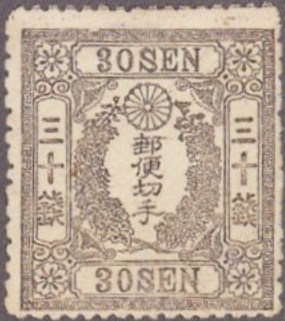 Wish it were mine...  k |
|
Send note to Staff
|
|
|
Valued Member
Japan
165 Posts |
|
|
This is pretty easy textbook forgery. You don't need to be an expert to recognize it. Here is the tip: 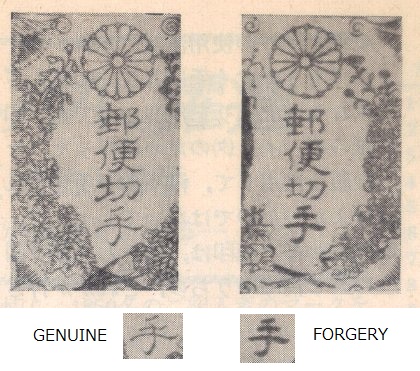 The key is the bottom character "te" in the 4 letters word "Yubinkitte" (meaning postage stamp)printed in the center of the stamp. mdlock's one is clearly a forgery and khj's one is a genuine one. Your minefield is cleared now! |
|
Send note to Staff
|
| Edited by Prahanoaki - 12/25/2012 2:41 pm |
|
|
Pillar Of The Community
United States
898 Posts |
|
|
Prahanoaki: That's a great set of illustrations! Thanks very much for going to the trouble of preparing and sharing them. A great help!
(Does your screen name by any chance mean "fall in Prague"? (Puraha no aki, Prague's fall))
-- Dave |
|
Send note to Staff
|
|
|
Valued Member
Japan
165 Posts |
|
|
Philatarium,
You are welcome Philatarium, there are several other versions of forgery but this "te" character trick always works with this particular 30 sen stamp.
and yes, "prahanoaki" means Fall of Prague. Good guess! But it has a double meaning, my last name starts with "aki" meaning fall (or autumn) and my nick was "Aki" when I was in high school down in Columbus, GA. I guess my Japanese name was complicated to pronounce for lot of people there. So, "prahanoaki" can also mean Aki of Prague cause I presently do live in Prague, Czech Republic. Prahanoaki is easy to remember for lot of Japanese people because of the famous Spring of Prague which is Prahanoharu in japanese. |
|
Send note to Staff
|
|
| |
Replies: 7 / Views: 1,704 |
|



 Posted 12/23/2012 2:37 pm