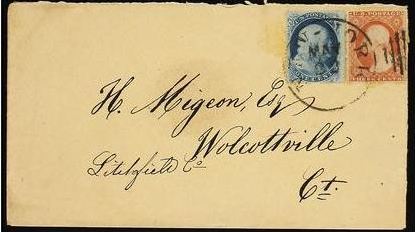
As most of you will know, I go beyond looking at the cover itself and instead look into the history of the named addressee. In this case, H. Migeon, was one, Henri Migeon, and what follows is nothing less than an incredible (but lengthy) biography.
In fact, to this day, there is an historic district in Torrington, Connecticut named after him:
Quote:
Henri Migeon was born Sept. n, 1799, in Haraucourt, department of Ardennes, near Sedan, France, and was the son of Jacques Migeon, a strong friend and personal acquaintance of General Lafayette, the great friend of America. Mr. Migeon was a self made-man. Although his advantages for early schooling were limited, yet he was a thorough student of his own inclinations, and devoted himself to the study of the sciences; and especially as connected with the manufacture of woolen cloths in his native country; and also to general literature.
He was employed for a time by a woolen house, as traveling agent in the sale of their goods in his native country. By such a course of *life he became a proficient in the methods of the production of such cloths, and this being known to General Lafayette, he warmly recommended the young man to go to America where his skill and labor would find, not only a large field for occupancy, but larger remuneration and reward. Upon his decision to come to this country, General Lafayette furnished him with a letter of introduction and
commendation to the mayor New York city, Mr. Hone, through
whom he was favorably introduced to leading manufacturers of woolen
cloths in the country, in 1828.
After a stay of some months in America, Mr. Migeon returned to his native country, bearing expressions of gratitude from leading citizens here, to General Lafayette, for sending to them a man of such ability and advantage to the interests of that branch of enterprise in this nation, whereupon General Lafayette sent an autograph letter to Mr. Migeon's father as follows:
"Paris, July 8, 1829.
Sir: It is with great pleasure that in renewing our ancient acquaintance I am able to congratulate you upon the return of your excellent son. I have received news by him from the friends to whom I have written, viz: Mr. Hone, one of the most respectable gentlemen in the state of New York, expresses his thanks for the introduction of Mr. Migeon to him, and hopes he will soon return. A friend of the manufacturer informs me that he is regarded with sentiments of esteem and approbation in his employment. Mr. Hone also informs me that the respectable agent of the manufactory is much attached to him. I am persuaded that these expressions of approbation and friendship will be agreeable to you, and also to all his family. I beg of you to accept the assurance of my distinguished consideration.
Lafayette."
Upon Mr. Migeon's return with his family to New York, in 1829,
several places opened before him for employment, among them was that of Wolcottville by Governor Oliver Wolcott, and he finally determined to go to Milbury, Mass., having received greater pecuniary inducements from there. But this decision quite disappointed Governor Wolcott, and he continued at intervals to write to Mr. Migeon on the subject; several letters concerning the matter being preserved and dated in 1831 and 1832, From Millbury he removed to New York.
The first time Mr. Migeon was in Wolcottville he came from New York to Litchfield in the stage, arriving there about dark, and as the stage came no further than Litchfield, determined to proceed on foot to Wolcottville.
The road from Litchfield to Wolcottville wound among the hills, through lonely forests and deep valleys, and it being a very windy night various disturbing noises were heard from every direction, and Mr. Migeon being in a strange country, among a people whose language he did not well understand, and possessed naturally of a nervous
temperament, he was very much disturbed in his feelings of safety
especially as he remembered that he had with him all the capital he
possessed in the world.
In after life he often alluded to this journey as being one of great
terror to him, and stated his thankfulness that he met no person that
night, for if he had he feared that in his nervous state of mind he might have shot anybody as a robber although they might have been the best friends in the world.
In 1836, after having been engaged in the woolen mills some few years with Mr. Groves, he purchased his house and lot, which he retained until his decease and which still remains in the possession of the family.
During the financial pressure in 1837, Mr, Migeon, removed to New York to prosecute business for himself. He had invented a method of refinishing broad cloths; an invention which enabled a great saving, and one which entirely revolutionized the trade in cloths, since before that time damaged cloths were regarded as nearly worthless. Mr. Migeon established his new enterprise in New York and was eminently successful in it. The value of this invention was so much appreciated that he received a prize medal of gold from the American Institute. He continued in this business a number of years, during nearly all of which time his family resided in Litchfield, Conn., where he had purchased the Governor Wolcott place, the ample grounds of which evidenced his fine taste and fondness for horticulture.
In his work in New York, after a few years, he associated with him in business two of his nephews, John and Eugene Lenoir, enterprising young men, who, with their young wives, were on the ill fated steamer Arctic in 1853, on their way home from France after a visit. The steamer has not been heard from since, an event that is remembered by this family with peculiar interest and sadness.
This event so disarranged Mr. Migeon's business relations that, having up to this time, accumulated money so that he judged he might retire from business, he sold the establishment to his son and son-in-law, and made Wolcottville his permanent home. Here he purchased considerable lands, and entered upon improvements such as have been, and will be for many years to come an ornament and honor to the village. Many of the trees along the streets near his late residence were planted by him, and are now in a thrifty state, and if cared for as they are likely to be, will be an ornament a hundred years to come. One of the finest avenues in the village which he had done so much to improve is justly named after him.
Mr. Migeon was an enthusiastic citizen in favor of his adopted
country. Born in the time of the French revolution, his father an
actor in that revolution and a special admirer and friend of Lafayette, who had strong leanings towards republican principles and institutions, he became thoroughly educated to republican freedom, and after being in this country a short time became familiar with political opinions and took his position with the old whig party, and therein became a great admirer of Henry Clay. When Mr. Clay was north
on a certain occasion Mr. Migeon made him cloth for a fine suit of clothes, and some years after, when Mr. Clay was in New York at
a great dinner, Mr. Migeon being present reminded him of the suit.
"Yes," said Mr. Clay, "they still hang in my wardrobe not worn out."
In satisfying his patriotic zeal Mr. Migeon found much pleasure for
a number of years in aiding the children in the celebration of the
Fourth of July in Wolcottviile by giving each child fire crackers.
When the hard times came he gave them the price of a pack, thinking the money might be of more advantage to the families. In 1876, he distributed coins of the United States, from the mint, with the date of that year, to each child of the public school to be kept in remembrance of that day. To the more advanced classes he gave pieces of more value, and on that occasion made the following remarks, which have remained in the possession of the principal.
"Mr. Fellows, principal, and young ladies and gentleman scholars of the Wolcottviile academy,
On this memorable epoch of our centennial, and Fourth of July, 1876, I am happy to see you all on such an occasion, as it affords me opportunity to congratulate you all upon the result of your studies and good behavior during this your last term of scholarship; in consideration of which I beg you to accept from me a small piece of silver as a souvenir. After the report of your excellent teacher, which I see in the Wolcottviile Register, I thought it due to those who are best noted in that report, to call them out by name that they may first receive said souvenir.
H. Migeon, Wolcottville, July 4, 1876."
Mr. Migeon was well read in the general literature of the day, and in all practical applications of science was greatly interested. His
personal appearance was that of familiarity with business life; discriminating judgment; self-reliant and courageous, but with due deference to the rights and privileges of others.
He retired from business early in life, and the remainder of his days were far from being unprofitably occupied. A fine cabinet of
mineralogical and fossilliferous specimens gave evidence of his esthetic disposition. He also made an extensive collection of ancient coins and other antiquities, for the reception of which he built a little museum to his house. Mr. Migeon was favored in forming the
acquaintance of many public and distinguished men, in consequence
of his frequent journeyings, he having crossed the Atlantic about
forty times, and his reminiscences of them were very entertaining.
He was presented at the court of Napoleon Third, during the height
of that emperor's power and prosperity.
The following was published in the Courier des Etats Unis^ the
leading French paper of this country:
"Mr. Henri Migeon, one of the oldest French residents of the United
States, died at his residence at Wolcottville, Conn., Dec. 24, 1876, in the seventy-eighth year of his age. Mr. Migeon was born in Haraucourt, Department of the Ardennes, France; came to America in 1829, with letters of recommendation from General Lafayette. His residence in this country was a long life of industry and probity. He was the first to introduce machinery, which with his skill greatly promoted the manufacture of cloths in Massachusetts and Connecticut. He died Inved and honored by all those who knew him both in business and social relations. His liberality was proverbial, and there was not a philanthropic or patriotic object to which he did not contribute generously."
During the late French war with Germany, he actively promoted the rising and contributed large sums, specially for the relief of the suffering near Sedan, where his daughter Madame Baudelot resides. Her house was protected by the American flag, and was the daily resort of many persons, both as fugitives, and the almost starving people of the vicinity. This sympathy for his native region he continued until his decease, keeping a deposit of money in that country the interest of which was regularly appropriated to such ends. The same thoughtfulness for the needy was manifested in his own community during many years. Mr. Migeon married Marie Louise, daughter of Francois Baudelot of Haraucourt, France. Her father was a distinguished man in his time for science and patriotism, in 1792, he was mayor of Vendresse, and took all the available men to cut down the forests of Mazaim to blockade the passage of the enemies. His eldest son was decorated on the field of battle by Napoleon First, who himself placed the cross of chevalier, the legion of honor upon him, in recompense for his bravery. His second son was the originator of the idea of utilizing the gases of furnaces as fuel, which formerly were allowed to escape. This invention is now in universal use. He also invented the beer cooler which is celebrated the world over.
Mrs. Migeon was a noble and honored companion of her husband.
Although raised in comparative affluence, yet during the first years
of their residence in this country, though placed under straitened
circumstances, she cheerfully rendered all possible assistance to
him, and by their united efforts, comfort and enjoyments crowned
their closing years. While returning from France in the steamer
Lafayette on June 30, 1871, she died on the ocean; her remains
being brought to Wolcottville and interred.





 Posted 01/27/2013 2:17 pm