| Author |
 Replies: 9 / Views: 2,348 Replies: 9 / Views: 2,348 |
|
|
Moderator

United States
5107 Posts |
|
|
What do you make of this overprint? Definitely says 1878 in a green overprint, plus some difficult to see letters above. Specimen? Revenue? 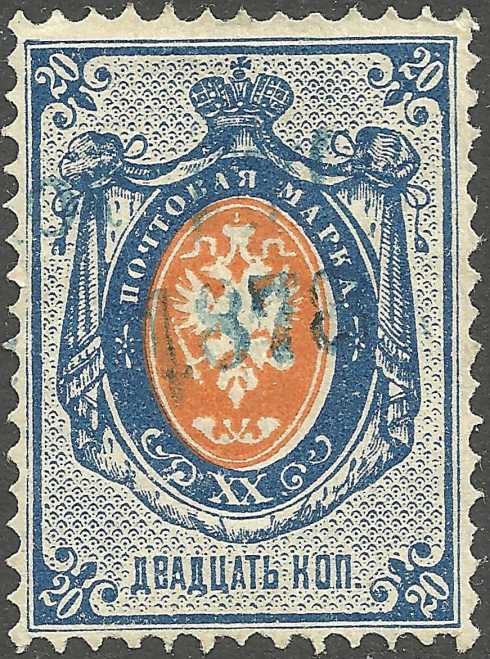 |
|
Send note to Staff
|
|
|
|
|
Valued Member
Greece
233 Posts |
|
|
Partime, my guess is that you have a late use of a so-called "pre-adhesive postmark". The word above the 1878 date is most probably the name of the town of origin of the postmark. Unfortunately, the blue-green color of the cancel on the blue background of the stamp does not allow me to decipher any of the letters. You can see an online version of Dobin's book "Postmarks of the Russian Empire. Pre-adhesive period." (dealing extensively with this type of cancellations) here: http://www.standard-collection.ru/e...-period.html |
Send note to Staff 
|
|
|
Pillar Of The Community
United States
8609 Posts |
|
|
Looks like a cancel to me,remember any countries post office could of hit it with a cancel. |
|
Send note to Staff
|
|
|
Moderator
United States
5107 Posts |
|
|
Excellent resource Vasia. I will check it out later. However, I have full gum on the back, so I am leaning towards a pre-cancel of some type rather than a postmark. |
|
Send note to Staff
|
|
|
Valued Member
Greece
233 Posts |
|
|
Partime, it is really odd about the "full gum" on the back!  Maybe you can post a scan if possible. You occasionally find USED imperial period stamps with significant traces of the gum, but full gum! Regarding pre-cancels, I have never heard of their existence on Russian issues. |
|
Send note to Staff
|
|
|
Pillar Of The Community
United States
8609 Posts |
|
|
It looks like a early regular cancel type used in Russia for that time period ,without a better cancel it looks just typical -----here are 1879 and 1876 cancels from my collection ,I haven't checked my duplicates for more . 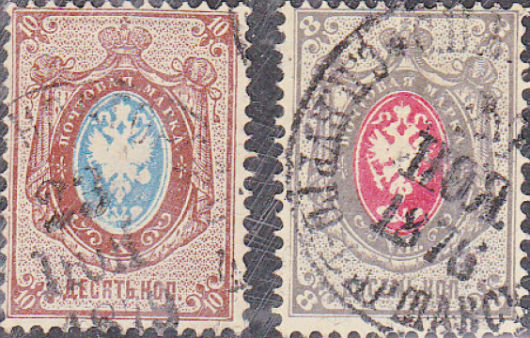 |
|
Send note to Staff
|
|
|
Valued Member
Greece
233 Posts |
|
|
It is definitely NOT a typical early cancellation of the so-called 3-line date. There are no indications of the single-ring characteristic of these cancellers. It belongs to the category of "pre-adhesive" postmarks, which is really a misnomer characterizing a type of cancellation that started its use before the introduction of postage stamps.
Here is an interesting quote from Kiryushkin and Robinson's book "Russian postmarks. An introduction and guide" which might be applicable to the postmark of Partime:
"At those post stations which handled larger amounts of mail, the post station keeper could order, at his own expense, a postmark from the Postal Department's workshop. Such postmarks comprised two straight lines, with the name of the station and the district on the upper line, and the date on the lower line. These postmarks were used as backstamps until 1877. From 2 June 1877 they began to be used for cancelling stamps as well". |
|
Send note to Staff
|
|
|
Valued Member
Japan
165 Posts |
|
|
Moderator
United States
5107 Posts |
|
|
Well, not Full OG. I got two stamps mixed up. This is No Gum, previously hinged. It would be nice if someone could run it through the cancellation detector software to see what comes out. |
|
Send note to Staff
|
|
|
Valued Member
Australia
63 Posts |
|
| |
Replies: 9 / Views: 2,348 |
|




 Posted 02/08/2013 12:17 am


