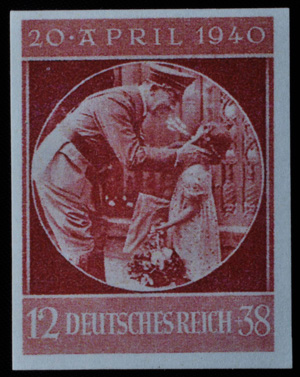
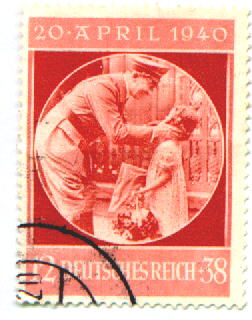
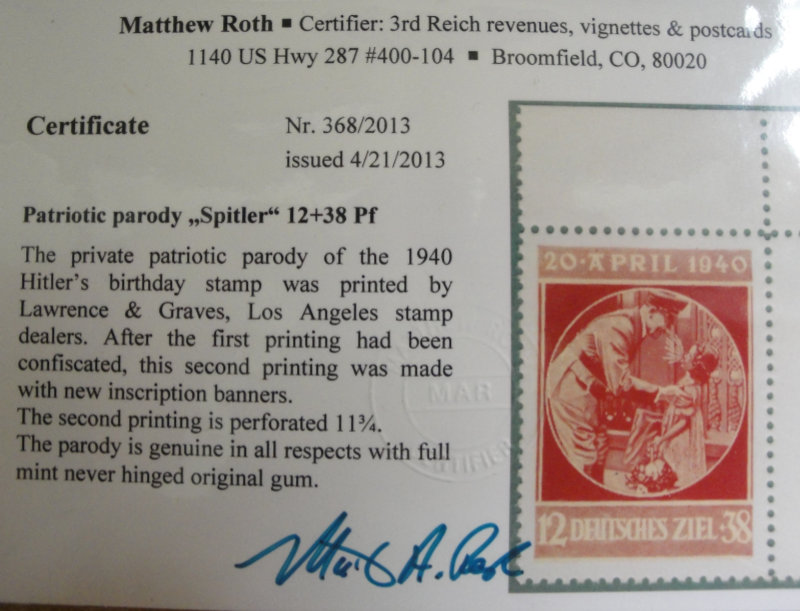
Here's another example that's similar (but different from the original scan), along with an interesting article of how they came about:
Quote:
The "Spitler" Propaganda Parody
Sometimes propaganda parodies of postage stamps are made by civilians for either patriotic reasons or for profit. The "Spitler" is a perfect case in point. I first wrote about this civilian parody in Scott's Monthly Stamp Journal of September 1980. We will just discuss it briefly here. I first bought a perforated and imperforate block of the Spitler from Warner's Stamp Store on Nassau Street about 50 years ago. The salesman took me aside and whispered that he had something special. He charged me $9 for the two. Today the price would be several hundred dollars. Herman Herst talked about these stamps in Nassau Street and said that the government had confiscated them. I always wondered why years later you would still see them occasionally offered for sale. It was only after much research that we figured out that there were two sets, and most offered today are reprints.
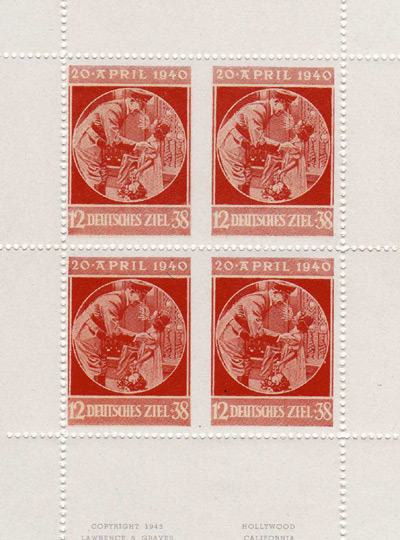
This "stamp block" is a private patriotic parody of Germany 1940 12+38 pfennig brown-red Hitler's birthday stamp, with a child spitting in Hitler's face and the legend "Deutsches Ziel" ("German aim"). The German original shows Hitler receiving a bouquet of flowers from a young girl, with the legend "Deutsches Reich." The parody was produced in America by Lawrence & Graves, Los Angeles stamp dealers, in miniature sheets of four (2x2). The sheets have full margins bearing the small inscription "Copyright 1943 / Lawrence & Graves" beneath the left label and "Hollywood / California" beneath the right label.
The labels were distributed to prominent stamp dealers and collectors, including U.S. President Franklin Roosevelt and British Prime Minister Winston Churchill. The mailing to President Roosevelt resulted in the Secret Service and postal inspectors being notified and confiscation of the printer's Spitler stock, plates, and production supplies. It appears that after the Secret Service confiscated the original supplies, Lawrence and Graves (or another party) reissued the label in the original sheet format. The original Spitler is a browner red than the reprints. The original can be distinguished immediately from the reprint by the nature of the design that forms the red background in the top and bottom color bars containing the lettering. In the original, the background is formed by a grid or mesh of red with un-inked dots in the holes of the mesh. In the reprints, the background is formed by diagonal lines of connected dots from top right to bottom left, with un-inked areas between the lines. These distinctions do not show in routine photocopies or in full-size halftone photographic reproductions.
The original printing was perforated 12. Examples are known tied to a 1-cent postal card with a circular cancel from Berlin, Oklahoma, April 20, 1943. (April 20 is Hitler's birthday).
The cards have Lawrence & Graves's imprint on the message side, accompanied by a handwritten inducement of the general form, "Is this B170? Price 10 cents. Miniature sheet of four 35 cents." Handwritten addressees include H.E. Harris of Boston; Mr. Billy Muir, 6727 Hollywood Blvd., Los Angeles, Calif.; Hobbs Stamp Co., 38 Park Row, New York City, N.Y.; and a Denver, Colo. address. The reissue is perforated line 11 3/4. The legend in the bottom margin is in a silver-gray ink that does not photocopy well. A cover showing a U.S. 3-cent stamp and a Spitler reprint was mailed from Kansas City, Missouri, on 2 November 1945 to Mr. E. Iment in Kansas City.





 Posted 02/19/2013 8:21 pm