To chime in on the discussion of Michel Spezial, I would add a few clarifying words. Yes, it is true that some information is dropped with new versions of the catalog. Sometimes it is because earlier information has proven to be incorrect, and other times it just seems to be mystery why the material was removed. However, the newer catalogs are a big improvement - much more information has been added as the years go by. I think a very serious collector of Germany would want to save outdated versions, or at least make photocopies of information that has been deleted before old catalogs are disposed of. Also, my experience has been that plate flaws, or varieties can come and go from Michel. And, a Bundespruefer in Germany may not agree with, or recognize a variety in an older catalog.
Can someone translate the post which gives the Peacetime (early) versus Wartime (late) Ludwig differences? I'm having a lot of trouble distinguishing. Thanks in advance.
P0506img ------- Your asking about difference on the Bavaria of 1914-1920 King Ludwig stamps , the difference between the early issues and the war issues . You will need to talk to a expert who can walk you thru the differences .
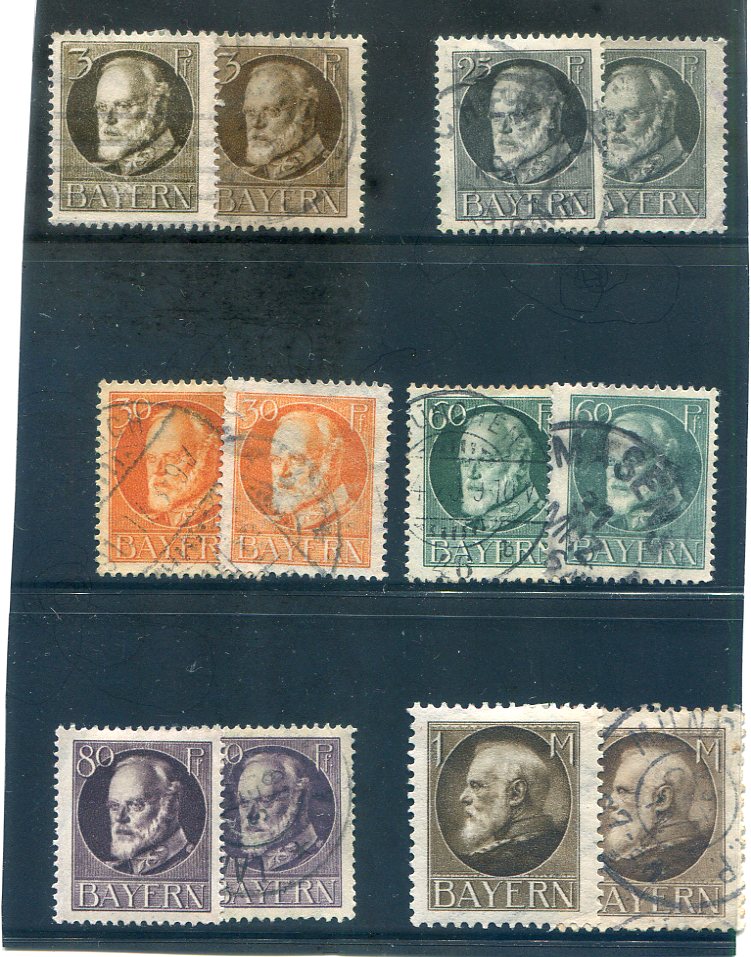
But until they come along , here are the ways I handled this as a collector .The first thing a expert has is both reference material and more important they have their own reference material ,not someone elses computer scans that they lifted off the internet .
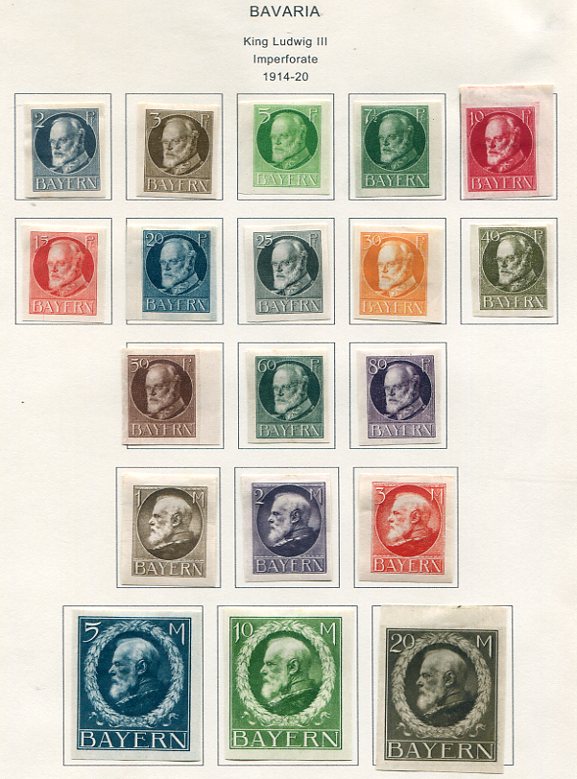
They will show the war time printed stamps, scans so you can match those to the early issues . With the war time issues they can be the regular perf stamps or the imperf stamps both are the same . Here are the war time printed stamps in the scan below .
Distinguishing the peace printings from the war printings is difficult for this issue and I have not figured it out yet. However, here are a few pointers. If the postmark date is 1915 or earlier it is definitely a peace printing. 1916 and later are likely war printings. The later the date the more likely. Imperforate stamps are always war printings. The gum on the peace printings is satiny with a fine structure. The gum on the war printings is smooth to uneven and applied thickly.
Disclaimer: While a tremendous amount of effort goes into ensuring the accuracy of the information contained in this site, Stamp Community assumes no liability for errors. Copyright 2005 - 2026 Stamp Community Family - All rights reserved worldwide. Use of any images or content on this website without prior written permission of Stamp Community or the original lender is strictly prohibited. Privacy Policy / Terms of UseAdvertise Here





 Posted 02/23/2015 11:35 pm