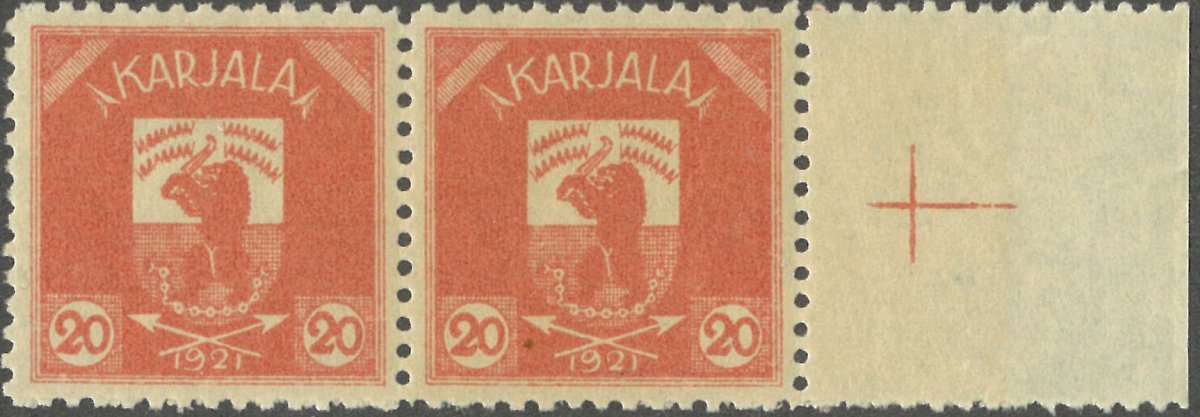
A dancing bear with unshackled chains swinging a billhook!

Intrigued?
I'm going to do a little show and tell.

The short lived Karelia rebellion of 1921-22 had one issue- some 15 stamps. But there is a common forgery which needs to be separated from the genuine.

The long and complete version is found on my Big Blue blog.
 http://bigblue1840-1940.blogspot.co...of-1922.html
 ]
The short and succinct version is here......

 1922 Scott 5 40p magenta "Bear": Genuine
Characteristics of a 5p - 75p genuine stamp....
• The bottom of the "J" in "Karjala" finishes complete, that is slightly upturned, or at least horizontally elongated. Varro Tyler, in his book "Focus on Forgeries", 2nd edition, 2000, makes this sign a diagnostic point. Others suggest a more complete evaluation of the stamp is necessary.
• The third chain on the left is not a complete circle- where the bear"s paw (foot) obscures the right side of the chain link. This sign is only seen for the 5p - 75p denomination stamps.
• The Northern Lights (zigzag lines) are tall and prominent.
• Facial features (Here two eyes) are usually present.
• A string of white dots or beads are seen between the front legs (arms) of the bear.
These signs should be enough to determine if the stamp is genuine.
 1922 Karelia Scott 7 75p orange yellow "Bear"; Forgery
The characteristics of the 5p - 75p denomination forgeries are...
• The bottom of the "J" in "Karjala" is short and truncated. The stroke tends not to reach the horizontal.
• The third chain on the left is a complete circle.
• The Northern Lights (zigzag lines) are short and broken.
• Facial features tend not to be prominent.
• A wide white streak- or two wider white strokes- are seen between the front legs (arms) of the bear.
Remember the " left third chain link" sign is only helpful for the 5p - 75p denominations.





 Posted 04/28/2013 6:55 pm