| Author |
 Replies: 10 / Views: 4,939 Replies: 10 / Views: 4,939 |
|
|
Valued Member
United States
200 Posts |
|
|
|
Trying to identify the plate number for a Great Britain SC 58. I have scrutinized the scrollwork, and the bust, with a 10X glass, but cannot see the plate number. Sheet position is N-K, if that's any help. Looked in both Scott and Specialized for hints, but no progress.
All suggestions as to where on stamp to look will be appreciated.
Thanks...
Donald
|
|
Send note to Staff
|
|
|
|
|
Pillar Of The Community
United Kingdom
3220 Posts |
|
|
Hi Donald,
On the ½d stamp the plate number appears on both sides between the large ½ and the Queen's head with the top of the plate number nearest the edge of the stamp, i.e. the plate numbers are sideways as you look at the stamp normally. |
Send note to Staff 
|
Nigel |
|
|
Pillar Of The Community
United States
6756 Posts |
|
|
I happened to have an old scan of GB #58 plate 4. I rotated it sideways. The green circlea show the location of the "4". Those 2 spots will be the location of the 1st digit of the plate number. In other words, if the plate were #14, then the "1" would be in the green circle locations, and the "4" would be in the locations marked by the blue rectangles. 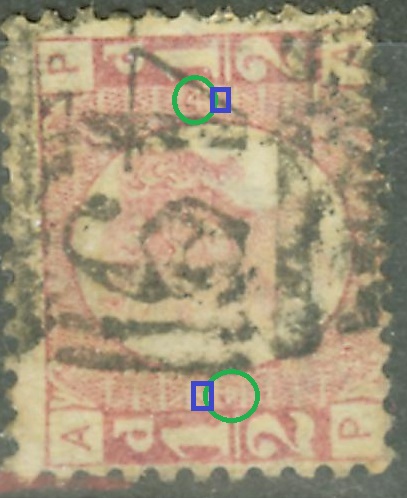 |
|
Send note to Staff
|
|
|
Pillar Of The Community
United States
6756 Posts |
|
|
I forgot to mention, if you see any digit in the blue rectangle area, that automatically means there is a digit in the green circle area (even if the green circle area is obscured by a postmark). So any digit in blue rectangle area means plate number 10+. |
|
Send note to Staff
|
|
|
Valued Member
United States
200 Posts |
|
|
Thank you, gentlemen. Naturally, both positions illustrated by khj are obscured by the postmark. One of Murphy's innumerable laws at work. I have almost convinced myself I have plate 3, but cannot be absolutely sure. I may just have to put it in my album with a question mark re the plate number.
Thanks, again; at least I now know where to look.
Donald |
|
Send note to Staff
|
|
|
Pillar Of The Community
United States
6756 Posts |
|
|
Quote:
both positions illustrated by khj are obscured by the postmark. Yeah, it happens. The stamp is so small, the postmark doesn't have to be centered in order to obscure the number on both sides. I have a couple of #58s like that. |
|
Send note to Staff
|
|
|
Valued Member
United States
200 Posts |
|
|
It would have been better to print the numeral, rather than only the outline of a drop-out to the underlying paper, but who knows what the postal authority thought processes were in 1870.
|
|
Send note to Staff
|
|
|
Pillar Of The Community
United States
6756 Posts |
|
|
Quote:
It would have been better to print the numeral, rather than only the outline of a drop-out to the underlying paper They did with later stamp issues. Of course, still same problem. Sometimes the postmark happens to obscure the plate number. As I mentioned, it happens far more often with #58 because of the smaller than normal stamp size. |
|
Send note to Staff
|
|
|
Valued Member
United States
428 Posts |
|
|
If you are dealing with a cancellation mark obscuring an important portion of a stamp, there is now a relatively easy way to deal with this. Go to http://retroreveal.org and upload your scan and there is a very good chance you'll be able to look through the cancel and see what is lurking underneath. In the case of the 1/2d line engraved, I would do the scan at a very high dpi, select that general area for retroreveal processing, and you should be good. -Larry |
|
Send note to Staff
|
|
|
Pillar Of The Community
United States
845 Posts |
|
|
retroreveal - that's good to know. I had a problem with a few GB Sc #33's the other day due to postmarks obscuring the plate #. I'll try retroreveal and see if that helps. |
|
Send note to Staff
|
|
|
Valued Member
United States
428 Posts |
|
| |
Replies: 10 / Views: 4,939 |
|




 Posted 05/12/2013 1:47 pm