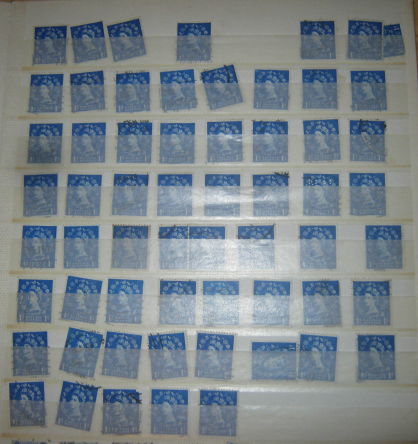
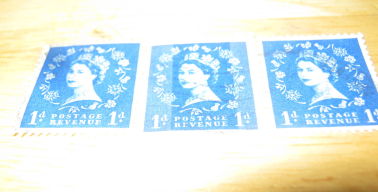
Here I have a page of 60 Queen Elizabeth II 1952 1d blue stamp (SG516) but I have found one stamp that is diffent from the other 59 stamps. please take alook at the images and please let me know why this is.
Are you talking about the light vertical band on each side of the middle stamp? If so, I believe those are the phosphorescent bands applied to some of the denominations of that definitive set
That is referred to as tagging. It is a band of phosphorescent ink which is almost transparent. It will flouresce under a blacklight. Britain started experimenting with tagging at about these stamps were printed.
Tagging was used as a way to verify that a valid postage stamp was being used to pay the postage, and that the postage stamp was in the right position on the enveloped to be cancelled properly.
Evening 241079, You will probably find you have more than one different out of all those. There are seven seperate sets that include the 1d ultramarine, with various watermarks etc. Check out the back of the stamp. Your 'odd man out' is either from the 1959 set with phosphor lines to front and graphite lines on the reverse, or the 1960-67 set with just phosphor lines to front. The former is the better stamp of the two, value-wise. DavidR
As DavidR mentioned, there are numerous sets that include the 1d Ultramarine... but you can narrow it down to four. As you didn't mention any graphite lines on the back then the stamp must come from the 1960's sets with watermark Crowns. 1960 phosphor bands reacting green 1961 phosphor bands reacting blue 1965 phosphor bands (8mm) reaction violet 1967 phosphor bands (9.5mm) reaction violet
scotzm, That's more detail than in my SG 'Concise'! The different colours are mentioned in a note, but not the dates or band sizes. You must have the 'Specialised', I assume. Are all the values of the set in all band colour/type? DavidR
In many ways the 1d Ultramarine with phosphor banding of the 60's issues is easier to identify (leaving out the cream and whiter paper type) as there are four main types. Compare that to the likes of the 2½d carmine-red of the 60's issues which include all the above phosphor variations plus the two stamps with one band plus the type 1 and type 2 diadem variations plus the three "tilting portrait" variations.
"....Are all the values of the set in all band colour/type?"
No...some values such as the 1961 4½d chestnut had only one phosphor variation and was issued with two bands reacting blue...or the 9d bronze-green issued in 1966 with two 9.5mm bands reacting violet.
Disclaimer: While a tremendous amount of effort goes into ensuring the accuracy of the information contained in this site, Stamp Community assumes no liability for errors. Copyright 2005 - 2026 Stamp Community Family - All rights reserved worldwide. Use of any images or content on this website without prior written permission of Stamp Community or the original lender is strictly prohibited. Privacy Policy / Terms of UseAdvertise Here





 Posted 05/22/2013 5:15 pm