| Author |
 Replies: 13 / Views: 5,812 Replies: 13 / Views: 5,812 |
|
|
Pillar Of The Community
Canada
1155 Posts |
|
|
I was going through some stamps and noticed this one with a Constantinople postmark. I know that the stamps used in Turkey were overprinted so my question is Was it common for a non overprinted stamp to be used ? 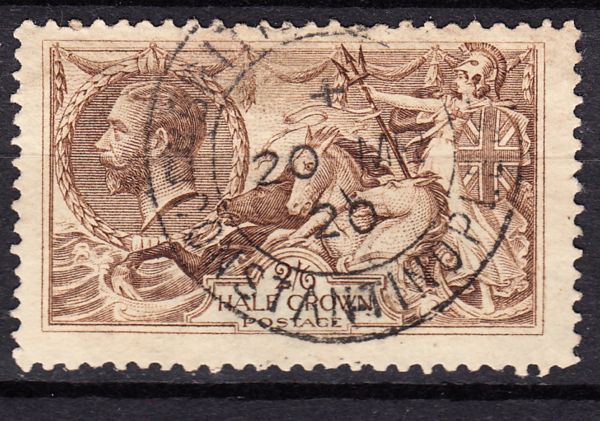 |
|
Send note to Staff
|
|
|
|
|
Pillar Of The Community
Canada
4648 Posts |
|
|
Hi Irish
My understanding on this topic is that while the overprinted stamps were preferred ones to be used, British embassies / consulates did have a supply of regular stamps and could be used, if they were used from the embassy itself.
Hopefully, we can get some clarity on this?
Chimo
Bujutsu |
Send note to Staff 
|
|
|
Pillar Of The Community
Canada
4648 Posts |
|
|
I was just going through my postcards and remembered that I had a French version of a cancellation you are referring to. This is an ordinary French stamp that is not overprinted and was cancelled in Constantinople. The card is addressed to Mount Wolfe, Ontario and used in 1910. To the best of my knowledge, both the British and the French used the same postal procedures to mail from Turkey or the Levant (?) Chimo Bujutsu 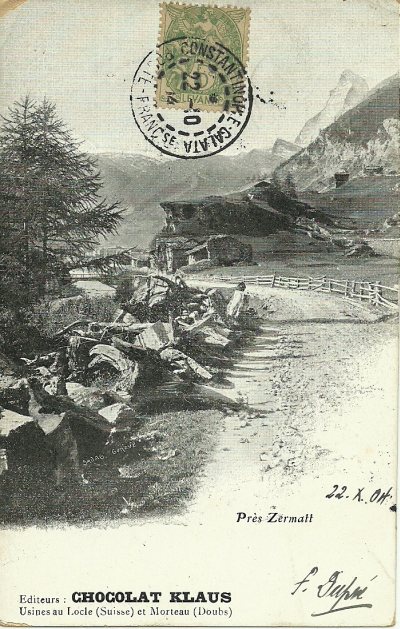 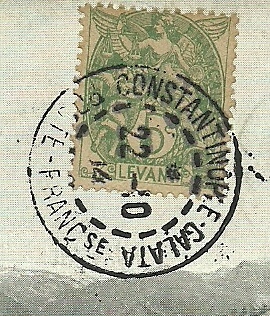 |
|
Send note to Staff
|
|
|
Valued Member
United States
57 Posts |
|
|
Bujutsu your card has a specific France Offices in Turkey stamp (Scott #25), not a metropolitan French one, so that would be the correct usage from Galata district in Istanbul. Irishjack's stamp is however a more interesting story since it does not have a surcharge in Ottoman currency that would signify it an an issue of the British Post Office in Turkey. The date on the cancellation might be a clue - 1920. It would not be before 1921 that new surcharges would be produced for the British Post Office, and in the interim the PO had been closed down due to WWI (Britain and the Ottomans being at war). The British occupied Istanbul in 1919 in wake of the Ottoman collapse, so perhaps the British post office in that period was using Sterling-denominated issues in lieu of new Ottoman-currency surcharged issues that had not been produced while the previous (1913-1914) surcharge issue might have run out. Just theorizing here. |
|
Send note to Staff
|
|
|
Pillar Of The Community
United States
7103 Posts |
|
|
Scott lists Feb. 4, 1919 as the reopening date for the Constantinople post office, lasting until September 27, 1923.
I realize Scott is not the first choice of source material for this question, but I don't have time to check SG right now... |
|
Send note to Staff
|
|
|
Pillar Of The Community
United States
521 Posts |
|
|
Quote:
Istanbul was Constantinople
Now it's Istanbul not Constantinople
Been a long time gone, Constantinople
Now a Turkish delight on a moonlit night Song stuck in my head now. |
|
Send note to Staff
|
|
|
Pillar Of The Community
Canada
4648 Posts |
|
|
My apologies there. I guess my eyes are screwing me up today.
I didn't even see that.
However, I am still inclined to think that regular stamps were in use from the different embassies. I could be wrong here.
Chimo
Bujutsu
|
|
Send note to Staff
|
|
|
Pillar Of The Community
Australia
3547 Posts |
|
|
This is listed in Gibbons as SG Z185, 2013 cat. £50, under British Post Offices in Constantinople and Smyrna, 1919-1923. It's Gibbons' Type Z4, reading 'BRITISH. A P.O.' across the top, in use from July 1919 to July 1920, for both civilian and military.
Looks rather nice! |
|
Send note to Staff
|
|
|
Pillar Of The Community
Canada
4648 Posts |
|
|
Wow. I didn't realize it catalogued that high. I got it at flea market for about 50 cents.
Thanks for the information.
Chimo
Bujutsu |
|
Send note to Staff
|
|
|
Pillar Of The Community
United States
1362 Posts |
|
|
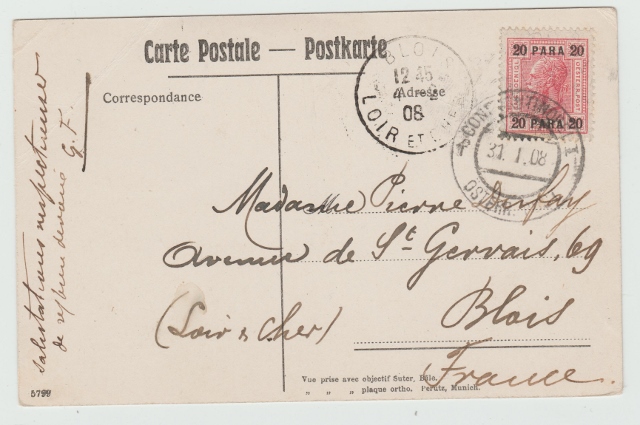
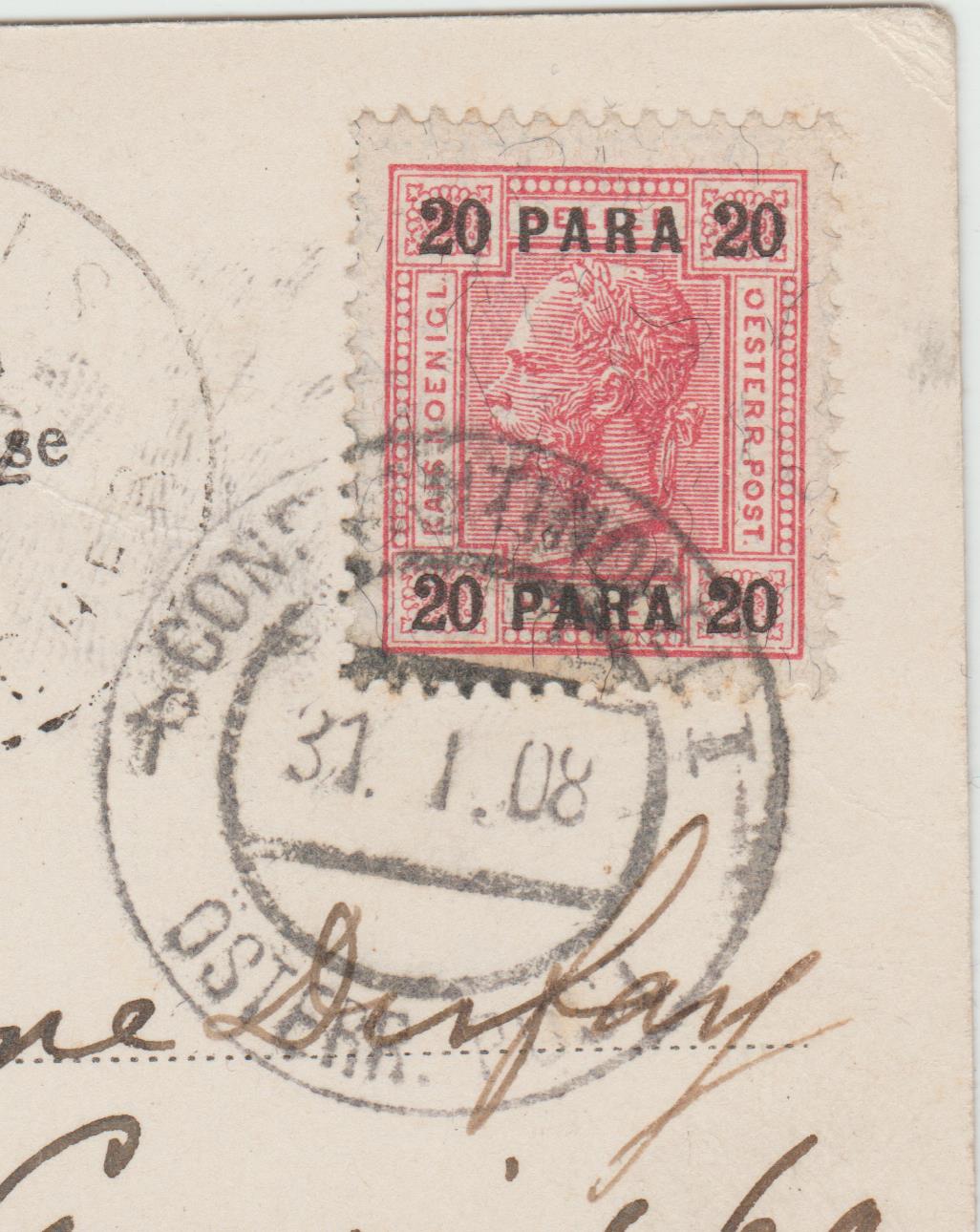
Constantinople on 1900 Austria-Offices in Turkey stamp. One of my favorites: 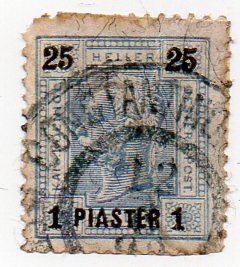 |
|
Send note to Staff
|
| Edited by stampfan9 - 06/10/2017 5:10 pm |
|
|
Pillar Of The Community
Norway
1661 Posts |
|
|
Pillar Of The Community
United States
1362 Posts |
|
|
Thanks! The emperor does need a bath, unfortunately I don't know how to clean a stamp, and even if I did know how I would be afraid to try.
|
|
Send note to Staff
|
|
|
Pillar Of The Community
Norway
1661 Posts |
|
|
Cleaning stamps are normally quite easy. Use the search on this forum, and you will get lots of good answers - for various levels of issues.
But be aware - your stamp has chalky stripes!
These stripes might loose its color if simply soaked in water! So in this case I would suggest to put Franz Joseph on top of a wet sponge, face up, until the piece the emperor is attached to is completely soaked - then try to seperate the stamp from the piece of paper gently. Ideally use a tweezer and avoid messing with the emperors face as much as possible, as the chalky surface is vulnerable when wet. Else Franz Joseph might look a bit messed up after....and for the same reason - for chalky stamps I would not dry them as any other normal stamp. When out of the water, toss of any drops gently - then leave to dry on a coarse towel - this time face up. (Using a coarse towel ensures the gummed side only get a few tiny spots of contact with the cotton, however not enough for the remaining glue to stick) The stamp might curle during drying - leave it until it feels dry - but before it gets 'completely çrispy dry' you should uncurle it gently and keep it pressed flat in e.g. a stockbook overnight.
Sounds complicated but it is not. If you have a few other Austrian Franz Joseph stamps with similar chalky stripes in spare, I would suggest to test with them first. |
|
Send note to Staff
|
|
|
Pillar Of The Community
Netherlands
799 Posts |
|
| |
Replies: 13 / Views: 5,812 |
|




 Posted 05/28/2013 12:25 pm