| Author |
 Replies: 16 / Views: 7,984 Replies: 16 / Views: 7,984 |
|
Valued Member
United States
30 Posts |
|
|
Hi All, I would like to thank everyone for their patience with me as I learn more about this hobby and improve my knowledge for identifying genuine copies. I recently acquired a copy of the Ed. #6. This stamp appears to pass all of the secret marks (A and R connected, pearls, vertical nose/mouth lines, lines from throat to chin, and dotted neck lines), however, more than just the ends of the two lower curved lines of the upper left corner ornament are touching each other. Also, per Spain_1850's advice, I been using the Guia Tort to plate this particular stamp and it appears to have the common variation #4, broken upper right frame.  Would love a fresh pair of eye to look at this and give me some feedback. I believe it is real, but as I mentioned above, the couple sets of touching curved lines makes me worry it could be a Fournier or Segui forgery. Regards and many thanks, Robert |
|
Send note to Staff
|
|
|
|
|
Pillar Of The Community
United States
1121 Posts |
|
|
Robert, one thing to remember is that any of the tests you mention can change if the stamp is overinked, underinked, or was printed from a worn plate, which could explain some of the tests failing. You seem to have made all the correct checks and I would say there is no doubt in my mind it is genuine. One other test I use is shown below (red arrows). 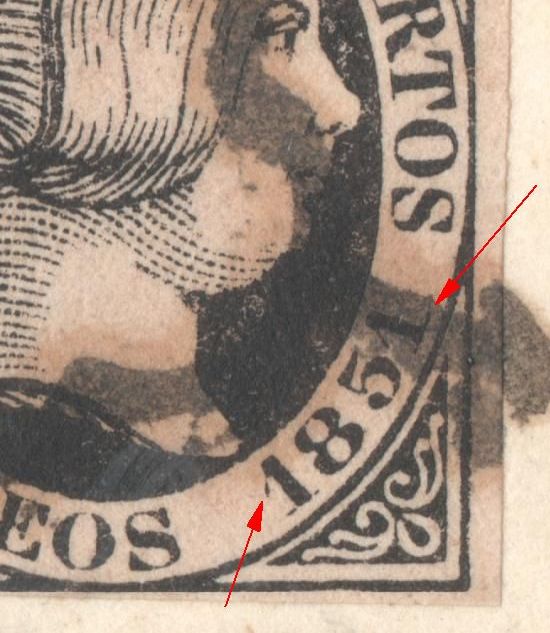 One arrow is pointing to the flag coming off the first "1" in 1851 and the other is pointing to the right foot on the last "1" of 1851. Both end in a slight "bulb" on genuine stamps. This test, as well as the others, can be used for all values in the set. Also, the fact that you can identify a specific plate variety shown in the Tort guide is further evidence that it is genuine. It is a nice copy of that particular broken frame variety!  A little more information can be found on the 6c of 1851 in this thread here, as well as a couple of known forgeries. https://goscf.com/t/26049Note that the poster named Francesc (who is a well known expert on Spanish stamps by the way) states that there are 16 different philatelic forgeries known for that stamp alone. Most of the ones I've seen however are quite clumsy looking. All the tests you made on yours should weed out most of the known forgeries. Don't forget to take notice of cancellations. Many of the early forgers did not take the time to replicate the correct cancel for a specific stamp and forgeries can sometimes be identified simply by looking there. Yours is 100% correct though. |
Send note to Staff 
|
|
|
Pillar Of The Community
United States
1121 Posts |
|
|
Robert, I have run across a larger scan of a possible Fournier forgery of this stamp. It has all the identifiers that are circled in the last post of this thread https://goscf.com/t/26049, plus a few that I will point out here. 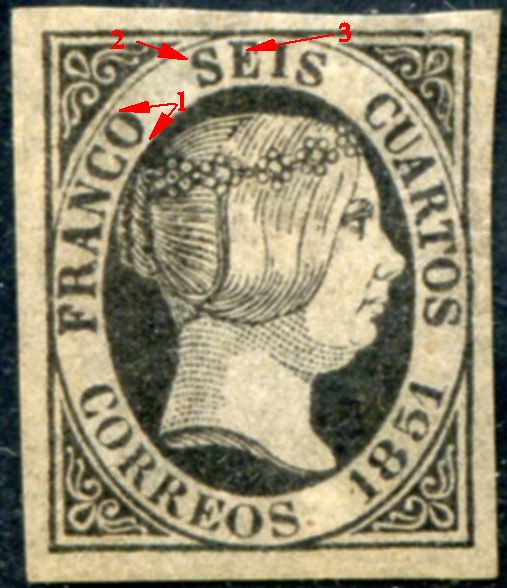 First, let me say that it appears that Fournier merely copied from an original copy of the stamp, therefore some of the identifiers for genuine stamps are present as well. But, it is just not that great of a replication job and there are plenty of clues to give it away. Along with the identifiers noted in the thread above: 1 - Points to the O of FRANCO. Compare to the genuine in the first post and you will see that the O here is situated closer to the outer circle than the inner one. It should be equidistant from both the inner and outer ovals. In fact, many of the letters or numbers on this Fournier forgery are off center, but the O really looks obvious. 2 - The first S of SEIS is rather poorly formed and misshapen. Again, many of the letters are also badly formed compared to the known genuine stamp in the original post. 3 - The E of SEIS sets almost perfectly vertical on the forgery here, whereas on the genuine stamp it leans significantly to the left. Please note that these are tests to identify this particular forgery only, but once you get a good feel for looking at the details like this on many genuine copies, they become easier to spot. This particular forgery is currently being sold on ebay as a genuine unused stamp. |
|
Send note to Staff
|
|
|
Valued Member
United States
30 Posts |
|
|
Hey Spain_1850,
Thank you for the update regarding the possible Fournier forgery and my apologies for delay in responding. I recently got married and have been out of town for the last month.
As for the Fournier forgery, the vertical E and the spacing of the O definitely stand out to me, and very noticeable from an authentic copy. I really appreciate your help!
Regards,
Robert |
|
Send note to Staff
|
|
|
Pillar Of The Community
United States
1121 Posts |
|
|
Valued Member
United States
30 Posts |
|
|
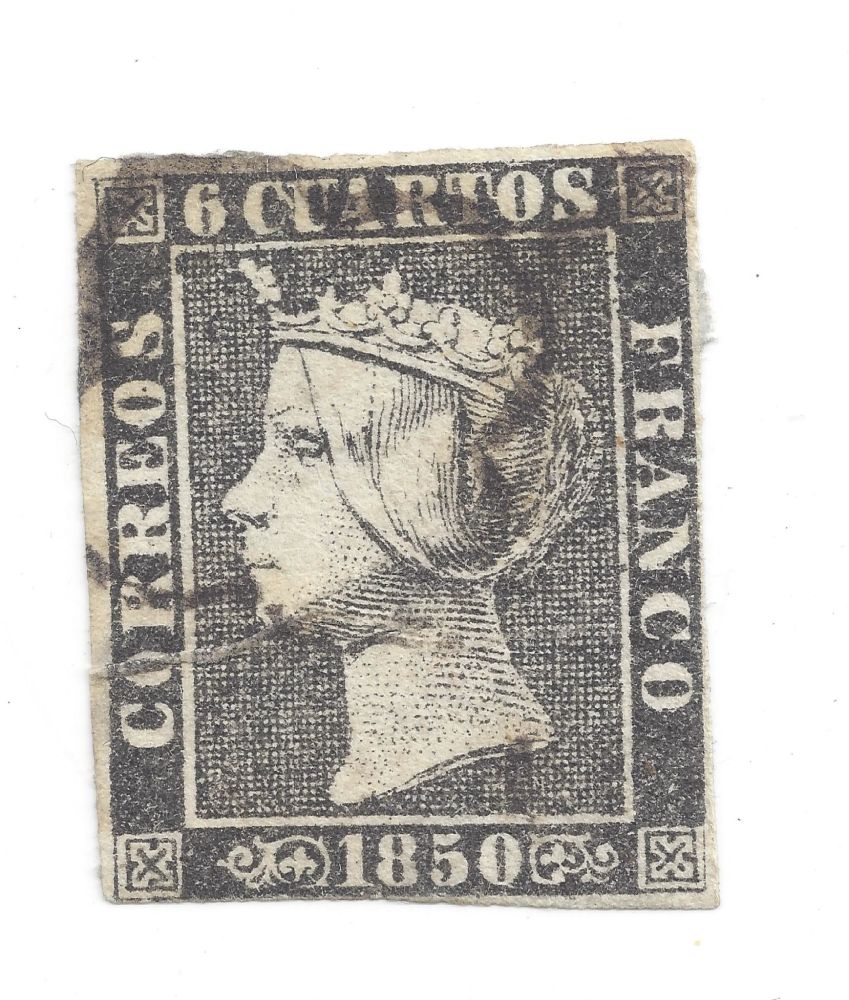
Hi spain_1850, Attached are three copies of the 1851 - 6C. I am fairly confident about the first two copies being genuine, but I am on the fence with the third copy. Let me know what you think.    Thanks, Robert |
|
Send note to Staff
|
|
|
Pillar Of The Community
United States
7106 Posts |
|
|
I'll be interested to hear what the experts have to say. I'd have taken a pass on the third stamp because of the shading, the hair and the eye, but I claim no expertise. I'm sure I've left lots of stuff on the table... |
|
Send note to Staff
|
|
|
Pillar Of The Community
United States
1121 Posts |
|
|
I would love to hear what the experts say as well.  I'm certainly by no means an expert on these that's for sure. I'm always learning something new about them. That's why I love to look at as many copies, or scans, as I can possibly find. There's always something new to see. On to the stamps. The first 2 to me seem OK and pass all of my general tests that have been noted earlier in this thread. The last one however, seems a bit strange to me as well. But, it doesn't fit any of my scans of known forgeries, nor does it look like any of the forgeries I have in my personal collection. It is definitely not a Fournier. It's also not a Sperati, as he did not forge the 6c. The other halfway decent forgery I am aware of is a Segui, but this does not fit that one either. I'm thinking it might be an impression from a slightly worn plate. If you look at the smallest of details that should be there such as the thin serifs at the top and bottoms of many of the letters, they are very hard to see in some cases, and absent on others. My gut feeling says it's genuine, mostly because I can't pin it to a particular forgery, but I can't say I'm 100% certain as well. I'd love to hear others opinions as well. |
|
Send note to Staff
|
|
|
New Member
Spain
4 Posts |
|
|
New Member
Spain
4 Posts |
|
|
I have had a study about this stamp with hundreds of it.(Gold and vermeil medal in two national expositions). There are 16 different types of fake stamps. After three years studiyng it you can see at frist sight if it is genuine or not.
Regards. |
|
Send note to Staff
|
|
|
Pillar Of The Community
United States
7106 Posts |
|
|
New Member
United States
3 Posts |
|
|
hello every one, I need to complete this reconstruction of 6 cuartos with cancelation red baeza. thanks 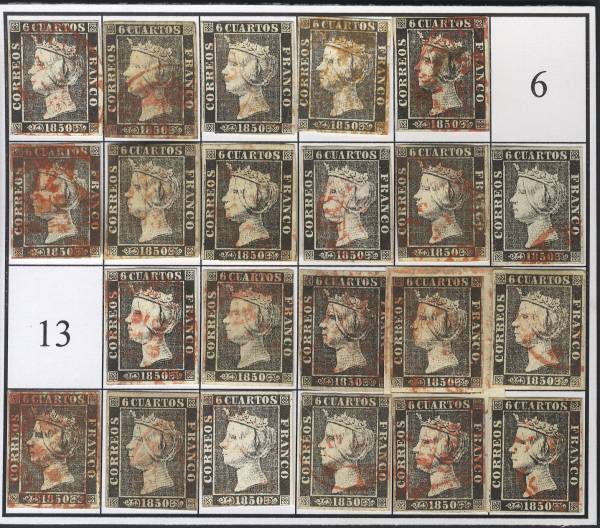 |
|
Send note to Staff
|
|
|
New Member
Netherlands
2 Posts |
|
|
Dear all, First of all let me introduce myself, I'm Mike Boger from Castricum The Netherlands. From an inheritance I have some old Spain stamps. 26 stamps - period 1850 - 1866. Some people told me that from that period there are a lot forgeries. Does someone have some experiernce with this? How can I recognise if they are forgeries or genuine? one of the images: Links to the photo's of the stamps. http://s359.photobucket.com/user/mikeb73c/library/or http://www.catawiki.nl/collection/mikeb73/indexHope someone can help. Kind regards, Mike 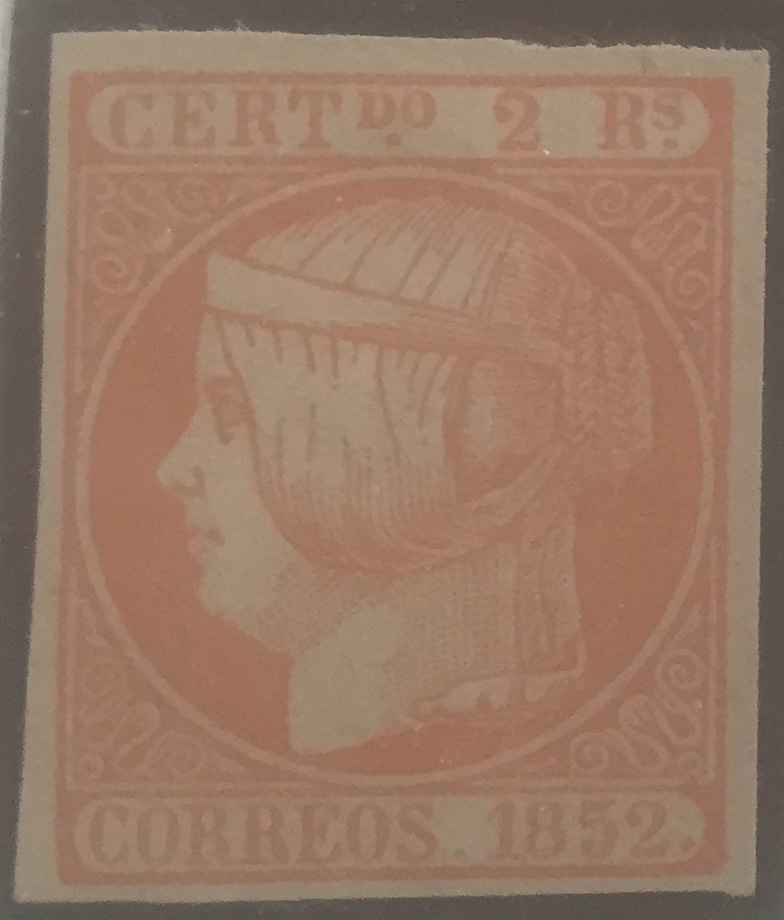 |
|
Send note to Staff
|
| Edited by mikeb73 - 09/01/2015 2:58 pm |
|
|
Valued Member
United States
254 Posts |
|
|
Pillar Of The Community
2013 Posts |
|
|
A real one, type II , with the crease at the back it don't have that much value. |
|
Send note to Staff
|
| Edited by area66 - 08/26/2016 8:46 pm |
|
|
Valued Member
United States
254 Posts |
|
|
Replies: 16 / Views: 7,984 |
|




 Posted 05/30/2013 11:43 pm