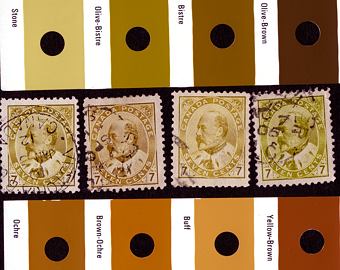
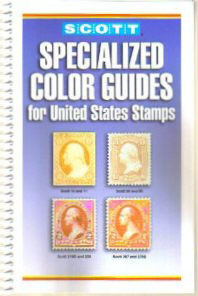
The 'Scott Specialized Color Guides for U.S. Stamps' is on
Amazon and possibly
ebay and possibly Linn's magazine. This would have colours hopefully corisponding to those stated in the Scott or Unitrade catalogues?
Linn's Refresher Course
Color presents challenge for stamp collectors
http://www.linns.com/howto/refreshe...rcourse.aspxThere is available (not sure where) a Canada colour guide for the older stamps, Pence issue, etc, but I am not sure if it covers the KEVII stamps.
A Wonder color guide is available, keyed to US stamps.
See a Stamp Community thread with a great discussion on colour guides here (and an example in color):
https://goscf.com/t/13874On a Stamp Community thread about KGV Indigo Blue colours
https://goscf.com/t/11682&whichpage=3this is stated by member Bffranton:
Quote:
I would also like to continue idea that words... hue, tint and shade
may not be clearly understood due to our "language" differences.
Given the HUE - 3 primary colors are pure (red, blue and yellow)
and the secondary colors (green, orange and purple)are precisely
defined mixtures of those,
the tertiary range is fairly prescibed formula as well.
So where do we get befuddled? In the saturations...
Shade involves an addition of black pigments,
and tints involve an addition of white pigments.
To further compound the issue, as earlier posts indicate,
not all shades of sapphire are the same due to variants in the earth's core chemistry
so just as all blue is not the same, neither would all lake (lac) be the same deep red.
Nor are all Blacks equally black, or Whites, white.
The differences may also be compounded by where in the world we live,
the time of year, and the "bending" of the natural light available to us in our locations.
Some areas of the world see a more yellow natural light spectrum, while others are more decidedly blue.





 Posted 10/18/2013 11:57 pm