| Author |
 Replies: 19 / Views: 6,105 Replies: 19 / Views: 6,105 |
|
Valued Member
Canada
17 Posts |
|
|
I have recently acquired a batch of stamps that included the copy of Newfoundland #40 depicted below. All I have been able to discover about it is what Ed Wener writes at the bottom of p 22 of his PDF "Newfoundland Fakes and Forgeries". He says his copies appear to be authentic, and where they were perforated is a mystery. I'm completely new to Newfoundland stamps. Can anyone enlighten me about this one: is it authentic? Where did it acquire perfs? Do these ever show up in auction? That sort of thing. Thanks! Steven 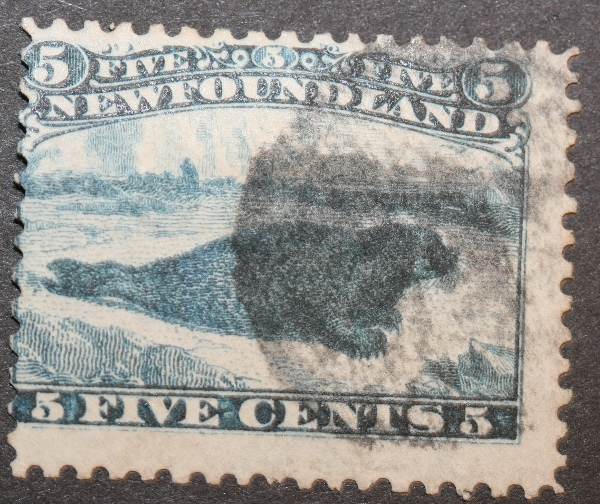 |
|
Send note to Staff
|
|
|
|
|
Pillar Of The Community
New Zealand
731 Posts |
|
|
Welcome Stevenov21 !
I am not a professional expert, but I do focus on and only collect Newfoundland--having done so since 1970. I've got pretty much a complete Used and Mint set of Newfies and lots of covers--so some understanding which I hope will be helpful.
One can never be sure and I am at work but happy to do some more research tonight, but my initial view is that the image you have is not authentic. The 1876/1879 issuance of this stamp was rouletted not perforated. The "blue" seal is sometimes confused with #53,#54 and #55 on a general basis, but any close attention one can see the differences (at the top of the stamp and the "5" for example.
Value wise, according to Unitrade 2012, the used VF #40 is listed in catalog at $60. The #53-54-55 are $16-$14-$8.
I suppose it is possible that someone took an authentic #40 and perforated it before posting it, but I'd be hard pressed to figure out why someone would do so.
Please don't take my initial view as untoward to you or the source. I'll dig out some images of my stamps so you can compare and I will dig into some deeper research books just to see if there was some oddity that I am not aware of.
I'm sure there will be other great experts on the community to chime in too.
Thank you for sharing |
Send note to Staff 
|
|
|
Valued Member
Canada
17 Posts |
|
|
Hi Tommy, Many thanks for your response. Ed Wener ( http://www.jacestamps.com/e-books/N...orgeries.pdf describes a forgery, blue, perforate 14, at the bottom of p. 21, but also illustrates a few genuine ones (in his opinion) at the bottom of p. 22, which are perf. 12. Besides being perf 14, the forgery lacks the bottom frame line and is also half a mm narrower. I don't have a caliper to measure the precise width and compare it with one of the rouletted copies I have, but as my copy is perf 12 and does have the bottom frame line, it seems to be closer to Wener's genuine perforates than to his forged one. But that's all I have to go on for the moment, and I look forward to hearing what you discover! |
|
Send note to Staff
|
| Edited by stevennov21 - 11/23/2013 2:03 pm |
|
|
Pillar Of The Community
923 Posts |
|
|
Psst! stevennov21. There's an "edit" button on the top line of your posts that you can always use to make corrections. You don't have to make a new posting each time. (I just used it to add this note.) |
|
Send note to Staff
|
| Edited by sak - 11/21/2013 08:33 am |
|
|
Valued Member
Canada
17 Posts |
|
|
Thanks sak! Edit achieved, and superfluous message deleted. Trust me to overlook something so obvious! |
|
Send note to Staff
|
|
|
Pillar Of The Community
New Zealand
731 Posts |
|
|
stevennov21,
I have done some more research and would point to Bogg's History of Newfoundland Stamps and Walsh/Butt's Newfoundland Specialized Stamp Catalogue (NSSC). Both are the definitive sources for Newfie stamps.
I would suggest that you send to an expert service (like Greene) to make sure; it cost less than $75 (I think) and would be worth it to know.
But my opinion is that this is not authentic. Neither NSSC or Bogg's allows or has any description of #40 with perforates. In fact Bogg's notes on page 56 that there are many forgeries and lists a few. Normally Bogg's does not do this, but in fact he devoted half a page to the 5 cent forgeries and has a picture of what looks like your image. He specifically calls out a false 11.5 perforated 5 cent blue. (I would check your perf carefully--if it is 11.5 then its false; if it is 12 then you have some hope). If it is 12.5 or 13 then per Bogg's it might be a Spiro forgery.
There are two tells of these forgeries--the icebergs in the background being not all there and the seal's tail not being divided. Your image appears to have a single tail with a shadow, not divided like the image in Unitrade or NSSC. But again--I am not an expert and can't really see the images properly.
There is an outside chance your stamp is black not blue (hard to see for sure--just throwing out crazy ideas). It looks blue to me, but since I am only trying to share as much facts or possibilities for you and the SCF group, if under some proper machine your stamp were determined to be black (and perhaps the tint blue was from something else), then this might open up hope that it would be #26. #26 was a seal from earlier in 1865 (not 1876 when the #40 was produced) but they were both made by the American Bank Note Company, and I believe from the same plates...however the #26 was perforated at 12.
As far as the PDF by Werner, your link is broken. I do recall seeing his research, and it appears robust--I just don't know it but I will check it out, more thoroughly. My quick advice would be follow the tail.
hope this helps. not meant to offend, just my opinion.
again--if I were you, I would send off to find out an answer--and then you know for certain. either way--keep the stamp: it is part of history and worth something. Either as a notable forgery or a book breaker.
cheers
|
|
Send note to Staff
|
| Edited by tommy - 11/22/2013 10:57 am |
|
|
Valued Member
Canada
17 Posts |
|
|
Hi Tommy, Absolutely no offense! I hugely appreciate your feedback! Here's the correct link - the final bracket broke the previous one; sorry about that! http://www.jacestamps.com/e-books/N...orgeries.pdfAgain, many thanks. PS I bought the batch for a pittance; I'm keeping the high-end ones and selling the low-end ones. If they all sell at my low asking price I'll have amply recouped my costs and have a couple of good stamps, or at the very least a couple of very good forgeries to boot (if you're interested, the ones for sale are on ebay). Thanks again for your feedback! Ps perf is a shade over 12 but under 12 1/4 x 12, as best I can tell. |
|
Send note to Staff
|
|
|
Valued Member
Canada
124 Posts |
|
|
Well, how about this?  It looks like the vertical perforation might be almost right (but not quite), but the top and bottom perforation don't align. It seems that either top or bottom at least don't gauge the same all the way. My guess is that there is at lease some fake perforation. |
|
Send note to Staff
|
|
|
Valued Member
Canada
17 Posts |
|
|
Good point. As best I understand it, I think Wener (see link) says that the the cancellations on his copies are authentic, because (I assume) you can see that the stamps were perforated before they were cancelled; he thinks that the perforation is some local, ad hoc initiative, because separating the rouletted stamps was proving to be difficult. A local initiative would, I assume, also account for the irregularity of the perforation.
I think I will send a note to the Greene foundation to ask whether I understand Wener correctly - i.e. if they can establish what came first, perforation or cancellation. If they can, I will send in the stamp and post the result.
Cheers
Steven |
|
Send note to Staff
|
|
|
Pillar Of The Community
New Zealand
731 Posts |
|
|
Hello Steven,
During the Thanksgiving holiday, I managed to read the entire PDF from Wener about Newfoundland forgeries. Interesting read and I noted that he is in New Zealand (where my wife is from and I reside there half the year; I would like to reach out to him at some stage). So thanks for that link...I had seen his document before but only sporadically.
I read and re-read his analysis, and while I still think you have do not have a legit stamp (and interesting perf side by side comparison above), I sort of think that you might have some hope of a legit stamp that was locally perforated (as you touch upon) at the time by some one. Its possible though even he admits it is a mystery. Not sure why someone would do this or if it increases the value. Anyways, I now think that if I were you, I would definitely send it to Greene and pay for it to be vetted. You will either have a unique genuine stamp of some worth or establish it as a new type of forgery. In either case, knowing would be worthwhile and advance your collection and the Newfoundland philately. I hope you do so and good luck.
Tom |
|
Send note to Staff
|
|
|
Pillar Of The Community
923 Posts |
|
|
Local ad hoc perforations presume someone with an ad hoc perforator.
I wonder what that might look like? I have never heard of one.
|
|
Send note to Staff
|
| Edited by sak - 12/03/2013 4:40 pm |
|
|
Pillar Of The Community
New Zealand
731 Posts |
|
|
We are talking about the era of 1879, which is 131 years ago. In that era, all kinds of wild things happened to stamps--on an "ad hoc" basis (i.e. things to stamps and covers not approved by the postal authorities). People created their own stamps, and tried to sell them to folks (several Newfoundland examples). Forgers used a new technology (a camera) and took photos of stamps and lithographed or copied stamps to con people. Postal authorities used wierd cancels. Etc etc.
The theory above (and its only a hypothesis) is that someone would have physically perforated the edges of an unperforated stamp for some reason (like to make it valuable or to make it easier to separate from a sheet). I am not endorsing this or saying it happened to the stamp above; in fact, I believe its probably not genuine. But it is fun and helpful to test hypotheses, and SteveNov appears to have done so with this item.
I suppose other SCF members would have good examples of "Ad hoc" changes or perforations over the years? Anyone else? |
|
Send note to Staff
|
|
|
Valued Member
Canada
17 Posts |
|
|
Thank you all for your feedback - very much appreciated!. The stamp is on its way to Greene, and I'll post their verdict as soon as it arrives. |
|
Send note to Staff
|
|
|
Pillar Of The Community
United States
6756 Posts |
|
|
Pillar Of The Community
923 Posts |
|
|
Continuing along with Tommy's testing of the hypothesis, an "ad hoc perforator", having no fraudulent aspirations, would not take care to align his perforations exactly with the rouletting cuts. In this example there are no signs of rouletting, especially on the wide right margin.
As I asked before, is it likely that there were "perforators" just lying around the Post Master's desk? Pinking shears, maybe, and those little rollie things my mum used to copy dress patterns.
Oops! (left = right)
Nitrolures: I can't believe a sewing machine can make such clean perf. holes! |
|
Send note to Staff
|
| Edited by sak - 12/08/2013 12:12 pm |
|
|
Pillar Of The Community
Canada
2277 Posts |
|
|
Been away for awhile but this post got me to open an album again. Attached is a few seals for reference. The center is apparently from the earlier plates and was likely rouletted originally. The upper brown is possibly a spirro forgery but the cancel makes me wonder as he generally used a 9 or 10 line cancel not cds style . The left brown is a perf 12 and the center blue is perf 14. If the rouletted blue is at proper dimensions you can see there was enough overall room to perf after the fact. However the where when and why its perffed is a bit perplexing. As far as perf machines laying around a sewing machine set at close stitch would probably have worked if the rouletted ones were a problem for the post offices. I likely made this more confusing but thats half the fun. 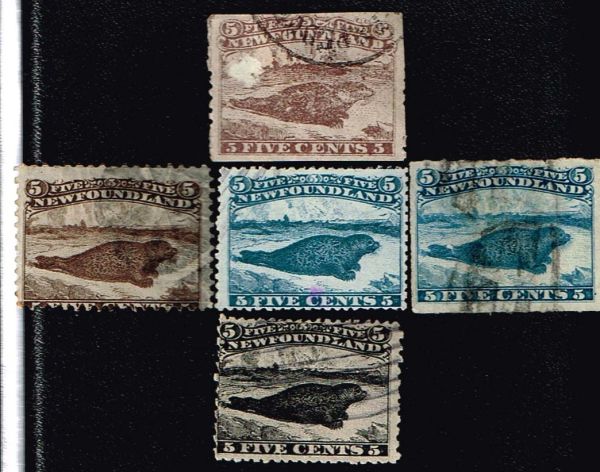 |
|
Send note to Staff
|
|
|
Replies: 19 / Views: 6,105 |
|



 Posted 11/20/2013 01:34 am


