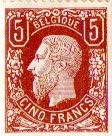
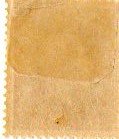
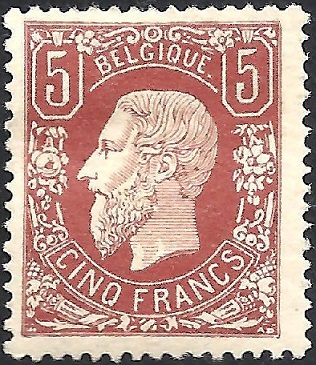
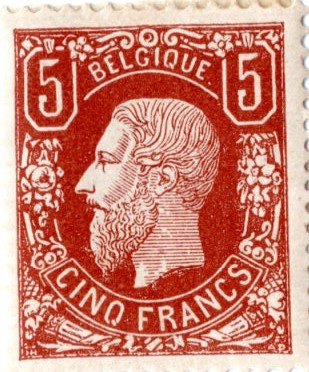
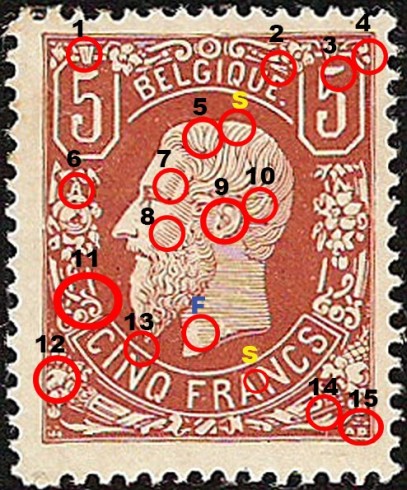
Lets look at the main characteristics of the forgeries. I updated my picture to include a few unusual items.
The one shown is the most common fake on non certified auctions.
There are about 20 varieties of the forgeries with many of the list items in each case.
Interestingly a forgery was made in Germany? about 2005. The author put the word "fake" outside the bottom left frame & still managed to sell dozens on auction. He also faked a cancel (Liege) on a postcard.
First and not easy with a picture is the perforations - they should be 15X15 (more accurately 14.75 X 14.75)
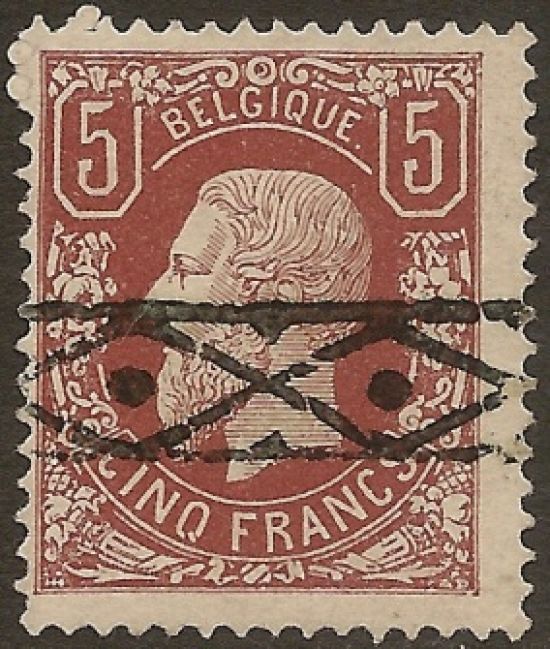
Roller cancels are generally not forged as they reduce the value in half. Some letters have them.
There are some very good fake postal cancels on letters & postcards ranging from 1875-81.

Note that the list does not apply in every case for the real one based on the position on the sheet. Excess ink can also obliterate some features.
1. The bottom legs of the V should not touch one another.
2. The line should not be forked.
3. The tip of the 5 should be rounded, not pointed or curved upwards.
4. Other than 1 or 2 positions on the sheet. the frame should have a break in it at this spot. On many fakes the outside frame tends to be very imperfect.
5. The Y shaped hair should not touch the top of the head or the hair at the base.
6. The delta has many shapes on forgeries but should not resemble a letter A
Delta on real one below

7. This one if often wrong. There should be 9 hairs (top one can be very slight) and the 4th from the bottom will be noticeably shorter.
8. The hairs should not be even & should have some curves.
9. The ear is another common area. It should have a fork on the inside & specific breaks as shown.

10. There should be dots (dashes) here between the hair lines.
11. These 2 ornaments should not touch.
12. This ornament should not touch or cross the frame.
13. There should be no color or bleeding in this area (Sperati variety trait).
14. This line should have a break in it.
15. The initials AD should be visible with a dash & 2 or 3 points above it. The frame line besides it should be thick.
S . The top one is a Sperati variety (2? exist) where the tip of the hair has a noticeable curve in it. The bottom S, Sperati put a white dot here between the A & N.
F. A Fournier variety (there may be 4 or 5 of them). Some of the hairs have a definite downwards curve on them.
Finally on some bad ones the letter L in BELGIQUE is longer than the E. The number 5 has a rounded appearance instead of straight edges. The middle line of the E is very short. The Last E may have a dot above it.
There were 3 printings, Feb.78, June 78 & Aug 80 & different inks were used, so results vary.
That's most of the traits - now you are all experts on the 5Fr Albert





 Posted 11/26/2013 11:40 am