| Author |
 Replies: 17 / Views: 4,567 Replies: 17 / Views: 4,567 |
|
Valued Member
Australia
26 Posts |
|
|
Hello all members, This is my first post and the question is not an easy one. I found this post card with 2c Jackson on it. The postcard dated 1877 and addressed to Germany. Firstly I am confused with the secret mark, as per Scott 1947 publication there is a diagonal line under the scroll at the left of "U.S.", has any one have clear idea or picture of it? I know it seldom show clearly, but I can see clear diagonal marking between the letters "U and S", so is that what it is or something else? Secondly the colour, in bold areas it looks like carmine-vermilion but the rest is vermilion or orange-vermilion. So how we check the colour? compare with lighter area or bold area? And then the paper looks to me as white wove paper ( since they all printed on a white or yellowish wove paper ), so it cannot be 178 as the paper is yellowish, and it's not 168 as the colour is brown, and it's not 135 or 146 as those shades are brown. So the question is could this be #180? as the stamp issued for 1876 Centennial Exposition and the date on the card suggest 7th October 1877? posted on 8th at St Louis. awaiting your valuable comments on this. please look at the other two stamps as well one is shade of brown and the other dull vermilion. N.B. Can anyone recognize the bold numerical cancellation on the middle stamp. Please note the postcard tide with only single stamp and I have placed two other similar stamp for comparison which are from my collection and two different shades.
cheers randeni 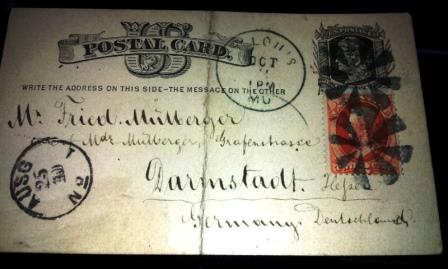 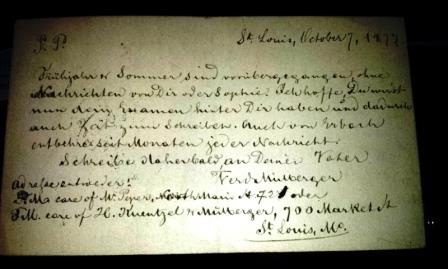 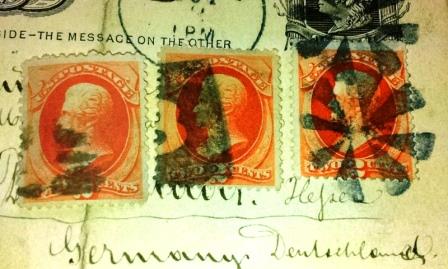 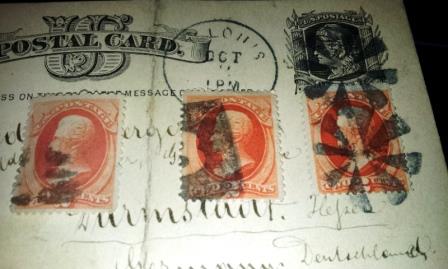 This image of #180 just found on an action site  |
|
Send note to Staff
|
| Edited by randeni - 08/18/2014 08:15 am |
|
|
|
|
Valued Member
Australia
26 Posts |
|
|
OOOPS
I think I posted above in the wrong Forum. I hope the administration can correct it..
cheers |
Send note to Staff 
|
|
|
Rest in Peace
United States
7097 Posts |
|
|
2 of the 3 are not original to the document as ca be seen by the partial non-tied fancy cancels. Unless you just put them there for reference. Scott #178 in use from 1875-79. |
|
Send note to Staff
|
| Edited by I_Love_Stamps - 08/18/2014 06:27 am |
|
|
Valued Member
Australia
26 Posts |
|
|
Yes, other two for the colour reference from my collection, I place them closer to the subject for picture purpose. this postcard posted on 8th October 1877 so issues after this date no need to consider.
I hope you experts have more to share with me please.
I better get some sleep before I get mad. see you all in the morning.
cheers |
|
Send note to Staff
|
| Edited by randeni - 08/18/2014 07:32 am |
|
|
Rest in Peace
United States
7097 Posts |
|
|
It's color is listed in the Scott catalog as Vermilion; and what was that "wise crack" supposed to mean? Quote:
"I hope you experts have more to share with me please. I better get some sleep before I get mad.."  Gee-whiz! I'm sorry, I thought I was being rather polite? The date on your postal stationery is dated October 7th 1877 which correlates precisely with when they was in use.  edit: spelling error edit: spelling error |
|
Send note to Staff
|
| Edited by I_Love_Stamps - 08/18/2014 07:49 am |
|
|
Valued Member
Australia
26 Posts |
|
|
Pardon me for my poor English. I was exited when I saw the stamp and eager to see someone say yes its or no it isn't with enough supporting materials. Gee I am So Sorry If I rude to any one. By the way I also found this image of #180 from an auction site cheers |
|
Send note to Staff
|
| Edited by randeni - 08/18/2014 08:12 am |
|
|
Pillar Of The Community
United States
2963 Posts |
|
|
180 is a special printing that was issued without gum and was never used for postage. You do not have a 180.
Your stamp, if the date on the cover is correct, is a 178 (issued in 1875). The other two vermillion stamps are either 178 or 183, depending on paper type.
Brian |
|
Send note to Staff
|
Brian Riley
APS 223349 |
|
|
Pillar Of The Community
United States
1414 Posts |
|
|
If the paper is relatively bright under long wave UV, the stamp would be a Continental Bank Note printing 178 on hard paper. If the paper is relatively dull under long wave UV, it would be the soft paper 183 American Bank Note (or late Continental) product. For comparison, use a common stamp like a 65 or 114 as a hard paper example or a Scott 210 or 213 as a soft paper example.
Clark |
|
Send note to Staff
|
|
|
Valued Member
Australia
26 Posts |
|
|
Special thanks to Clark and Brian as well as to others who helped me to identify this stamp.
Thank fellows, keep up the good work.
cheers
randeni |
|
Send note to Staff
|
|
|
Rest in Peace
United States
7097 Posts |
|
|
look how white the stamp is compared to both 1.) the postal stationery card (notorious for staining stamps) and 2.) the example to it's immediate left (probably of soft paper). So that's why I said Scott #178 (hard paper). -Cheers |
|
Send note to Staff
|
| Edited by I_Love_Stamps - 08/19/2014 04:27 am |
|
|
Valued Member
United States
202 Posts |
|
|
What an interesting, colorful, informative and somewhat controversial topic and discussion! I appreciate these "What if it is, what if it's that, etc.
They make me think and go research the stamp/s in question, something I rarely did in the past.
Thank you all.
|
|
Send note to Staff
|
|
|
Pillar Of The Community
United States
1946 Posts |
|
|
Quote:
N.B.
Can anyone recognize the bold numerical cancellation on the middle stamp.
I just happened across this thread and noticed that no one responded to your second question. The negative figure in a squared off block is most likely the figure "8" but could also be a "3". The easy part of the question is in referring to this as one of a large series of such cancels used in Boston, Massachusetts. The great authority on cancels of this type is still the magisterial work by Blake and Davis from 1949, ^Boston Postmarks to 1890^ (also Quarterman reprint from 1974). Based on comparisons with the illustrations in plate 100, your numeral cancel is either #1779 or #1787 for numerals 3 or 8 respectively. Either way, this marking was used from 1880-1882, so chances are most likely that the stamp bearing this cancel is on soft paper, making it a Scott #183. |
|
Send note to Staff
|
|
|
Valued Member
Australia
26 Posts |
|
|
Rest in Peace
United States
7097 Posts |
|
|
That's brilliant essayk! I never thought to look at the cork as a possible dating tool. However the #183 wasn't in use in 1877 (please correct me if I'm mistaken please.) and issued in 1879. The date on the card is 1877 which, in my opinion, makes the #178 a better fit. I suppose we could put this to rest if we could see a scan of the stamp at a higher resolution. |
|
Send note to Staff
|
| Edited by I_Love_Stamps - 09/03/2014 07:08 am |
|
|
Valued Member
Australia
26 Posts |
|
|
I think there is a misunderstanding, the two stamps on to the left side dose not belongs to the postcard. They are there to compare with the one on the card. So the middle stamp could be anywhere in between the mentioned period. I will try to post a clear scan soon. |
|
Send note to Staff
|
|
|
Rest in Peace
United States
7097 Posts |
|
|
Replies: 17 / Views: 4,567 |
|



 Posted 08/18/2014 04:09 am


