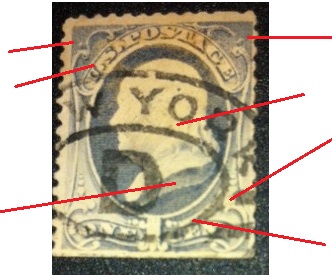
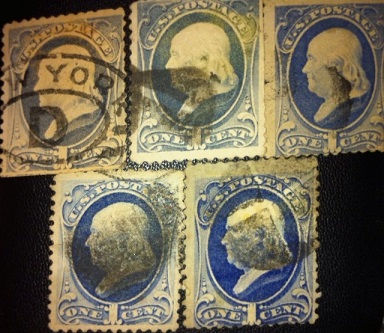
Belfastgirl, mind if I jump in here? As a specialized interest I have been studying the stamp designs you are looking at here since 1975. I've seen a few things and I may be able to help.
The terms A44 and A44b are conventions that the Scott catalog uses to differentiate two design states for the various one cent stamps from 1870-1886. Your comment that A44b must have preceded the production of A44 betrays a rather fundamental misunderstanding of how the catalogers approach this. I also sense that there may be some misunderstanding of the topic of intaglio printing of US postage stamps. Both these subjects are covered in an introductory way in the intro to the US Specialized. I am going to assume that knowledge in what I say here.
Below I have uploaded a side by side image of A44 (left) and A44b (right). The image on the left is from an early plate proof dated 1870, and shows the original version of the A44 design type. The image on the right is taken from a die proof of the A44b design, for the one cent redesign of 1881. These images are derived from scans taken through the plastic of the mounts in which I keep the actual stamps. Except for whatever error the mount introduces, and adhesions on the glass of the scanner, these views give you the purest forms of these two designs. (If you need to see die vs die and plate vs plate, that can be done, but should not be necessary.)
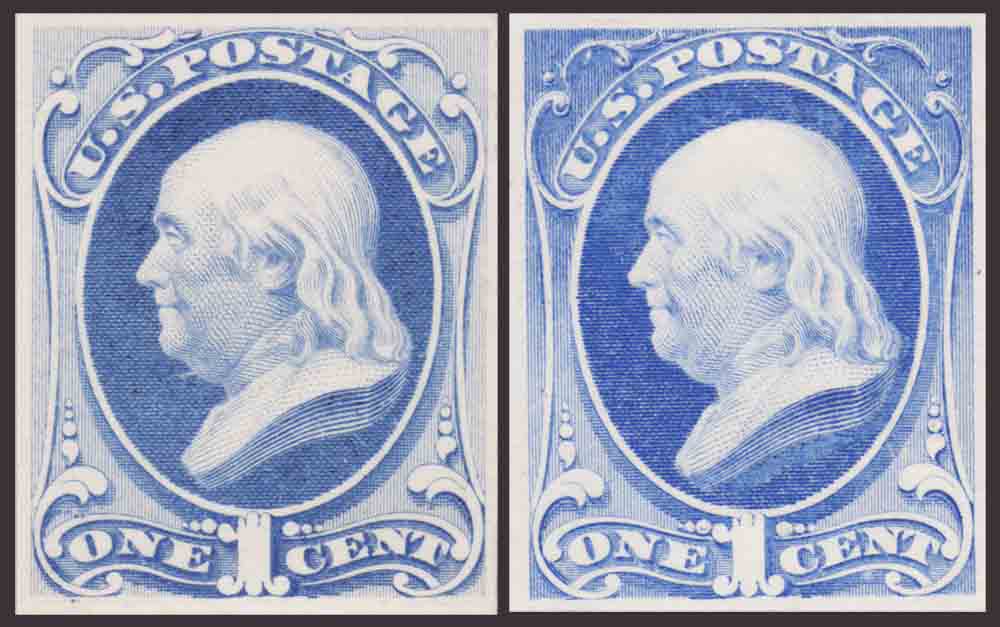
The first design (left) was created by the National Bank Note Company in late 1869 and early 1870. From that point until about 1877 the one cent stamp was printed on hand operated presses onto a comparatively bright, thin, stiff paper. For that medium the design did just fine for National and the company which followed them, Continental Bank Note Co. However, from 1877 until their consolidation with two other companies in 1879, Continental began to print their stamp on paper with a different kind of sizing agent that changed its overall texture. It was softer, and stamp paper became progressively softer after the consolidation into the American Bank Note Co. in 1879. By 1881 it was very much softer than it had been in 1870, and the trusty old design was not showing up as well as before. In 1881 the Government called for an improvement, and in June of that year Edward F Bourke was enlisted to rework the design on the original die. This he did with acid etching, and the result is what Scott calls A44b, the design on the right. Since that work was done it has been impossible to get an original die print of A44, so the change is unalterable. Moreover, the original plates were also put to rest, and so the design A44 can no longer be printed in any form.
All of this matters because it sets aside any possibility of the revised chronology you had suggested above to account for what you think you are seeing. Now that you know something of the background behind these two designs, perhaps you can appreciate why it matters a great deal to be clear about which design family your stamp is in. I do not need a sharper image to be able to tell that the stamp in the scan you posted is more like the image on the right and so part of the A44b family. Whatever else you want to say about it, your stamp could not have been made before June of 1881.
Now that you have a clear picture of the original designs, perhaps you can use it as a comparative reference for the feature(s) you want us to notice about your stamp.





 Posted 10/30/2014 1:19 pm