| Author |
 Replies: 15 / Views: 4,698 Replies: 15 / Views: 4,698 |
|
|
Valued Member
Bulgaria
216 Posts |
|
|
Hi I have a problem for identifying a stamp that a friend of mine wants to sell to me. It concerns the type Jefferson 10 c brown-Scott picture A49. Attached a scan of that stamp. Looking thru Scott, I found the following possibilities: - #139 But the paper is not white and there is no grill - # 150 But the paper is not white and there is no grill - # 161 But the paper is not white - # 187 Maybe? There is no secret mark in the right volute - # 197 ?? Can you help me by identifying the exact type of that stamp. Thank you a lot ! priatel 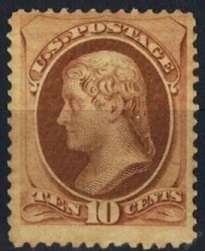 |
|
Send note to Staff
|
|
|
|
|
Pillar Of The Community
United States
6667 Posts |
|
|
Pillar Of The Community
United Kingdom
8628 Posts |
|
|
Don't have Scott, but this may be SG210 of April 1882, for which SG lists four shades beyond the standard pale brown (brown/deep brown/reddish-brown/black-brown). The shading between the left hand side of the oval and the edge of the shield should also give an indication as to issue. The 1882 stamp has four vertical lines, compared with five on the 1870 issue. The ball beneath the "E" of "Postage" was also smaller in the 1882 issue. But what do I know, as Montaigne said.
Regards.
Geoff |
Send note to Staff 
|
|
|
Valued Member
Bulgaria
216 Posts |
|
|
Thank you.
@stallzer
the site you gave me indicates very clearly how I have to proceed. Thank you |
|
Send note to Staff
|
|
|
Pillar Of The Community
United States
1817 Posts |
|
|
This appears to be Scott 187, the American Bank Note printing without secret mark. The photo makes it difficult to tell if there are four or five vertical lines between the left side of the medallion oval and the edge of the shield (four lines would make it the American Bank Note reengraved issue of 1882, Scott 209), but Scott 209 is typically in a darker shade and crisper impression than the one pictured here. The non-white ("soft") paper, while not a 100-percent positive indicator, is generally characteristic of the American Bank Note Co. printings as opposed to the Continental Bank Note (Scott 161) or National Bank Note (Scott 139 and 150) printings. |
|
Send note to Staff
|
|
|
Bedrock Of The Community
United States
10838 Posts |
|
|
Valued Member
Bulgaria
216 Posts |
|
|
There are 5 weak lines.
When I check the eye of Jefferson, it has vertical lines Inside and no big upper spot at the eyebrow.
So I think it is a 187 one.
What can be the influence on the price the fact that it is on the upper side out of center ?
At which % of the Scott value can it be sold (in %)
Thank you |
|
Send note to Staff
|
|
|
Pillar Of The Community
United States
1414 Posts |
|
|
Quote:
What can be the influence on the price the fact that it is on the upper side out of center ?
At which % of the Scott value can it be sold (in %) First, assume the stamp has no faults, however note that most stamps from this period have one or more faults. The Scott Valuing Guide in the United States Specialized catalog can be used. This stamp would grade as very good to fine with a price about 1/3 of catalog. The stamp may be unused and is priced in the catalog as never hinged, hinged or no gum. A regummed stamp would catalog as no gum. If the stamp happened to be never hinged (unlikely), the value would be about 25% of catalog. Unfortunately, off center stamps are common and may not command even 1/3 of catalog. If the stamp is damaged or altered, the value would be between 5 and 10 percent of catalog. Prices for damaged or off center stamps continue to drop while prices for very fine of better stamps continues to rise. Clark |
|
Send note to Staff
|
|
|
Valued Member
Bulgaria
216 Posts |
|
|
@cfrphoto Thanks for your comment. Attached the back side of the stamp. It is full original gum . Never hinged. The Scott give an evaluation for never hinged stamp. May I consider it ? If you check the total aspect of the stamp ( 2 sides) what will be your estimation ( in %) of the catalog value ? Thanks for your help. priatel 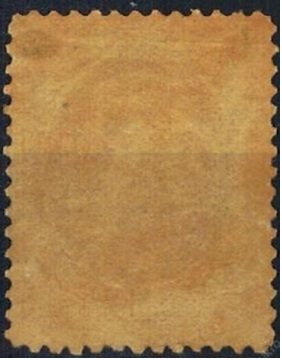 |
|
Send note to Staff
|
|
|
Pillar Of The Community
United States
578 Posts |
|
|
Looks (crudely) regummed to me...and with that oval discoloration upper left, almost 0% chance it's NH (even if the gum is original.) Check for reperf too (questionable "look" on multiple sides for me.) The look of the perfs (cut, separation) leads me to believe it's a soft paper banknote, so I'd guess Scott 187 for identity. As is the case with any potentially unused 19th Century stamp, you have to check closely (UV) to ensure a cancel hasn't been removed and make sure the regum/redistributed OG isn't covering other faults/alterations (dip it.)
A high resolution scan (600 or 1200 dpi) of both front and back would probably get you a much better answer. |
|
Send note to Staff
|
|
|
Bedrock Of The Community
United States
10838 Posts |
|
|
It has a horizontal crease near the top, which seriously affects any value. |
|
Send note to Staff
|
|
|
Pillar Of The Community
United States
578 Posts |
|
|
Is your friend asking more than $50 for the stamp? If not, then it's probably worth proceeding with better scans & more questions. If so, then probably best to just pass (IMO.) |
|
Send note to Staff
|
|
|
Valued Member
Bulgaria
216 Posts |
|
|
Thanks for your comments.
And if you can give me additional ones, I will be happy to learn a little bit how you examine a stamp.
My conclusion is to refuse his offer, because he was thinking that the stamp was a 187 never hinged.
187, yes ! never hinged, no ! ( IMO now-0 but I will wait for the result of the UV test))
I asked him to make the test Under UV lamp and to show me the result.
If he gives me the picture, I will post it here .
Thanks again.
I will come back here for asking your thoughts as experimented collectors or stamps users.
So he will be very disappointed but it's better that he knows the true about his stamp now than later ! |
|
Send note to Staff
|
|
|
Pillar Of The Community
United States
1946 Posts |
|
|
I would check for a removed cancel very carefully, because for some reason the 10c American soft paper stamps of this issue are notorious for having lots of faint cancels (in black and in magenta especially). Very tempting to misrepresent them.
As for grade, that spot of gum side discoloration is a big problem when it comes to gum condition. Even if it could be established that the gum is original and the stamp never bore a hinge, it could not command the NH premium because of that gum fault.
Because so much rides on grading, when you want a preliminary opinion on grade it is best to scan the stamp outside of any mount or stock card. In this case, on the reverse I see a horiz line across the middle which I assume to be the end of the pocket on the stockcard. But I also see a line higher up, about on the level of the spot, for which I cannot account. Is that another kind of gum defect, or possibly a crease of some kind? I cannot tell. Nor can I tell if the gum on the lower half has problems being masked by the plastic of the stock card pocket.
Do you see the problem?
Number 187 is a big ticket item as mnh, so you want to take a really GOOD look.
Edit [BTW the expression "dip it" as used above refers to watermark fluid, not water. Perhaps you already knew that, but I wanted to cover that base, just in case.] |
|
Send note to Staff
|
| Edited by essayk - 11/18/2014 10:05 am |
|
|
Valued Member
Bulgaria
216 Posts |
|
|
Pillar Of The Community

United States
853 Posts |
|
|
I have a 10 cent Jefferson identification question as well, so thought I might piggy-back here on the existing thread in hopes of learning more about the 19th century regular issues as I push my collection back in time. I just purchased stamps to fill out my 1879 series 182-191. Among these were a 187 and 188. The 188 bears the secret mark and is of "normal" size for this series as far as I can tell. But the 187 is markedly larger than the others in the series I have. This 187 is near 30 mm from top perforation to bottom, which is one more perforation worth than others. In the images below I tried to align perforation for perforation with the 188 and to have the imprints align also. The imprint heights are the same, it is just that the 187 is big. I do not believe the 187 is a 209 because I can count five lines in the left margin between the oval and frame. And it is not nearly as dark as the 209 I have seen in another thread on identifying these. But in terms of size, it seems to me this 187 is more like the later stamps (comparing to say a 210 which I have in my collection). Unfortunately I do not have a 209 to compare directly to this 187. To add to my confusion, on the back of the 187 is penciled 187, but on the back of the supposed 188 is penciled what looks like 147 which is clearly not a good Scott number, right.... So I hope I can get some pointers here as to other factors I ought to look at. The paper looks yellowish, but I have very little experience there. And I can see fibers which I understand imply soft paper. But the relative size is throwing me. Given the used condition, there's not a lot at stake financially, clearly, but I do want to learn more, so I thank you in advance for your help. In the images below, the left is the 187 and the right the 188. 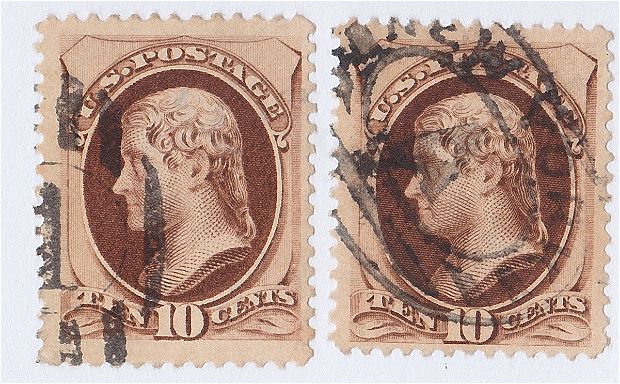 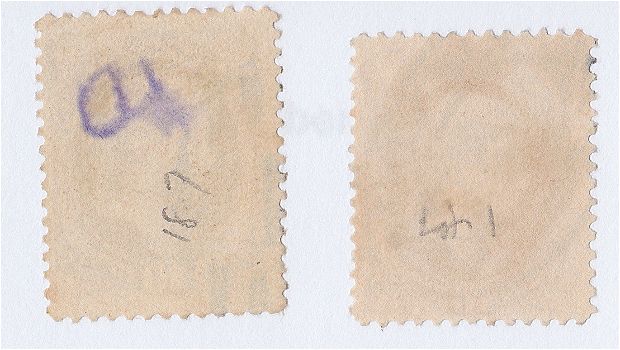 |
|
Send note to Staff
|
-- Jonathan |
| Edited by jleb1979 - 10/10/2019 2:14 pm |
|
| |
Replies: 15 / Views: 4,698 |
|




 Posted 11/17/2014 6:11 pm


