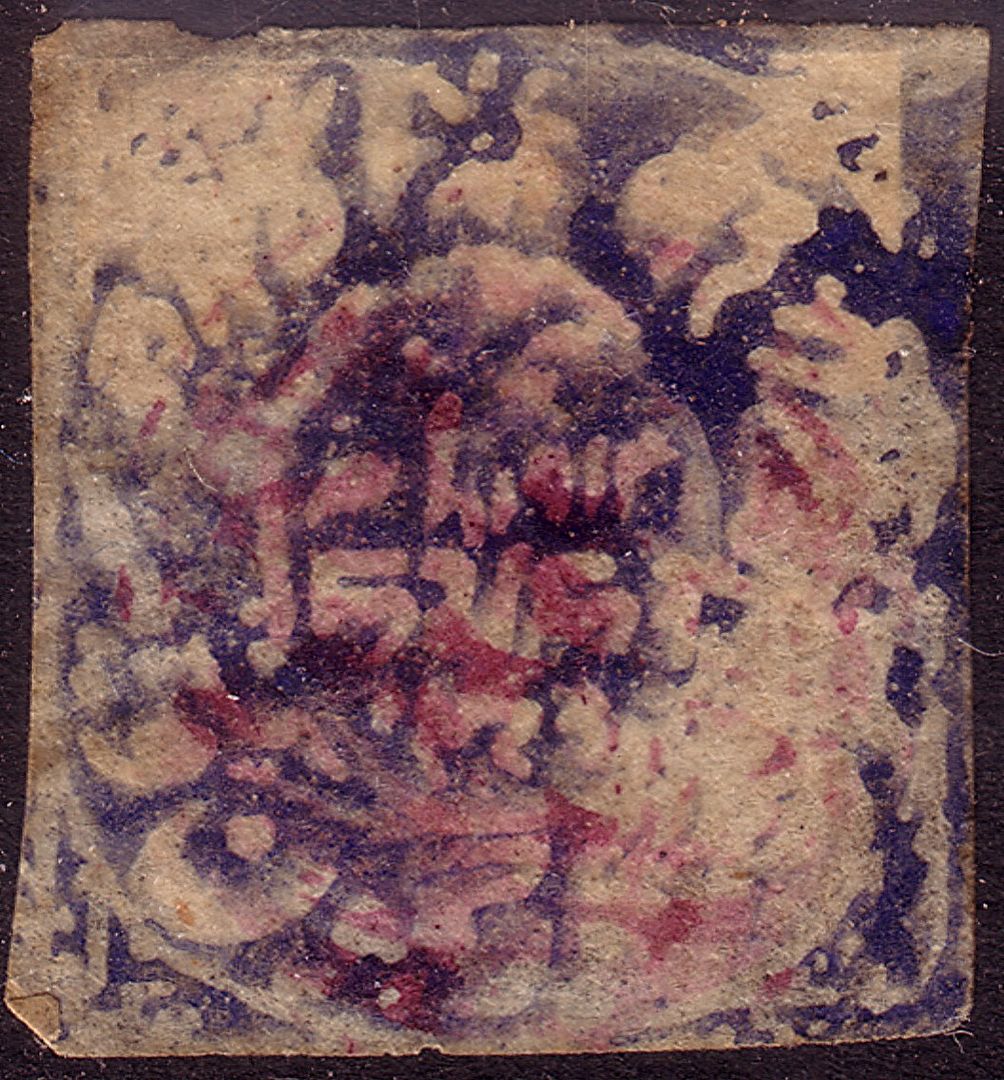
Assuming the reader at least has a general idea of what and where Kashmir was/is, I should nevertheless explain the 'Old Rectangulars' part.
These stamps are referred to as 'Old' in order to distinguish them from the 'New' Rectangulars, issued for both Jammu and Kashmir in 1878, to supersede the individual 'Old' Rectangulars for Jammu and for Kashmir. (The New Rectangulars are a vastly larger and more complex field. I might try to take it on at a later date.)
While neighbouring Jammu was able to get by with only two values, ½ and 1 Anna, Kashmir needed six values, ranging from ¼ Anna to 8 Annas. I say needed advisedly: all six values are reasonably abundant used, to the extent that Gibbons rates the used top value 8 Anna cheaper used than mint. Not a common situation!
The lowest value, the ¼ Anna, was probably intended for postcards. I've yet to see it used that way, or on any postal item for that matter. Still, unused or used, it's fairly common:

This is the complete plate, a strip of five. It formed the top half of the plate, with the bottom row of five being the 2 Anna value. Goodness knows why - but no 2 Annas are known in black, and no ¼ Annas are known in a 2 Anna shade.
Here is a single ¼ Anna unusually
without the margins being trimmed off:

And here is what is usually described as a proof strike of the ¼ Anna plate in printer's ink:

These are not terribly uncommon. If your heart is set on one, you'll be able to find it, with a little patience.
Any Kashmir Old Rectangular printed in printer's ink should set the antennae quivering. All the legitimate stamps were printed in watercolour.





 Posted 03/13/2015 12:26 am