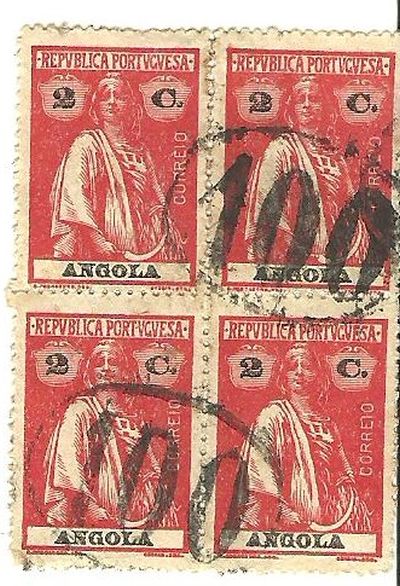
Good evening,Quote:
Bujutsu said in 14 May 2015
Hi All
Somewhere in the distant past, I saw an article on a marking like this, but, I cannot remember the source.
They are large oval '100' markings. I am wondering if this is a special marking, or, is it a form of marking used on registered mail from this country?
Thanks a lot
Chimo
Bujutsu
[...]
Dear Bujutsu,
These numeral cancellations, markings, were used on the XIXth century (payment amount by the recipient), etc, etc... and on XXth century they were used again in several Angola post offices.
There are several studies about them (mainly in Portuguese language) in spite they do not agree with the same interpretations.
It seems the most probable is that they are just provisional cancellations during 1920s-->40s (before the arrival/acquisition of a proper datestamp) and we know at least the following "numbers" within an oval (on stamps):
50, 100, 150, 200, 250, 300, 350, 400 and 500.
They have not the same scarcity on stamps (some of them are rare). Occasionaly some of these numbers appear in auctions, here and there, on cover.
Two of most relevant studies about them are the following: (The Correia (1998) text also reports several other previous studies):
CORREIA, Dr. Elder Manuel Pinto (1998). "História postal de Angola (2) Obliterações numéricas ovais". In
Boletim do Clube Filatélico de Portugal nº 381 Setembro 1998. Lisboa: Clube Filatélico de Portugal. (Portuguese)
MAGALHÃES, Alexandre Guedes de; and the International Society for Portuguese Philately (1989). "Postal Markings of Angola" in
Portu-Info nº94. (English). Previoulsy published in Portugal in Portuguese language.





 Posted 05/14/2015 1:28 pm