| Author |
 Replies: 5 / Views: 2,524 Replies: 5 / Views: 2,524 |
|
|
Pillar Of The Community
United States
2947 Posts |
|
|
I'm a sucker for anything aesthetic, like this cover. Don't know what the postmark is though. 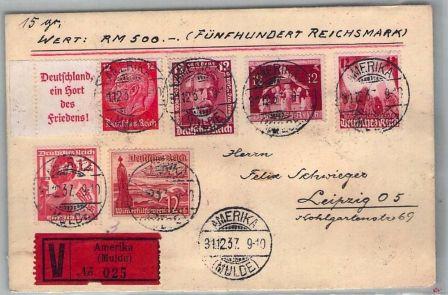 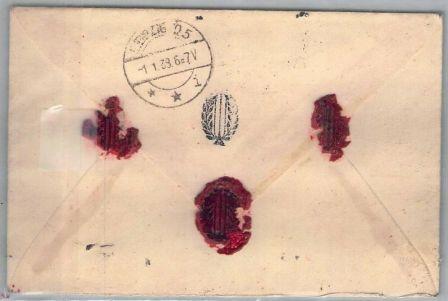 |
|
Send note to Staff
|
|
|
|
|
Pillar Of The Community
1213 Posts |
|
|
Wiki comes through, again - it was a tiny factory/village on the Mulde River in Saxony, Germany:
Amerika (German pronunciation: is a former company settlement in the German Free State of Saxony and a district of the town of Penig.
As a small village of 79 residents (2010), it is known merely for its name, the German word for America, which was given to it in the 19th century. In 1836, a spinning factory was built on the left bank of the river Zwickauer Mulde, but houses for workers and clerks were not built until 1870. Initially, because a bridge was only built much later, workers and visitors coming from the right bank of the river had to cross the water using stepping stones or boats to access the place. As "crossing the pond" in those times was chiefly understood as emigrating to America, the factory was named "Amerika" by the local population. The name became official in 1876 (incidentally, the centennial of the United States of America) the when village's railway station was named "Amerika".
The factory was closed in 1991. Amerika was part of Arnsdorf until 1993 and, together with the latter, became part of Penig in 1994. In 1995, the town of Penig bought the buildings from the Treuhandanstalt, and new trades and a museum (including workshops of locksmiths and file cutters, powered by a refurbished water turbine) have been established since.
|
Send note to Staff 
|
| Edited by Kimo - 05/31/2015 1:51 pm |
|
|
Pillar Of The Community
United States
2947 Posts |
|
|
ahh Kimo, I was making it to complicated. I thought maybe it was a ship name. Never imagined a village named Amerika, in Germany. |
|
Send note to Staff
|
|
|
Pillar Of The Community
1213 Posts |
|
|
Happy to help. I have always found Occam's Razor to be a great way to start researching in philatelic matters. Start with the simplest answer and is most always the correct one. |
|
Send note to Staff
|
|
|
Pillar Of The Community
United States
2941 Posts |
|
|
During the period, Germany has a tendency to color stamps of certain values consistently across multiple sets/years. 12 Pf stamps were usually red, and 6 Pf stamps were usually green. Because these were the most common values at the time, there were a lot of different red/green stamps issued.
This led to German collectors frequently making covers like this in red or green. This one was probably also done because of expiring postage -- the Karl Benz (MiNr 605), Communal Congress (MiNr 619), and Nürnberg Party Rally (MiNr 633) [last three stamps on top row] all expired on 31 December 1937, so this was the last day of use for those three.
The franking (72 Pf) appears to be correct for a 15 gram insured letter with value of 500 RM sent to a rural domestic recipient:
Basic letter rate (rural domestic) -- 12 Pf
Transportation/registration fee for insured -- 50 Pf
Insurance -- 10 Pf per 500 RM |
|
Send note to Staff
|
|
|
|
Pillar Of The Community
United States
1026 Posts |
|
|
Germany wasn't alone in the color scheme. It was actually the UPU behind it. Most (if not all) UPU countries used green for domestic postcards, red for domestic letters and blue for international letters. |
|
Send note to Staff
|
|
| |
Replies: 5 / Views: 2,524 |
|




 Posted 05/31/2015 1:45 pm


