| Author |
 Replies: 18 / Views: 5,428 Replies: 18 / Views: 5,428 |
|
Valued Member
20 Posts |
|
|
|
I just began using Stamp Manage and as I entered in my stamps I quickly discovered that there are many varieties that a) my album doesn't list (already figured that) and b) many other sources do not list. (A lot of these variations and Scott numbers I don't seem to see online... wasn't aware of these varieties till now)
When you collect, do you generally differentiate between tagged and untagged stamps for your collection? Or should I just not bother? It is horrible how some stamps have such varieties to the point of not even knowing if I've got the right ones put in to the album.. for all I know I have to go through them each again and be sure they're correct.
Is stamp manage extra extra picky? Do I just be happy with having correct perfs etc. and not worry about the tagged varieties?
What are your thoughts?
|
|
Send note to Staff
|
|
|
|
|
Pillar Of The Community
United States
2547 Posts |
|
|
Pillar Of The Community
United States
8956 Posts |
|
|
I do pay attention. This is a very personal thing; it just depends on how deep you want to go. If you are going to collect general US, you have about 5000+ Scott numbers to worry about.
I specialize and collect only a small portion of the catalog, so I do not mind going "all the way" with varieties, even those that are no listed in the Scott catalog.
Peter |
Send note to Staff 
|
|
|
Pillar Of The Community

United States
1498 Posts |
|
|
As has been said many times by multiple individuals, it's up to you as to what you want to collect. Only you can decide what is best for you. You get to choose how detailed you want your collection to be.
For many years, I ignored tagging as well as all other minor catalog numbers. Then, in late 2010, I decided to branch into minor US varieties (this was cheaper than going back to fill in some of the classics). Along the way I stumbled across a PNC with a plate number that could be worth $75 if the tagging was right. Eventually my curiosity won out & I bought a UV lamp. As a result, I was able to identify many inexpensive varieties that heretofore had remained unknown to me. But collecting tagging varieties does have its pitfalls.
It sounds as though you've already identified one of the problems in attempting to acquire tagging varieties. Many (probably most) sellers don't bother with minor varieties of any ilk and tagging seems to be the most ignored. This can make it difficult to locate a specific stamp. Another problem is that some sellers seem to have difficulty identifying tagging types. I have returned numerous purchases sold as untagged that were in fact tagged.
Finally, all those newly discovered varieties usually aren't found on the normal album page. As a result, you need to figure out how you want to display your extra stamps. I decided to peruse the Scott catalog, select those minor varieties that I wanted to collect & could afford, and then started making my own album pages for said varieties.
To finish, let me say I have never regretted my decision, although the journey has been occasionally frustrating. And my PNC, of course, was worth only $1. |
|
Send note to Staff
|
|
|
Pillar Of The Community
United States
978 Posts |
|
|
Hi Short1
I agree with JLLebbert. It is up to you to decide what depth you want to go in collecting.
Colombia stamps have tagging but I ignore the fact that they are tagged or not.
Jerry B |
|
Send note to Staff
|
|
|
Rest in Peace
United States
4052 Posts |
|
|
Back in the day, Alfred "Tag" Boerger was a pioneer dealer in these varieties. He argued that tagging applied to a printed stamp was another ink, even if it was only visible, well, out of visible range; and he argued that fluorescent dyes in paper made them another paper variety; and I found his arguments completely convincing; and I have never paid attention to these varieties.
Your move. |
|
Send note to Staff
|
|
|
Pillar Of The Community
United States
1624 Posts |
|
|
Valued Member
Canada
414 Posts |
|
|
I think tagging creates new varieties that are distinct from their untagged cousins, so I collect them. It may, however, be easier in some countries than others. The bars are very visible in most Canadian and British tagged stamps. |
|
Send note to Staff
|
|
|
Valued Member
United States
258 Posts |
|
|
I have to agree with the general sentiment that it doesn't matter for a general collection. However, if you are putting together a specialized collection of a specific issue I think it would matter for completeness.
Terry |
|
Send note to Staff
|
|
|
Valued Member
United States
248 Posts |
|
|
I wouldn't worry about tagging unless you have a specialized collection. Even with a specialized collection, you cannot tell varieties under normal light. Here is a page from my Australian collection with tagging varieties - you can only see the difference between the stamps under ultraviolet light. 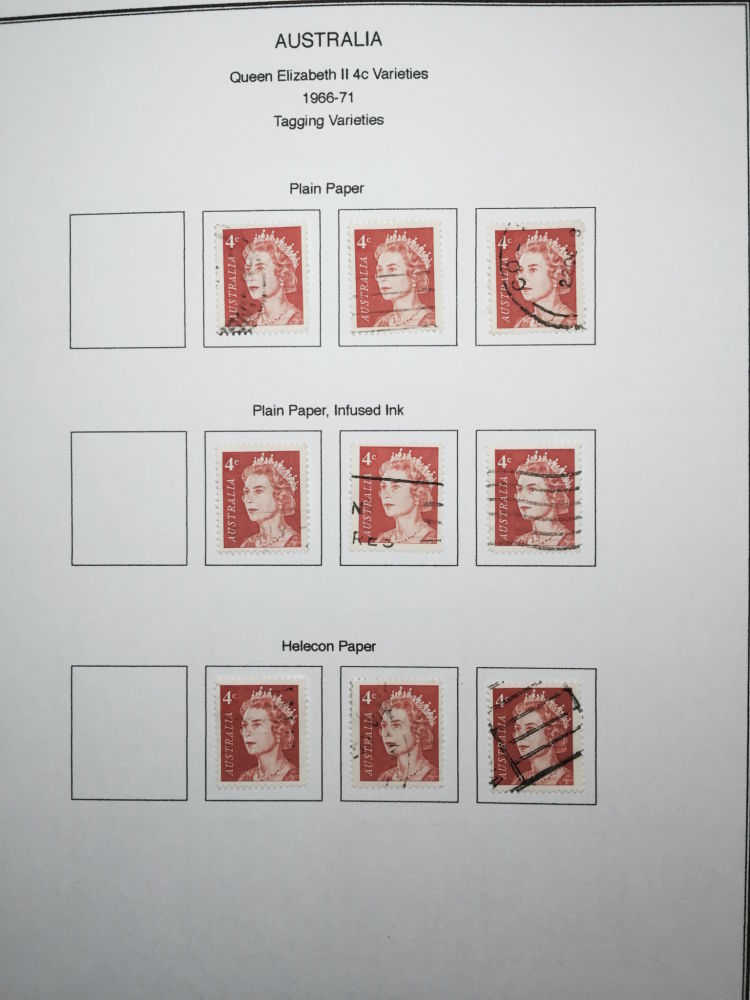 |
|
Send note to Staff
|
|
|
Valued Member
20 Posts |
|
|
Not gonna lie- I find it really annoying that there are all these hidden varieties. Sure, I could collect every "face" of stamp that have been issued. But it's weird to me that the stamp in my book might not even be the correct stamp based on Scott number. It feels like cheating. And figuring out what the correct version is is ridiculous and boring to me. I wasn't put on earth to sit and categorize stamps. Sigh... |
|
Send note to Staff
|
|
|
Valued Member
United States
258 Posts |
|
|
Quote:
I find it really annoying that there are all these hidden varieties.  Short1: My attitude is that I'll mount #362xivii as #362 and not lose any sleep over it. Terry |
|
Send note to Staff
|
|
|
Pillar Of The Community
United States
2830 Posts |
|
|
Since paper and tagging varieties come from different printings they often have shade differences. Some distinct shades are evident in the Australian Definitives above. |
|
Send note to Staff
|
|
|
Valued Member
United States
364 Posts |
|
|
I have Steiner's Canada pages and unfortunately it cares about tagging, so then I care about the tagging to fill the album spaces. |
|
Send note to Staff
|
|
|
Rest in Peace
Netherlands
963 Posts |
|
|
"I have to agree with the general sentiment that it doesn't matter for a general collection. However, if you are putting together a specialized collection of a specific issue I think it would matter for completeness.
Terry"
So why bother to collect different colours, perforations, types of paper, sizes, etc......
If you do not wish to specialize, be happy!
But if you do wish to specialize do NOT think a difference in perforation or type of paper is a VARIETY!
If you drive a Ferrari and your neighbour is racing a Maserati... His vehicle is just a VARIETY ;) Not worth having [to collect..]
|
|
Send note to Staff
|
|
|
Rest in Peace
Netherlands
963 Posts |
|
|
pk-short,
Why not explain what is the difference between plain paper, infused ink and Helecon???? And add that description to your sheet!
You are not collecting different versions of a stamp simply because crazy catalogues list them under separate (sub)numbers! If you do not understand what it is about [or you do not want to!] then just forget about it!
groetjes, Rein |
|
Send note to Staff
|
|
|
Replies: 18 / Views: 5,428 |
|



 Posted 07/18/2015 6:31 pm


