|
This page may contain links that result in small commissions to keep this free site up and running.

Welcome Guest! Registering and/or logging in will remove the anchor (bottom) ads. It's Free!
To participate in the forum you must log in or register.
| Author |
 Replies: 18 / Views: 4,617 Replies: 18 / Views: 4,617 |
|
Valued Member
United States
11 Posts |
|
|
I came across this cover in my collection and have been looking up this car company which only lasted in Elkhart, IN from 1915 to 1916. 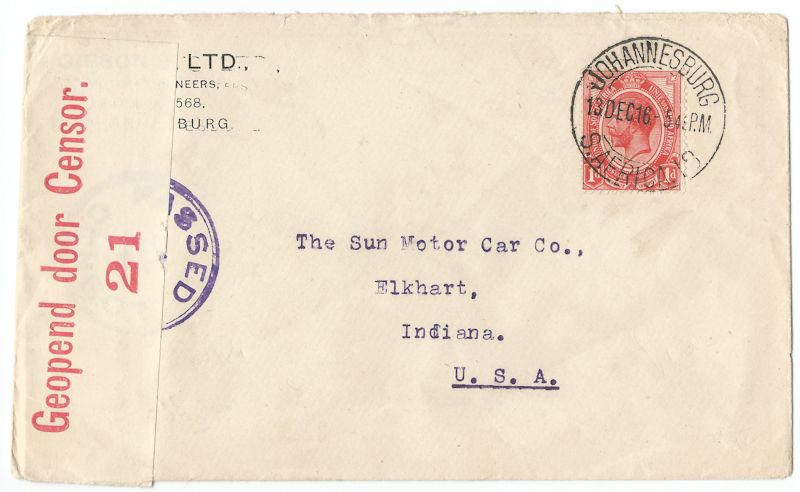 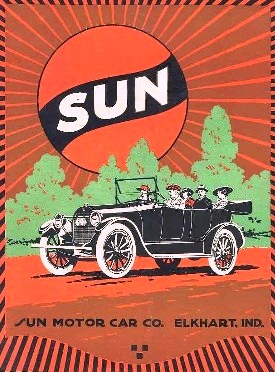 |
|
Send note to Staff
|
|
|
|
|
Rest in Peace
United States
4052 Posts |
|
|
Q/ Any guesses on what they might have been corresponding about? A tooling order, perhaps? |
Send note to Staff 
|
|
|
Valued Member
United States
11 Posts |
|
|
The letter is from Gibsons LTD motor engineeers Johannesburg. unfortunately there is no letter inside. |
|
Send note to Staff
|
|
|
Pillar Of The Community
1213 Posts |
|
|
According to my reference book "Standard Catalog of American Cars: 1805 - 1942" the Sun Motor Car Company was originally started by R. Crawford and used a design develoed by Roscoe Hoffman. It was begun in 1915 in Bufalo, New York but moved to Elkhart, Indiana when they were ready to begin actual production. They produced 337 cars in 1916 and 696 in 1917 before going into receivership. They were bought out by the Automotive Corporation of Toledo which manufactured some more Sun autos in 1921 and 1922 as well as provided parts and service to all Sun car owners including the ones who purchased their Sun autos from the 1916 - 1917 production runs.
I would guess that the interesting cover from South Africa might have been from a company there that was interesed in marketing Sun autos and providing local servicing of them in South Africa. |
|
Send note to Staff
|
| Edited by Kimo - 08/20/2015 11:58 am |
|
|
Moderator

United States
12330 Posts |
|
|
Early car manufacturer's were very plentiful, with literally many springing up overnight in many cities. (There was actually a car named Asheville which was built in Asheville NC although none have survived.) Like the other hundreds and hundreds of auto manufacturers of the times, Sun sold an 'assembled car'. Rather than incur the expense of developing their own sub components like engines, transmissions, brake systems; they simply purchased these items and assembled a car from them.
I mention this because many manufacturers also exported cars of that time in an interesting fashion. They would disassemble the entire completed car here in the USA, crate it, ship it, and then reassemble it once it arrived in the foreign land. I know for sure that Studebaker had a large reassembly facility in South Africa and every Studebaker that was located in SA was a reassembled crate car for several decades. This type of exported crate car remained common until the 1950s.
So my guess is that Sun did export some crate cars into SA and this firm was somehow involved.
Don
|
|
Send note to Staff
|
| Edited by 51studebaker - 08/20/2015 06:34 am |
|
|
Pillar Of The Community
United States
526 Posts |
|
|
Indiana had a dozen or two dozen small town automobile manufacturing companies during this era. Remember that automobile manufacturing simply emerged from wagon and carriage manufacturing--you just added a motor, whether internal combustion or electric, and figured out how to connect its motive power to the wheels (drive shaft, differential gear).
Small towns/farm marketing centers had a ready supply of men who understood how to make wagon/carriage bodies and how to do ironworking, which developed into the tool-making industry. The classic example, perhaps, is the Studebaker wagon works at South Bend, where the Studebaker family (emigrants from Pennsylvania) had been making wagons and carriages for decades.
Elkhart emerged in the 1830s as a steamboat depot on the St. Joseph River, then around 1870 (if I am not mistaken) was chosen as a location for railroad machine shops. So it would have had the minimal infrastructure for building motorized carriages. But so did a lot of other towns and most of these early companies went bankrupt. There is (was?) a good museum in Auburn, Indiana -- the Auburn, Cord, Duesenberg Museum, I think it was called, another small town with an automobile manufacturer, in this case named after the town. The Auburn lasted a lot longer than the Sun car company. But I don't know if the museum still exists. Marvelous Duesenbergs were on display . . . .
But even the Auburn and Cord and Duesenbergs eventually were absorbed into the handful of surviving big car manufacturers, the big three plus American Motors and Studebaker, and then during my lifetime, American and Studebaker shut down--I remember the blaring headlines in the local newspapers the day the Studebaker shutdown was announced.
Edited to add: These small mom and pop auto manufacturers went bankrupt, of course, because Henry Ford figured out how to make autos cheaply. 1915 is just about the time Ford was really gaining traction in Detroit. A small shop like Sun Motor Car Company could not possibly compete. It was doomed, really, from the start. But they didn't know that.
The luxury makes (Duesenbergs and so forth) survived a while longer as niche companies, but even they eventually were absorbed.
|
|
Send note to Staff
|
| Edited by Hieronymus - 08/20/2015 09:00 am |
|
|
Moderator
United States
12330 Posts |
|
|
Many early manufacturer were also originally bicycle manufacturers.
It is commonly thought that 'economy of scale' was the largest contributor of the demise of the independent auto manufacturers. But this is not entirely true. In fact there were major changes in the distribution and dealerships at that time. Before this change, car dealers could carry multiple manufacturers on the same lot. Additionally, they had full control of the what models they ordered from the factories. If a dealer were in a rural part of the country, they could order more pickups.
But as the 'Big Three' manufacturers began to become more powerful, they exerted pressure upon the dealerships. First, they insisted the dealers represent only them exclusively; those who did not comply lost their dealerships. This meant that representation for the smaller independent manufacturer dried up in many towns.
But the real death knell occurred as the Big Three then changed how dealers ordered cars each month. The manufacturer now dictated what the dealerships received each month. They pushed extra cars into every loti n the country which in turn made the dealers lower prices to move the cars. It was this lowering of prices which forced the remaining independent auto manufacturers (Studebaker, Packard, Hudson, Willys, etc.) to eventually fail by the time the 1950s rolled around. Their dealers simply could not compete with the Big Three lower prices.
Don
Edit:
I was glassy eyed on my first trip to South Bend Ind., home to Studebaker. It included trip and to the Studebaker brother homestead and visiting many of the original Studebaker buildings. On some of the older building, I was able to snag some of the original bricks as souvenirs. I had a VHS video camera (back when it was bleeding edge) and South Benders watch with puzzlement as I ran about taking pictures of all the old buildings.
I was completely enamored with Studebaker and their history. The Studebaker National show was that week and I drove the 51 in my avatar from NC to South Bend. But my dreamlike fascination with Studebaker soon took a hit as I got a chance to talk to many South bend families and ex-workers at Studebaker.
Studebaker lucked out in the late 1950s by happening to have a fuel efficient car, the Lark. The economy had turned south and this car breathed some life into the struggling manufacturer but by 1963 the hand writing was on the wall. They pulled out of South bend and moved manufacturing operations to Canada as a 'cost savings' move. Sure it was. It was because they walked away from a 200 year history of retirement funding. Every South Bend employee lost all their benefits and frankly their weren't too happy about this as the operations moved to Canada and continued to produce cars for another few years.
A sad ending to a once proud and great company. |
|
Send note to Staff
|
| Edited by 51studebaker - 08/20/2015 09:49 am |
|
|
Pillar Of The Community
United States
572 Posts |
|
|
The Auburn Cord Duesenberg Museum still exists and is well worth the trip for anyone interested in the huge cars of the 20' and 30's. 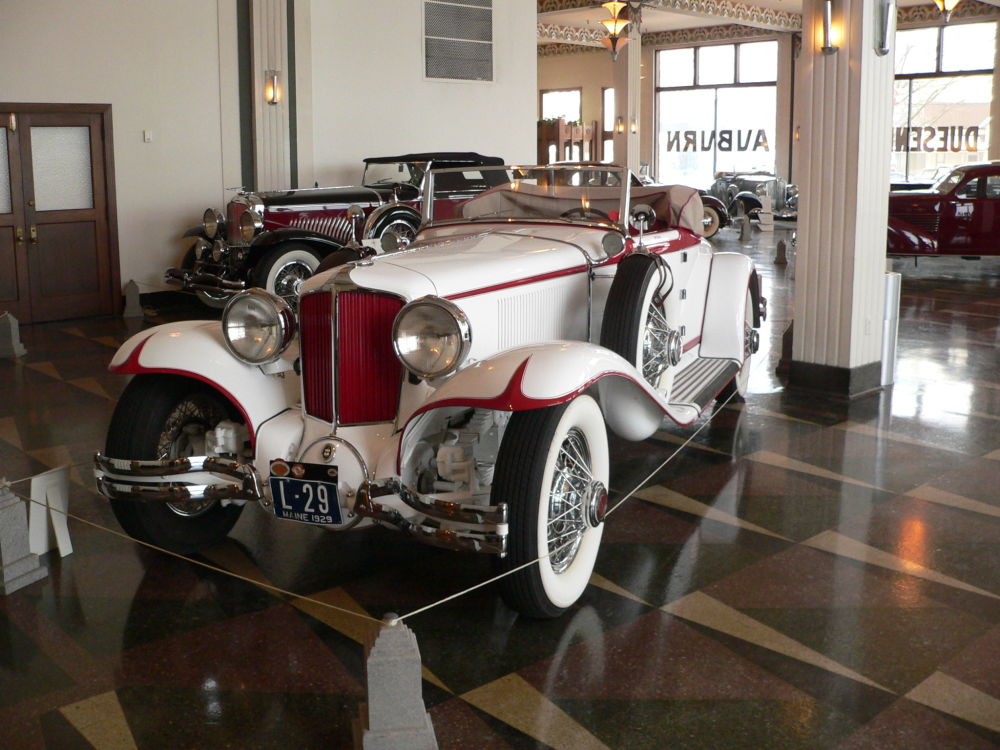 |
|
Send note to Staff
|
|
|
Pillar Of The Community
United States
526 Posts |
|
|
Not to get into a debate over fine points in Don's very helpful account, but wouldn't the ability of the Big Three to force extra cars onto dealer's lots and the ability of dealers to lower prices in order to sell the cars, be (at least in part) a result of economy of scale? In other words, the mass-produced Detroit cars were produced massively enough and at low enough cost to make it possible to flood the lots and to "force" dealers to lower prices. Against that, the smaller-scale manufacturers could not compete.
Don's scenario describes the later stages of the consolidation process--the size and economy of scale of the Big Three, at least in great part, permitted them, for instance, to force/entice dealers into becoming dealers exclusively for one of the Big Three, undermining the distribution network for the independents.
Is economy of scale the only explanation for the growth of huge discount chains like Walmart and the related "dying" of Main Street businesses? No. Cheap gas and saturation automobile ownership contributed and a lot of other factors. But economy of scale is probably the biggest single factor in both areas of business.
I'm not disputing Don's description, just pointing out that the ability of the Big Three to squeeze the independents out of access to the distribution network was itself already the product of an earlier stage of consolidation. From hundreds of indepedendents in 1915 or 1920 or even 1925, in the later stages there were a few dozen--Wyllis, Hudson, Packard etc. by the 1940s?? During the 1950s these were absorbed leaving the Big Three plus Studebaker and American Motors in the 1960s. I would put Studebaker and American Motors into a different category than Hudson or Wyllis and Packard and then again Hudson, Willys, Packard, into a different (middle) category than the plethora of independents like Sun Motor Company.
Don is an expert, I'm an amateur on this (my field is history in general). My purpose is not to argue with Don but to clarify how economy of scale might have worked differently in the early stages of consolidation (1920s, 1930s) and later stages (1940s, 1950s). The dates here perhaps should be adjusted and refined but the general pattern, I think, holds. |
|
Send note to Staff
|
|
|
Pillar Of The Community
United States
526 Posts |
|
|
Quote:
They pulled out of South bend and moved manufacturing operations to Canada as a 'cost savings' move. Sure it was. It was because they walked away from a 200 year history of retirement funding Pensions are a problem when serious inflation takes place. American business as a whole abandoned defined-benefit pensions in favor of employee accounts (401k etc.) in the wake of the Carter inflation of the late 1970s. Eventually this doomed the Big Three too But because of economy of scale, they survived longer than Studebaker and Studebaker survived longer than most of the others. TOday, the only employees who enjoy defined-benefit pensions are government employees and they do so solely because their employers (politicians) shamelessly raid the public treasury to mollify unions and are not accountable for a bottom line. Normally, if a company cannot meet its obligations, it goes bankrupt and employee pensions are affected. Unless, of course, the government uses taxpayer money to bail the company out. In the long run, however, unless the problems that brought the company to the edge of bankruptcy are solved, the bailout will only work for a while. Unions are capable of killing the goose that laid the golden egg. Companies are capable of being greedy  s and robbing stockholders by paying exorbitant executive salaries. There's malfeasance to go around. Where the malfeasance lay in the Studebaker case, I do not know. I'm asking. I would not rely solely on what former Studebaker employees say. I'd want to investigate. The former employees may be completely right or partly right. Or, it might be a combination of lack of sufficient economy of scale to compete with the Big Three, on the one hand, and mismanagement by the company on the other hand. But I would point out that retirement money vested in a defined-benefit pension is only as good as the strength of the company--the individual's future is very much tied to the company. 401k retirement funding stays with the person but, of course, is subject to the vicissitudes of the investment vehicles the employee chooses and is very much at the mercy of inflation. Defined-benefit pensions are wonderful--they, on paper, provide protection against inflation. But only if the company can survive. And if the company's pension obligations skyrocket because of inflation, then the survival of the company can be threatened. The survival of the company can also be threatened by greed on the part of owners (stockholders?), boards, and executives. Edit: PS: I want to try to clarify. Studebaker's demise predated the Carter inflation. Defined-benefit pensions were still the norm. I am not suggesting that Studebaker was doomed by skyrocketing pension obligations. No, I am simply saying that the employees' tragic loss of their pensions was a result of a company dying. Why this particular company died, I don't know but I suspect it had something to do with economy of scale together with bad management decisions. In 1962 the juggernaut of the Big Three and the consolidation that had been going on for decades was still going strong. That Studebaker management made this worse by bad decisions is possible. I would be very surprised, however, if it were all attributable to management's failures. I would think that as a poor-sister in size and scale to the Big Three, Studebaker would have had trouble competing long-term. And after the Carter inflation, even the Big Three were in trouble. P.P.S. Lest anyone accuse me of union-bashing, I was once a card-carrying member of the United Steelworkers. Been there, done that. Edited to add http://www.hemmings.com/hcc/stories...pinion2.html |
|
Send note to Staff
|
| Edited by Hieronymus - 08/20/2015 10:36 am |
|
|
Moderator
United States
12330 Posts |
|
|
I agree with Hieronymus and did not mean to sound like economy of scale was not a factor. The post WWII market place was very interesting. First, the Big Three got preferential treatment from suppliers of difficult to get post war materials (like nickel). This extended from the late 1940s and into the early 1950s (with the Korean War). When independent manufacturers could get things like nickel for chroming, they paid more and got less than the Big Three.
But keep in mind that there was also a post war buyers market. No one was able to buy a new car during the time period of 1941 through about 1946; pent up demand was huge. Customers were paying dealerships cash under the table to just get on a list to buy a new car. Studebaker was proud of their 1946-7 advertising slogan, "First by far with a post war car". The Big Three had simply (and cost effectively) rolled out 1942 models into this buyers market with some new trim, calling them 1946s. But Studebaker, in their infinite wisdom, decided to tool brand new body styles at a cost of several million.
I am hard pressed to call these kinds of decisions strictly economy of scale. But I agree that economy of scale certainly had a major role in the demise of the independent auto manufacturers. If you think about the auto industry evolved in the same way computer manufacturers did. With the rise of the technology, many companies jumped in to seize their part of the market. But as time went on, there was a great consolidation and shrinking of the number of manufacturers, eventually including off-shore pressures.
Don |
|
Send note to Staff
|
|
|
Pillar Of The Community
United States
526 Posts |
|
|
From the article I linked to, after describing how Studebaker only broke away from the rest of the independents in the late 1930s and began to hob nob with the Big Boys, the article continues:
"But in the post-war era, they made mistakes."
"The first was that they failed to sock away sufficient funds to enable the company to withstand a major downturn in business. Instead, they paid out large dividends, which pleased stockholders. From 1946 to 1952, that didn't seem to present a problem--but when things began to get rocky in 1953, the company didn't have enough cash to ride it out."
"Another big problem was Studebaker's aggressive union, which saddled the company with the highest labor costs in the industry. The company always seemed to cave in to union demands rather than risk a strike. Next were sales and quality problems with the 1953 models, followed by a big downturn in sales in 1954. By mid-1956, the company was teetering on the brink of bankruptcy."
* * *
"You're familiar with the way they demolish big buildings by implosion, right? Instead of one big explosion, experts use a series of smaller charges carefully placed and timed to work together to weaken the structure enough so that it falls in on itself."
"Well, that's essentially what happened to Studebaker. The company looked strong. Then a small explosion hit: high labor costs. Then another: quality problems and poor sales in 1953. Then came Ford's sales blitz in 1954, which decimated the independents. Another explosion hit in 1960 when the Big Three got into the compact car market only a year after Studebaker did. Then Churchill was shunted aside, Egbert got sick, the union went on strike and before our eyes, the building came tumbling down."
|
|
Send note to Staff
|
| Edited by Hieronymus - 08/20/2015 10:43 am |
|
|
Moderator
United States
12330 Posts |
|
|
Studebaker was founded in 1852 and finally closed its doors in 1966. They were the longest running auto manufacturer in the world. They proudly advertised that they employed many grandfather-father-son combinations. 1950 was Studebakers best year in terms of number of produces cars/trucks and sales. They merged with Packard in 1956 but true Packard owners refuse to acknowledge the Studebaker-Packard models that were produced. (With just cause since the quality was lost.) The sad truth was that during the 1950s Studebaker was trying selling a Chevy quality car at Buick level pricing. Studebaker dealers were finding they had inventory left sitting in the lot every month and Studebaker did not have the leverage to make them discount them the way the Big Three did with their dealers. Once the dealerships started to struggle, everything spiraled downward. Economy of scale over simplifies the situation by making it sound like the Big Three simply out-manufactured the independents. I feel there is more to the story.
I agree that by 1956 Studebaker had cash issues. But as I mentioned, they got another chance to turn it around by the late 1950s with the Lark. I would also add that many of the ex-employees also felt that Studebaker bailed on South Bend in an effort to avoid the unions.
Again, whatever the reason(s), a sad ending for a once great company.
Don
Edit; Big Three dealerships were able to work with the manufacturer in terms of left over stock, discounting, and carrying them if they could not pay that month. Studebaker and other independent manufacturers did not have the deep pockets to do this and could not offer the dealerships good terms. |
|
Send note to Staff
|
| Edited by 51studebaker - 08/20/2015 10:55 am |
|
|
Valued Member
United States
225 Posts |
|
|
Valued Member
United States
11 Posts |
|
|
Wow, more people here are talking about the Sun or it's competitors then they were probably talked about them back then! I also wonder how their starting their company and manufacturing in the middle of WWI might have affected sales as well. This is the reason the letter was censored I presume. |
|
Send note to Staff
|
|
|
Pillar Of The Community
United States
526 Posts |
|
|
World War I did not "exist" in the USA in 1915. We entered the war in 1917 after Woodrow Wilson broke his campaign promise of 1916. And it lasted only to November 1918. It was not disruptive in the same sense as World War II was.
It forever changed the shape of Europe and the Middle East, which, in turn, totally transformed stamp collecting (breakup of the Ottoman and Austro-Hungarian empires). It affected Canada and Australia's cultural memory deeply. It did not leave the US unchanged, but the real changes (and they were powerful) in the US were already underway (the Progressive Era, both parties--T. Roosevelt and Wilson), accelerated after the war ended and had to do with domestic issues. To finance the Progressive "reforms" a national income tax was instituted and the role of the states in the federal/state relationship was forver changed by the direct election of senators. Woodrow Wilson and his advisors--all of them deeply racist Democrats--segregated federal government employees for the first time and laid the foundations for 35 long years of racial conflict.
And that's just for starters.
But in 1915, starting a business was no big deal, really. Keeping it going was another matter. |
|
Send note to Staff
|
| Edited by Hieronymus - 08/20/2015 3:09 pm |
|
|
Replies: 18 / Views: 4,617 |
|
|
To participate in the forum you must log in or register. | |
Disclaimer: While a tremendous amount of effort goes into ensuring the accuracy of the information contained in this site, Stamp Community assumes no liability for errors. Copyright 2005 - 2026 Stamp Community Family - All rights reserved worldwide. Use of any images or content on this website without prior written permission of Stamp Community or the original lender is strictly prohibited.
Privacy Policy / Terms of Use Advertise Here |
| Stamp Community Forum |
© 2007 - 2026 Stamp Community Forums |
| It took 0.23 seconds to lick this stamp. |
 |
|
|
|


 Posted 08/18/2015 10:10 pm


